
- The country comparison spans 10.7 percentage points between South Korea and the UK across the forecast period.
- South Korea remains 1.2 percentage points above the USA due to AI compute expansion and industrial AI budget support.
- The USA remains 1.5 percentage points above Japan as chemical R&D, software spending and enterprise data assets support formulation assistants.
- Japan remains 7.4 percentage points above Germany because AI infrastructure policy and government generative AI use improve institutional readiness.
- Germany remains 0.6 percentage point above the UK as industrial AI infrastructure and R&D expenditure support controlled deployment.
Comparable CAGRs create different entry conditions due to compute availability, formulation data quality, laboratory workflow maturity and enterprise AI governance. Full report coverage includes North America, Latin America, Western Europe, Eastern Europe, East Asia, South Asia & Pacific, Middle East & Africa.
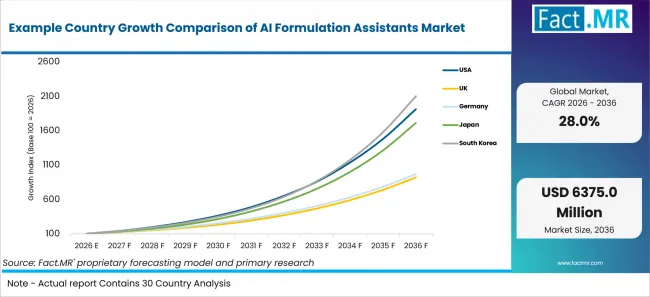
Example Country Growth Comparison Of Ai Formulation Assistants Market | Source: Fact.MR
What supports South Korea adoption?
35.6% CAGR, supported by AI compute expansion and industrial AI funding.
South Korea is building the compute base needed for model-assisted industrial R&D. MSIT announced in February 2025 that the government aimed to secure 18,000 high-performance GPUs by the first half of 2026. Korea.net reported in November 2025 that the proposed 2026 budget allocated KRW 10.1 trillion toward AI transformation, including KRW 2.6 trillion for AI adoption across industry, daily life and public services and KRW 7.5 trillion for talent development and infrastructure. Formulation assistants are expected to benefit where chemicals, coatings and beauty manufacturers connect proprietary laboratory records with secure assistant workflows.
What supports USA adoption?
34.4% CAGR, backed by chemical R&D depth and enterprise software readiness.
The USA has large industrial and software-oriented R&D pools for formulation assistants. The U.S. Census Bureau reported in March 2026 that chemical manufacturing value of shipments reached USD 901.0 billion in 2022. NCSES reported in May 2026 that chemicals manufacturing accounted for 19% of U.S. business R&D in 2023.
How is Japan scaling demand?
32.9% CAGR, led by AI infrastructure support and public-sector generative AI use.
Japan is pairing AI infrastructure policy with public-sector experimentation. METI’s webpage on the AI and Semiconductor Industry Foundation Strengthening Framework, last updated in May 2026, states that Japan will provide more than JPY 10 trillion in public support for the AI and semiconductor sectors through fiscal 2030. Japan’s Digital Agency stated in May 2026 that the Government AI GENAI pilot would be accessible to approximately 100,000 government employees starting May 29, 2026.
What supports Germany adoption?
25.5% CAGR, supported by industrial AI infrastructure and R&D intensity.
Germany’s adoption path is tied to industrial AI and high research spending. Destatis reported in March 2026 that German business R&D spending reached EUR 92.5 billion in 2024. Formulation assistants are expected to find demand among chemical and materials producers that require experiment traceability, secure data access and repeatable model review.
What supports the UK outlook?
24.9% CAGR, shaped by public compute expansion and R&D investment.
The UK is improving access to the computing and research base needed for scientific assistants. ONS reported in August 2026 that UK gross domestic R&D expenditure reached GBP 79.4 billion in 2024. The UK Compute Roadmap commits up to GBP 2 billion by 2030, including an expansion of the AI Research Resource by 20x. Formulation teams in chemicals, cosmetics, food ingredients and life sciences are expected to use assistants for faster review of older experiments and customer briefs.













Leave a Reply