
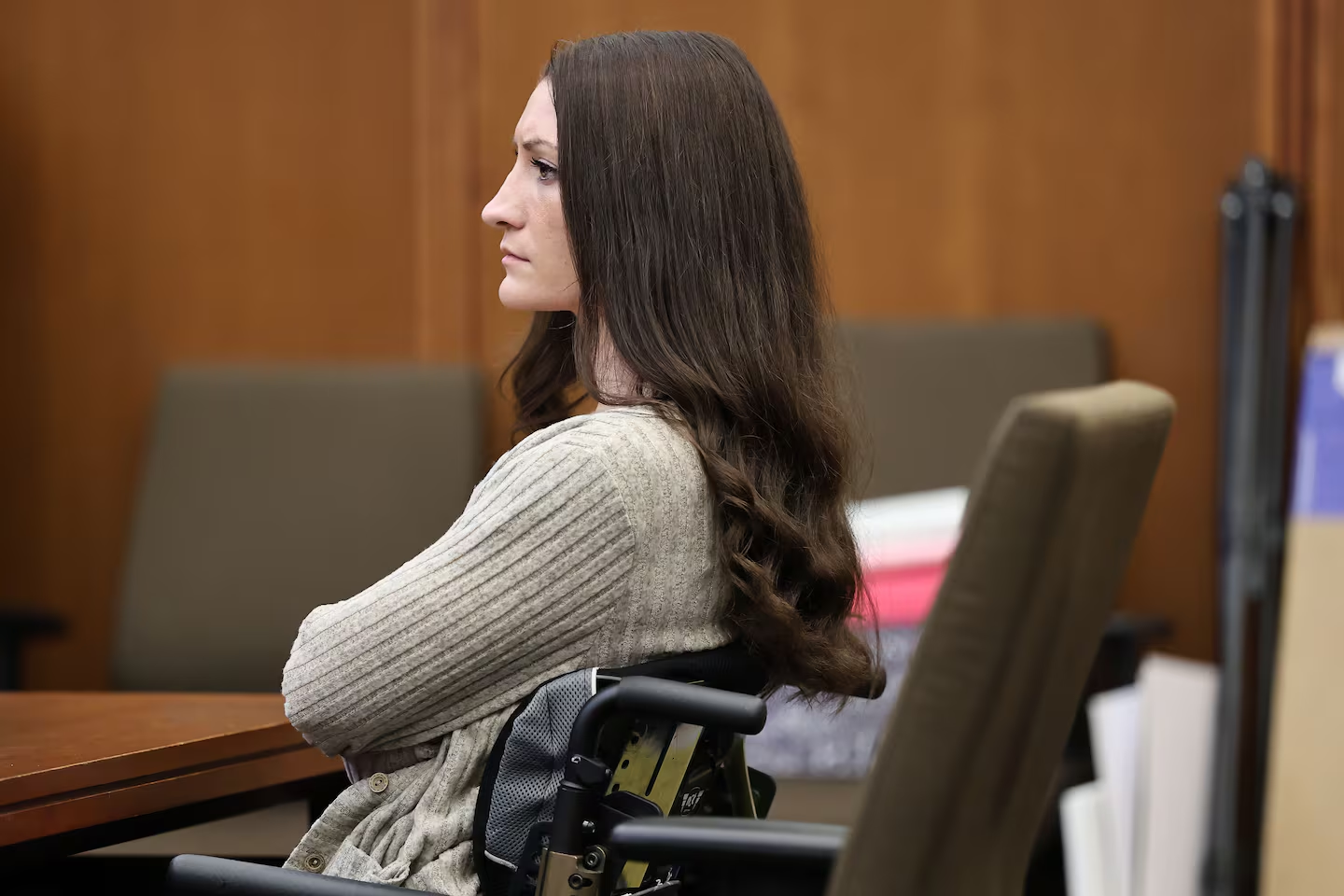
Both sides will have 1 hour for closing arguments — 3:51 p.m.
By Travis Andersen, Globe Staff
Judge William Sullivan said he’s inclined to give only one manslaughter instruction if he does so, rather than parsing between involuntary and voluntary manslaughter.
Prosecutor Shanan Buckingham said that “there was testing done” to identify Clancy’s blood on the outside of the house.
She said there’s been “adequate testimony” about why the pill bottles weren’t seized from the nightstand the day of the killings.
She also said prosecutors object to an instruction on involuntary manslaughter.
Sullivan said he’ll give a manslaughter instruction but will not instruct the jury on the quality of the police investigation.
He said he’ll have “a better draft” of the instructions for the lawyers to review on Thursday morning.
Court then adjourned for the day.
Clancy’s defense lawyer calls police investigation shoddy — 3:38 p.m.
By Travis Andersen, Globe Staff
Defense lawyer Kevin Reddington said jurors should also be instructed on inadequate law enforcement investigation.
“If there’s evidence of a police investigation that was deficient,” jurors can consider that, he said. “The police … didn’t investigate anything.”
He said police didn’t test blood at the crime scene among other oversights.
Clancy’s lawyer backs jury instruction on involuntary manslaughter charge — 3:34 p.m.
By Travis Andersen, Globe Staff
Clancy’s lawyer, Kevin Reddington, said the jury should be instructed to consider involuntary manslaughter as a lesser included offense to the murder count, based on the evidence.
A lesser included offense is a less serious crime committed during a graver offense.
He said jurors can find evidence of a mental disease or defect in a defendant while still finding the person knew what they were doing; under that scenario, he said, the mental disease would justify a voluntary manslaughter finding.
He also suggested jurors should be instructed on involuntary drug intoxication.
Prosecutors, defense request changes to jury instructions — 3:33 p.m.
By Travis Andersen, Globe Staff
Clancy’s lawyer, Kevin Reddington, requested a couple of changes to a portion of the instructions regarding mental disease or defect and a defendant’s ability to understand the wrongfulness of their actions.
Before they begin deliberations in a case, juries are given instructions that explain the relevant laws and define the burden of proof, among other guidelines.
Reddington asked that Judge William Sullivan not give any instructions on voluntary drug intoxication. Sullivan said he’ll “strongly consider” cutting the reference to voluntary drug intoxication since both sides agree to it.
Discussion over jury instructions begins — 3:30 p.m.
By Travis Andersen, Globe Staff
Prosecutor Shanan Buckingham listed a number of tweaks to the instructions related to drug intoxication and other issues.
Buckingham said prosecutors object to involuntary manslaughter being an option as a lesser offense to the murder counts, citing the strangulation of the children.
Buckingham asked that jurors also be instructed to give no more weight to any individual piece of evidence, including material that may be considered duplicative.
Charge conference begins — 3:14 p.m.
By Travis Andersen, Globe Staff
The lawyers and Judge William Sullivan returned to court to begin hashing out the language of the instructions he’ll give jurors before they start deliberating, a process known as a charge conference.
Judge denies motion for directed finding of not guilty — 1:18 p.m.
By Travis Andersen, Globe Staff
Defense lawyer Kevin Reddington renewed his motion for a directed finding of not guilty before the case reaches jurors, which Judge William Sullivan denied.
He called a lunch recess at 1:15 p.m. and said the parties will return around 2:30 p.m. for a charge conference, where both sides and Sullivan will hammer out the language he will use when delivering instructions to the jury.

Prosecution rests its case — 1:14 p.m.
By Travis Andersen, Globe Staff
Following the sidebar, Dr. Gregory Saathoff said he was aware prosecutors had left a phone message with Clancy’s parents seeking to set up an interview with him, and they did not respond.
He said he was also aware Clancy’s sister had told authorities she was waiting to hear from defense lawyer Kevin Reddington before committing to an interview. She did not give one.
He later stepped down from the stand and prosecutors rested their case; Judge William Sullivan sent the jury home with closing statements scheduled for Thursday.
Clancy would likely not have been contending with hormonal shifts in January 2023, expert witness testifies — 1:09 p.m.
By Travis Andersen, Globe Staff
Dr. Gregory Saathoff said Clancy stopped breastfeeding Callan in October 2022.
He said he would not expect her to be still contending with hormonal shifts from doing so in January 2023.
He said Patrick Clancy told him Lindsay indicated she tried to kill herself as soon as he found her on the ground at their Duxbury home. He then called 911.
He said he doesn’t know when Clancy crushed up the pills found on the wine glass.
Saathoff said he’s aware that an expert who testified for the defense teaches medical residents that someone hearing command hallucinations automatically obeys the voice.
That was stricken and the lawyers were called back to sidebar.
Psychiatrist says Clancy was presented many options for additional treatment — 1:03 p.m.
By Travis Andersen, Globe Staff
Following the sidebar, Dr. Gregory Saathoff said medical records show Dr. Jennifer Tufts was “very responsive” to Clancy’s symptoms and concerns and tried to make adjustments based on what she reported.
He said Women and Infants Hospital, while it didn’t accept Clancy for its postpartum program, offered her multiple additional treatment options which she said she would discuss with her provider, but according to the provider notes did not.
Regarding her suicide hotline calls, Saathoff said a clinician recommended that she attend a day treatment program or in-patient program, according to the call records. She told the hotline she did not have a plan to end her life, Saathoff said.

Psychiatrist who treated Clancy made reasonable prescribing choices, prosecution witness testifies — 12:56 p.m.
By Travis Andersen, Globe Staff
Dr. Gregory Saathoff said Jennifer Tufts’s prescriptions were “very reasonable” for Clancy, referring to the psychiatrist who treated Clancy for several months.
He noted that Clancy had taken Prozac several years earlier and had been prescribed Zoloft after Dawson’s birth but then decided not to take it when her anxiety wore off.
The anxiety after Callan’s birth, he said, was more significant, so she went to Tufts.
Saathoff said Tufts also acted reasonably when she took Clancy off the Zoloft due to her insomnia, starting her instead on Ativan and Benadryl.
He said Clancy was concerned about becoming addicted to Ativan.The lawyers came back to a sidebar.
Clancy’s sleep got better in early January 2023, psychiatrist testifies — 12:50 p.m.
By Travis Andersen, Globe Staff
Dr. Gregory Saathoff said Clancy’s sleep improved while she was being treated at McLean Hospital, a psychiatric facility, in early January 2023.
She also told her mother by text later that month that she was sleeping better, he testified.
He said Clancy in September 2022 had expressed concerns about anxiety and insomnia.
One provider, he said, noted in the fall of 2022 that Clancy was finding her children “more challenging” as they grew older.

Judge William Sullivan sustained a defense objection when prosecutor Jennifer Sprague asked him to elaborate.
Saathoff said he had no issues with the prescriptions that Dr. Jennifer Tufts, who treated Lindsay Clancy for several months before the killings, had written for Clancy.
Tufts at times saw Clancy more than once a week, he said, and was “very responsive” to Clancy’s concerns.
Psychiatrist testifies about Lamictal, which Clancy worried would cause her to develop a rash — 12:45 p.m.
By Travis Andersen, Globe Staff
Dr. Gregory Saathoff said about 1 in 1,000 patients develop the serious rash Clancy was concerned about when she declined to take the drug Lamictal.
He said when the medication is given slowly over time, the potential for a severe rash is decreased.
Lamictal is now one of the most commonly used mood stabilizers for people with bipolar disorder, he said.
Dr. Jennifer Tufts, a psychiatrist who treated Clancy for several months,had written her low-dosage prescription, which he testified is standard.
Nothing in Clancy’s medical records indicated need for blood testing, psychiatrist testifies — 12:42 p.m.
By Travis Andersen, Globe Staff
Dr. Gregory Saathoff said he’s been “very interested in public psychiatry” throughout his career.
“What is most important to me is working with patients,” he told prosecutor Jennifer Sprague when asked about his professional focus, referencing defense lawyer Kevin Reddington’s earlier recitation of his scholarly articles and job experience related to extremism and terrorism.
He said he saw nothing in Clancy’s medical records that would have required blood testing.
He said Clancy’s thyroid levels were within normal limits when they were checked in November 2022.
Expert witness for government takes issue with comment from prosecution’s opening statement — 12:38 p.m.
By Shelley Murphy, Globe Staff
Clancy’s attorney Kevin Reddington read from the prosecution’s opening statement to jurors and asked if his opinion supported it.
The prosecutor, Shanan Buckingham, told jurors that Lindsay Clancy “made the selfish choice” to kill herself and her children because she was tired of the life she was living.
She also told jurors that Clancy had manipulated her healthcare providers when seeking help for anxiety, depression and insomnia.
“Well there’s a lot in that,” forensic psychiatrist Gregory Saathoff told jurors. “I think that statement you read really minimizes what she was going through.”

Psychiatrist recalls history of treating women in prison — 12:37 p.m.
By Travis Andersen, Globe Staff
Dr. Gregory Saathoff said one 18-year-old woman he treated with postpartum psychosis had become “convinced that she had to kill her child,” causing her to become suicidal.
A second case, he said, involved a woman in her 20s who displayed signs of mania and religious delusions regarding her child.
Both of the women had had adverse reactions to a particular drug, he said.
Psychiatrist testifies on redirect — 12:33 p.m.
By Travis Andersen, Globe Staff
Dr. Gregory Saathoff told prosecutor Jennifer Sprague on redirect that treating and evaluating prisoners over the years requires “the best” possible care that can be provided.
He said he’s treated hundreds of women prisoners with psychosis.
Common symptoms include delusions, false beliefs, auditory hallucinations, disorganized thinking, and trouble communicating.

By Travis Andersen, Globe Staff
Dr. Gregory Saathoff said “yes” when defense lawyer Kevin Reddington asked if patient reports of an external voice can be legitimate.
The lawyers later came back to a sidebar.
Following the sidebar, Reddington asked Saathoff if he believes Clancy “made the selfish choice” to kill her children before taking her own life, reading a transcript from prosecutors’ opening statement.
“I think that statement … really minimizes what she was going through,” Saathoff said.
Defense attorney drills down on details of psychiatrist’s testimony — 12:26 p.m.
By Lea Skene, Globe Staff
Defense attorney Kevin Reddington returned to testimony on Tuesday, when psychiatrist Dr. Gregory Saathoff suggested Lindsay Clancy was lying about exactly what happened in the hours before she killed her children.
Saathoff had testified that Clancy said she was getting chicken nuggets out of the refrigerator for her children when she started hearing a man’s voice telling her to kill them.
But her then-husband, Patrick Clancy, said their son Dawson was already eating chicken nuggets before he left the house to pick up a medication and takeout for dinner. Lindsay Clancy killed the children while he was out.
Saathoff suggested those statements show she’s an unreliable narrator.
Returning to that testimony Wednesday, Reddington noted that there were two young children present who likely could have been eating chicken nuggets.
Clancy reported external voice, psychiatrist testifies — 12:25 p.m.
By Travis Andersen, Globe Staff
Dr. Gregory Saathoff said Clancy reported hearing an external voice.Some auditory hallucinations, he said, can be internal for people who are psychotic.
Clancy’s lawyer, Kevin Reddington, showed Saathoff an article about people who hear voices that was co-authored by Dr. Phillip Resnick, a forensic psychiatrist with expertise in postpartum conditions who testified for the defense.
The article said voices are typically heard from inside someone’s head, while voices heard externally are atypical.
Psychiatrist said testing showed Clancy wasn’t malingering — 12:19 p.m.
By Travis Andersen, Globe Staff
Dr. Gregory Saathoff said neuropsychologists can test subjects for possible malingering or exaggerating their symptoms.
He said another prosecution expert conducted such a test, which showed Clancy showed no such signs except for likelihood of suicide.
Reddington asked if the test showed “she was not malingering,” and Saathoff said “yes.”
Saathoff said Dr. Phillip Resnick, a forensic psychiatrist with expertise in postpartum conditions who testified for the defense, is a renowned expert on malingering.
He said Resnick’s opinion was that Clancy was not lying in any way.
Contentious exchange between defense attorney and prosecution’s last witness — 12:18 p.m.
By Lea Skene, Globe Staff
As cross-examination continued, defense attorney Kevin Reddington asked the prosecution’s last rebuttal witness exactly what his assessment concluded about whether Lindsay Clancy was being truthful about her mental state when she killed her children.
“I guess you were telling the jury, in your opinion, that she was making stuff up to make herself look like she’s crazy when she killed her children. Is that what you told the jury?” Reddington asked.
“I didn’t use those words,” psychiatrist Dr. Gregory Saathoff answered.
“No, you’re a little more finessed than I was,” Reddington responded.
Saathoff acknowledged that part of his evaluation was trying to determine whether Clancy was lying about experiencing “command hallucinations,” a male voice that was telling her to kill her children and herself.

Psychiatrist said he tried to speak with Clancy’s mother — 12:14 p.m.
By Travis Andersen, Globe Staff
Dr. Gregory Saathoff said he did not interview Clancy’s mother but “tried to.”
He said prosecutors told him that her mother would not speak to him. He said he never reached out to defense lawyer Kevin Reddington to set up an interview.
He said Clancy told her “she would like for me” to speak with her family.
This was in the context of Saathoff’s testifying that Clancy had concealed some of her issues from her family, citing a text message to her mother indicating she was doing well when she was in fact struggling.
Defense attorney scrutinizes prosecution’s theory that Lindsay Clancy was in her right mind — 12:10 p.m.
By Lea Skene, Globe Staff
Defense attorney Kevin Reddington asked psychiatrist Dr. Gregory Saathoff whether a person in psychosis could “misremember something.” The doctor said yes.
“Or have a false memory?” Reddington said.
“It’s possible,” Saathoff replied.
Reddington noted that Clancy has told investigators that she slashed the screen of a second-floor window before jumping out, when actually there was no evidence of it being cut.
He suggested that discrepancy indicates she was misremembering individual details of what happened when she killed her children and attempted suicide.
Patrick Clancy told him about the crushed pills, psychiatrist testifies — 12:07 p.m.
By Travis Andersen, Globe Staff
Dr. Gregory Saathoff said he did not hear a conversation between Clancy and her husband on the 911 call, but that Patrick Clancy separately told him his wife had said she tried to kill herself.
He said there was blood on the couple’s bedroom floor but he couldn’t recall if any was on the doorknob.
Saathoff said a wine glass with crushed medication was found in the couple’s bedroom; he told defense attorney Kevin Reddington he didn’t recall previously telling jurors the crushed-up powder came from antipsychotic drugs.
He said he’s not aware of law enforcement ever testing the powder.
“It was Patrick Clancy’s observation,” Saathoff said of the crushed medication.
He said he wasn’t aware of any pill press or drug residue beyond the glass being found in the room.
Reddington said he and Patrick Clancy recovered medication bottles from a nightstand drawer by the couple’s bed a couple days after the killings.
He asked Saathoff if a person in a state of psychosis can have a false memory, and Saathoff said it was possible.
Saathoff said Clancy told him she slashed the screen of the bedroom window with a knife, but the screen wasn’t slashed.
He said “no” when Reddington asked if he felt Clancy was malingering or deliberately lying when she told him that.
Defense attorney asks psychiatrist about impacts of changing hormone levels — 11:59 a.m.
By Lea Skene, Globe Staff
As the cross-examination of forensic psychiatrist Dr. Gregory Saathoff continued Wednesday, defense attorney Kevin Reddington presented a line of questioning about changes in a woman’s hormone levels after giving birth and stopping breastfeeding.
Saathoff acknowledged those changes can impact neurotransmitters in the brain.
He also acknowledged they can lead to “intrusive and hard-to-control thoughts and hard-to-control behavior.”
Lindsay Clancy stopped breastfeeding her third child, Callan, about three months before killing her children. She gave birth to him eight months before the killings.
Psychiatrist resumes testimony after morning break — 11:58 a.m.
By Travis Andersen, Globe Staff
Following the recess, Dr. Gregory Saathoff continued with his cross-examination.
He said he listened to Patrick Clancy’s 911 call but did not hear anything on the call from Lindsay Clancy besides, in defense attorney Kevin Reddington’s words, “guttural grunts.”

Clancy stopped breastfeeding after starting Ativan, psychiatrist testifies — 11:17 a.m.
By Travis Andersen, Globe Staff
Under cross-examination, Dr. Gregory Saathoff said a hotline’s inability to help “could have a very serious effect” on a suicidal person in distress.
He said stopping breastfeeding can affect a new mother physically.
“It depends on the individual,” he said, adding that Clancy stopped breastfeeding Callan when she started taking Ativan in fall 2022.
Judge William Sullivan called a morning break shortly before 11:20 a.m.
Clancy called suicide hotline, psychiatrist testifies — 11:11 a.m.
By Travis Andersen, Globe Staff
Dr. Gregory Saathoff said he wasn’t aware if Clancy had informed anyone at her children’s preschool that she had intrusive thoughts.
Defense lawyer Kevin Reddington also asked if it was sound practice for a provider to merely ask a suicidal person if they had a plan to end their life.
Saathoff said he wasn’t aware that was the only question asked of Clancy along those lines.
He said Clancy twice called a suicide hotline for help but couldn’t recall specifically when.
“She spoke to them about suicidality,” Saathoff said.
The hotline staff, he said, “redirected her to her provider” but did not recommend hospitalization or take steps to have her committed.
“I know that they were not responsive to her suicidality because she did not indicate that she had a plan,” he said.
Reddington asked how he knew that.“I can’t tell you exactly within the records,” Saathoff said.
Forensic psychiatrist recounts Clancy’s discharge from Women and Infants Hospital — 11:04 a.m.
By Travis Andersen, Globe Staff
Dr. Gregory Saathoff said Clancy complained about a lack of sleep and feeling numb and hollow when she went to an emergency room in mid-December 2022.
On Dec. 20, he said, she went to Women and Infants Hospital in Rhode Island for a postpartum day program, and the hospital “felt that another program might be more appropriate, either in-patient” or partial hospitalization.
He said most patients at the Women and Infants program had given birth more recently than Clancy.
He said staff at the Rhode Island hospital had ruled out issues with medications, according to treatment records.
“She attended her appointments, yes,” Saathoff said, when defense attorney Kevin Reddington asked if Clancy “immediately” acted on provider recommendations.
Saathoff said Clancy felt her brain was suffering permanent damage that would never improve. He said she voiced “homicidal ideation” to “her husband and her mother.”
Saathoff said he doesn’t recall Clancy voicing homicidal ideation to her health providers.
He said “yes” when Reddington asked if Clancy in late 2022 was reaching out to people she thought could help her.
Defense attorney seeks to debunk idea that Lindsay Clancy was ‘doctor-shopping’ — 10:59 a.m.
By Lea Skene, Globe Staff
During cross-examination of forensic psychiatrist Dr. Gregory Saathoff, defense attorney Kevin Reddington sought to debunk the suggestion that Lindsay Clancy was “trying to doctor-shop” by meeting with multiple providers to get prescriptions.
“She was not going out looking out to score drugs … is that fair?” Reddington asked.
“Correct,” Saathoff replied.

Clancy ‘certainly’ had difficulty in late 2022, expert witness testifies — 10:56 a.m.
By Travis Andersen, Globe Staff
Dr. Gregory Saathoff said Clancy “was certainly having difficulty” in October 2022.
He said he reviewed a text Clancy sent to her mother on Oct. 20, 2022, asking her to visit since she wasn’t doing well after starting a medication for anxiety.
He said Clancy “expressed concerns that she was not following a plan and that it would have been better for her had she tried to stick with a plan” on medications.
He said “correct” when defense lawyer Kevin Reddington asked if it was his understanding Clancy wasn’t looking for drugs from different providers to get high.
The drug Clancy decided not to take has ‘profound’ benefits, psychiatrist testifies — 10:48 a.m.
By Travis Andersen, Globe Staff
Dr. Gregory Saathoff said “the benefits” of the drug Clancy declined to take because she was concerned about it causing a rash “are profound,” when defense lawyer Kevin Reddington asked if it was reasonable for her not to wish to take it.
“In her mind it was” reasonable, Saathoff said.
What can blood and genetic tests tell psychiatrists? — 10:46 a.m.
By Sarah Rahal, Globe Staff
Defense attorney Kevin Reddington pressed Dr. Gregory Saathoff on tests that are available when postpartum women seek psychiatric help.
Clancy’s highest score on the 30-point Edinburgh Postnatal Depression Scale was 23; Saathoff agreed that scores above 15 are concerning.
It can be helpful in such situations to take a blood test, Saathoff testified.
Blood tests can check thyroid and hormone levels and, for some medications, measure how much of a drug is in a patient’s system.
Clancy was prescribed 13 different medications over four months by a half-dozen providers.
Genetic testing using blood or a cheek swab can also examine genes that affect how psychiatric drugs are metabolized, potentially flagging concerns about dosing or side effects.
While no DNA test currently diagnoses postpartum psychosis or reliably predicts who is predisposed to develop it, researchers are working to make that a reality.
Psychiatrist discusses testing for postpartum patients — 10:44 a.m.
By Travis Andersen, Globe Staff
Dr. Gregory Saathoff said “it can be” helpful to administer a blood test to someone with such a high score on the Edinburgh Postnatal Depression Scale.
He said he’s not aware of enzyme tests being “typically available or used” when Clancy’s lawyer, Kevin Reddington, asked about such tests.
Saathoff said it can also be “helpful” to perform a thyroid test for postpartum patients, which was not done on Clancy.
He said one drug Clancy declined to take out of concerns about developing a rash can produce a fatal rash in “very rare” cases.

Psychiatrist discusses questionnaire used to diagnose depression — 10:39 a.m.
By Travis Andersen, Globe Staff
Dr. Gregory Saathoff said “it depends” on the medications a person’s being prescribed, when determining whether to test blood.
He said he’s unaware of any “specific test” that diagnoses postpartum depression, though patients can fill out a questionnaire known as the Edinburgh Postnatal Depression Scale.
“It’s a 30-point scale,” Saathoff said.
He said “a number” of Edinburgh tests were administered to Clancy.
Her highest score, he said, was 23 out of 30. Over 15 “is concerning, definitely,” he said.
Transition between postpartum depression and psychosis can be ‘rapid,’ psychiatrist testifies — 10:33 a.m.
By Travis Andersen, Globe Staff
Clancy’s lawyer, Kevin Reddington continued reading off various article headlines from Dr. Gregory Saathoff’s resume dealing with extremism, terrorism, prisoners, and related topics.
Saathoff said he treated women suffering from postpartum psychosis in the late 1980s and 1990s at a state hospital.
He said he’s also treated women with postpartum depression.
“What would you do” for treatment, Reddington asked.
Saathoff said his team would assess and treat the symptoms, which for postpartum depression can be similar to regular depression, along with sleep problems and suicidal ideation.
He said he couldn’t say what percentage of women with postpartum depression end their lives. He said there can be a “rapid” transition from postpartum depression to psychosis.
Saathoff said “it can be” important to take a blood test of a patient based on their symptoms and medical history.
Prosecution’s expert says he has treated two women experiencing postpartum psychosis — 10:31 a.m.
By Lea Skene, Globe Staff
Dr. Gregory Saathoff, a forensic psychiatrist and professor at the University of Virginia, said he’s treated women experiencing postpartum psychosis “in the late 1980s and also during the 1990s” when he worked at a state hospital.
The prosecution’s final rebuttal witness was responding to questions from defense attorney Kevin Reddington, who scrutinized the doctor’s background in an effort to cast doubt on his testimony.
Prosecution expert details research under questioning from Clancy lawyer — 10:24 a.m.
By Travis Andersen, Globe Staff
Following the sidebar, Dr. Gregory Saathoff said he’s published an article on fluctuating risk in women for extremist violence.
“This is looking at a group” involved in such violence, he said.
He’s published additional articles on extremist violence and socio-political conflict, bioterror, postpartum psychosis induced by one particular drug decades ago, political radicalization of women, applying big data for national security, and crisis negotiation.
Defense attorney highlights patterns in psychiatrist’s background — 10:18 a.m.
By Lea Skene, Globe Staff
As cross-examination of Dr. Gregory Saathoff began, defense attorney Kevin Reddington sought to highlight the psychiatrist’s history of working with prosecutors and law enforcement.
Reading from his curriculum vitae, Reddington noted Saathoff’s work with the Virginia Department of Corrections, which involves assessing and treating state prison inmates. The doctor has also worked with the federal Bureau of Prisons, conducting “two or three” evaluations of inmates since 2019, he testified.
“You certainly don’t advocate on behalf of the prisoners,” Reddington said.
“No, that’s not true at all,” Saathoff responded.
Reddington also noted Saathoff’s work with the US Department of Justice and the Virginia Attorney General’s Office.
“Fair to say that you’re a government man?” Reddington asked. Saathoff didn’t answer because the prosecution successfully objected to the question.
Psychiatrist says he’s never published articles on hearing voices — 10:17 a.m.
By Travis Andersen, Globe Staff
Dr. Gregory Saathoff told defense lawyer Kevin Reddington he’s never published any articles on auditory hallucinations.
Reddington cited a scholarly article on the topic authored by a defense expert, Dr. Phillip Resnick, whom Saathoff said is “well known” in the field of examining parents who kill their children.
The lawyers were called to a sidebar.
‘Fair to say you’re a government man?’ Clancy lawyer presses prosecution expert — 10:12 a.m.
By Travis Andersen, Globe Staff
Dr. Gregory Saathoff told Clancy lawyer Kevin Reddington he treats incarcerated people with mental illness in the Virginia state prison system.
“Some have life sentences,” Saathoff said.
He said he’s also worked for the federal Bureau of Prisons, evaluating two or three inmates in the federal system.
Saathoff continued describing his professional background, as Reddington ticked off various postings on resume indicating he’s worked for the federal prison system, the state prison system in Virginia, other law enforcement and military agencies domestically and abroad, and the University of Virginia.
“Fair to say that you’re a government man?” Reddington asked, prompting Judge William Sullivan to strike the question after prosecutors objected.
Psychiatrist says ‘there are benefits’ to evaluating someone soon after event — 10:01 a.m.
By Travis Andersen, Globe Staff
Dr. Gregory Saathoff told Clancy’s lawyer, Kevin Reddington, he was aware of the case and “didn’t specifically know” that the government had hired additional medical experts, “but that’s usually the case.”
He told Reddington “there are benefits” to evaluating a subject “closer to an event,” after the lawyer noted he didn’t start working on the matter until three years after the killings.

Psychiatrist testifies under cross-examination — 9:59 a.m.
By Travis Andersen, Globe Staff
Dr. Gregory Saathoff told defense lawyer Kevin Reddington on cross-examination that he conducted his interview of Clancy via Zoom.
He said he was first contacted about the case early this year but wasn’t formally retained until April. His employer, the University of Virginia, handled the contract with prosecutors, he said.
“The university’s getting paid,” he said, adding that he didn’t know how much the school had billed the district attorney’s office.
Prosecution’s expert suggests Lindsay Clancy was planning to kill her children while having an otherwise normal day — 9:58 a.m.
By Lea Skene, Globe Staff
Testifying for the prosecution, Dr. Gregory Saathoff said it’s his opinion that Lindsay Clancy knew right from wrong when she killed her children.
“The planning involved prior to the strangling of her children, I thought was significant,” he said. The preparation included an “avoidance of witnesses” or people who could intervene, he said.
Clancy drove her daughter Cora to the pediatrician earlier that day. She helped her kids build a snowman and made them lunch and dinner.
“The day was really one of significant control,” Saathoff said. He said Clancy met with her psychiatrist the previous day and denied suicidal or homicidal ideation, discussed future treatment options, and showed no signs of psychosis.
He said Clancy should be held criminally responsible for the murders of her children, a statement that concluded his direct examination by prosecutors.
‘Throughout the day she was methodical and quite controlled,’ prosecution expert testifies — 9:55 a.m.
By Travis Andersen, Globe Staff
Dr. Gregory Saathoff said Clancy was able to drive to the pediatrician’s office and back on the day of the killings.
She later played with her children and built a snowman with them outside the house and fixed lunch.
“The activities of that day were controlled,” he said. “Throughout the day she was methodical and quite controlled and organized. … There was a lot to do in terms of killing her children but also killing herself.”
He said that when her husband called from CVS, she did not report being in any sort of distress.
“By calling her husband back … that helped guarantee that he would continue” with the errands without rushing back home, Saathoff said.
“It is my opinion … that Lindsay Clancy was criminally responsible.”

Clancy used ‘readily available’ weapons to kill children, psychiatrist testifies — 9:51 a.m.
By Travis Andersen, Globe Staff
Dr. Gregory Saathoff said Clancy told him she looked up how far away the Plymouth restaurant was because she didn’t want her husband gone from the house too long.
Her use of “readily available” exercise bands to commit the killings also spoke to her “understanding and planning,” he said, nor was there evidence that Clancy had any delusions about her children.
He said the call she took from her husband while she was in the act of the killings was significant.
She called him back after not answering at first, meaning she “had the presence of mind to do that but also to conceal from him what was going on.”
He said Clancy told her husband when he found her outside the house that she tried to kill herself but did not confess to killing the children, nor did she tell him then about a voice in her head.
Significant planning was involved in killings, expert witness testifies — 9:47 a.m.
By Travis Andersen, Globe Staff
Dr. Gregory Saathoff said he believes Clancy at the time of the killings “did have the capacity to appreciate right and wrong.”
He said Clancy had met the day before with Dr. Jennifer Tufts, a psychiatrist who treated her for several months, and denied thoughts of self-harm or harming others, and that they had discussed possible future treatments.
He said the “planning involved” on her part was significant, searching for the distance of a Plymouth restaurant from her Duxbury home and a search of CVS, which he said were done before she texted her husband about picking up takeout.
“The fact that this was done without any witness present” was also significant,” he said.
He noted the children were strangled in the basement and his office door was closed, adding a level of concealment.
Psychiatrist says he saw nothing in Clancy’s medical records to indicate she was overmedicated — 9:42 a.m.
By Travis Andersen, Globe Staff
Dr. Gregory Saathoff said Clancy in December 2022 chose to continue taking a combination of Seroquel and Valium.
“That combination at that time, that was really helping her sleep,” he said.
He said it’s possible for someone to become overmedicated if providers prescribe too high of a dosage of a given drug.
He said Clancy’s providers “were responding” to symptoms she was reporting in prescribing her various medications. He previously testified to the difference between being overmedicated and having an adverse reaction to a drug.
He said he didn’t see anything in Clancy’s medical records indicating she was overmedicated.

A voice in Lindsay Clancy’s head wouldn’t necessarily prevent her from knowing right from wrong, psychiatrist testifies — 9:38 a.m.
By Lea Skene, Globe Staff
Even if she were experiencing “command hallucinations,” Lindsay Clancy could still have known right from wrong, Dr. Gregory Saathoff testified.
He said many people hearing voices will take action to avoid obeying commands that go against their values. They can still conform their actions to the law, he added.
His testimony addresses questions of criminal responsibility, which go to the heart of the case.
Massachusetts law presents a two-pronged standard to consider an insanity defense. The jury will be tasked with assessing whether Clancy was unable to appreciate the wrongfulness of her actions to a moral certainty, or was unable to conform them to the requirements of the law.
Clancy dealt with side effects of drugs, psychiatrist testifies — 9:37 a.m.
By Travis Andersen, Globe Staff
Dr. Gregory Saathoff said there’s a difference between being overmedicated and having an adverse reaction to a drug. He said her “insomnia” linked to Zoloft was an adverse effect.
He said Dr. Jennifer Tufts, one of the first medical professionals Clancy consulted after the birth of her third child , had Clancy cease the Zoloft.
Saathoff said Clancy experienced “significant side effects” from her medications.

Forensic psychiatrist says Clancy reported that Ativan helped with intrusive thoughts — 9:33 a.m.
By Travis Andersen, Globe Staff
Dr. Gregory Saathoff said Clancy reported having intrusive thoughts but that taking Ativan sometimes helped.
“Taking the Ativan resolved those thoughts,” he said Clancy reported.He said the drug is not designed to make a voice go away, which led him to believe her thoughts were internal, rather than from an external voice.
He said command hallucinations do not “propel” someone to automatically obey the voice. Many times, he said, people hearing voices try to resist the commands, and people in such a state can conform their behavior to the law.
He said Clancy was “suffering from a mental disease or defect” at the time of the killings, and that bipolar 2 “seemed to make the most sense” owing to her insomnia.
Prosecution’s expert says Lindsay Clancy ‘had control’ during children’s killings — 9:31 a.m.
By Lea Skene, Globe Staff
Forensic psychiatrist Dr. Gregory Saathoff said he found it significant that the voice telling Lindsay Clancy to kill her children wasn’t providing specific instructions, according to her account.
Given the small amount of time she had while her husband was out running errands, it was “important to do this quickly, methodically and the like,” Saathoff testified on direct examination Wednesday morning.
He’s expected to be the prosecution’s last witness.
“That is surprising that she was able to accomplish all of this without any other kind of direction or plan,” he said.
Clancy’s actions “indicated that she had control of the sequence of what she was doing throughout,” Saathoff added.
Lindsay Clancy trial: Prosecution’s last expert witness testifies she’s criminally responsible
Clancy’s suicide attempt was ‘very, very serious,’ psychiatrist testifies — 9:27 a.m.
By Travis Andersen, Globe Staff
Dr. Gregory Saathoff said the medical records show Clancy felt a sense of isolation as her mental health declined, and that she did not feel “mentally healthy enough” to return to work.
She also told him she was having financial stress, since she was in a position where she couldn’t work to help support her family, he testified.
He said her suicide attempt was “very, very serious, which is why she employed three different methods,” referring to her cutting her wrists and neck and jumping out the second-floor bedroom window.
‘It indicated that she had control’ during the killings, psychiatrist testifies — 9:21 a.m.
By Travis Andersen, Globe Staff
Dr. Gregory Saathoff, a psychiatrist who examined Clancy for the prosecution, returned to the stand Wednesday to continue his testimony.
He said Clancy told him the voice in her head did not tell her how or where to kill the children, or in what order, nor did it specify how she should kill herself.
He said Clancy had a small amount of time in the home without her husband present and even took a call from him in the midst of the killings.
“It indicated that she had control … of the sequence of what she was doing throughout,” he said.

Closing arguments will ‘hopefully’ begin Thursday, judge says — 9:19 a.m.
By Shelley Murphy, Globe Staff
This is the 21st day of testimony in Lindsay Clancy’s murder trial and the prosecution’s last witness, forensic psychiatrist Gregory Saathoff.
Judge William F. Sullivan said that once Saathoff concludes his testimony, jurors will be excused and return Thursday, “hopefully” for closing arguments and the judge’s instructions on the law.
Jurors have heard from 84 witnesses during the trial, including Saathoff.
Jury enters the courtroom — 9:17 a.m.
By Travis Andersen, Globe Staff
The jury entered the courtroom and Sullivan asked his standard questions to ensure that they avoided outside coverage of the trial overnight.
“Once more into the breach, as they say,” Sullivan said. Testimony is expected to conclude Wednesday, with closing arguments slated for Thursday.
Court is in session — 9:14 a.m.
By Travis Andersen, Globe Staff
Judge William Sullivan took the bench shortly before 9:15 a.m. He called the lawyers to a sidebar.

A courtroom smile cost reporter covering the Lindsay Clancy trial her Vanity Fair credentials — 8:49 a.m.
By Tonya Alanez, Globe Staff
A freelance reporter covering Clancy’s murder trial for Vanity Fair magazine has had her credentials pulled by the popular magazine after she flashed a high smile during the livestreamed proceedings, a spokesperson for the publication said.
Here’s what happened in the trial on Tuesday — 8:37 a.m.
By Shelley Murphy, Travis Andersen, and Lea Skene, Globe Staff
Clancy told a psychiatrist that she was standing by the refrigerator in the kitchen of her home on Jan. 24, 2023, about to cook chicken nuggets for her children, when she suddenly heard a man’s voice telling her to kill them and herself, according to testimony Tuesday at her murder trial.
It was about 5:34 p.m. and she had just ended a call with her husband, Patrick, who she had sent out minutes earlier to pick up medicine for their daughter at a nearby pharmacy and takeout dinner at a restaurant in neighboring Plymouth.
Lindsay Clancy said the voice came from outside her head and was constant, telling her over and over again, “This is your last chance, you have to kill your kids and then kill yourself,” Gregory Saathoff, a forensic psychiatrist hired by prosecutors to evaluate Clancy told jurors.
Prosecution’s final expert witness testifies
Travis Andersen can be reached at travis.andersen@globe.com. Jenna Reyes can be reached at jenna.reyes@globe.com. Follow her @jennaelaney and Instagram @jennaelaney. Lea Skene can be reached at lea.skene@globe.com. Follow her on X @lea_skene.












Leave a Reply