
WASHINGTON – Canadian officials say they targeted specific states and industries with retaliatory tariffs − such as those on food products, beverages and appliances − to apply political pressure on U.S. officials.
While the growing conflict between Canada and the U.S. represents a small fraction of the trade between the countries, the escalating trade war has already been disruptive.
Canada’s recent response came after President Donald Trump imposed 50% tariffs on about $20 billion of imports from Canada on Aug. 22, after the collapse of trade talks. Canada responded with “dollar for dollar” tariffs up to 50% on about the same value of imports set to start Sept. 8.
“We’re also targeting products that will target states in the U.S.,” Mélanie Joly, Canada’s minister of industry, said in unveiling the retaliatory tariffs Aug. 25. “We’re being wise and strategic to put political pressure.”
Trump said the same day on social media that “we don’t expect to be doing much business with Ontario any longer.”
Canadian officials aim for ‘political pressure’ with retaliatory tariffs
The United States exported nearly $334 billion worth of products to Canada last year and its second-largest trading partner sent nearly $382 billion back across the border, according to the U.S. trade representative. Both figures represented a drop from 2024 in a year when Trump imposed tariffs on countries around the world.
The cross-border dispute is playing out amid a worldwide conflict over tariffs. The Supreme Court overturned Trump’s emergency tariffs in February. But companies are seeking $166 billion in refunds from tariffs collected last year. Trump has sought to restore the rest of the revenue with fresh tariffs in July on countries with forced labor.
After trade talks with Canada collapsed Aug. 21, tariffs rose to 50% on about $20 billion in imports. Trump also vowed to double tariffs on cars and car parts to 50% on Jan. 1.
“Canada has been ripping off the United States of America for years,” Trump said on social media Aug. 24. “They feel entitled, and yet, WE DON’T NEED CANADA, THEY NEED US!”
Canada responded by announcing tariffs from 15% to 50% on about $20 billion in U.S. imports going into effect Sept. 8. Joly, the Canadian minister, said some of the tariffs were targeted at products from specific states – without naming them.
“We’ve always been clear that we need to put pressure,” Joly said. “I think in the U.S. they are very much aware of that.”

Cows at Majestic Crossing Dairy in Sheboygan County eat a balanced ration to maximize both health and milk production.
Wisconsin dairy industry in ‘lurch’ over tariffs: governor
Canada announced tariffs on more than 600 categories of imports that officials said were carefully calibrated to maximize their impact. The duties included 50% tariff on milk and cream, and 25% on cheese. A 50% tariff was imposed on toilet paper and facial tissue, and on the wood pulp used to make it. And a 25% tariff was set on appliances such as stoves, dish washers, refrigerators and freezers.
Wisconsin food processors send more than $1 billion of products to Canada each year, according to the University of Wisconsin. The state exports nearly $670 million worth of dairy products, although they aren’t broken out by recipient.
Wisconsin Gov. Tony Evers, a Democrat, said in his weekly radio address Aug. 27 that the trade war with his state’s largest trading partner was “leaving farmers and producers here in America’s Dairyland in the lurch.”

The Forest Stewardship Council (FSC) logo is seen on a package of Charmin toilet paper in a building of supplies store, in Vancouver, British Columbia, Canada on June 20, 2024.
Tariffs on wood and paper add ‘uncertainty’: industry group
Wood and related products such as paper are popular products heading both directions across the border.
Heidi Brock, president of the American Forest & Paper Association, urged both governments back to the negotiating table and said escalating tariff disputes will “disrupt the cross-border supply chains that help mills and manufacturers invest, compete and deliver essential products people depend on every day.”
“New counter-tariffs on U.S. goods, including pulp and paper products, risk adding uncertainty and cost for manufacturers, workers, customers and communities on both sides of the border,” Brock said.
Procter & Gamble, an Ohio-based manufacturer of consumer goods such as Charmin toilet paper and Puffs tissues, had warned investors about tariff costs even before Canada’s retaliation.
Andre Schulten, the company’s chief financial officer, told investment analysts April 24 that the outlook for 2026 was for higher costs from tariffs of about $500 million before tax. The company also expected $150 million in refunds from the emergency tariffs that were overturned.

Whirlpool announced the building of a $60 million plant in Perrysburg, Ohio, creating 150 jobs. It will be making parts for the Clyde and Marion plants. The announcement was made in Clyde with special remarks by U.S. Trade Representative Jamieson Greer.
Whirlpool passes along tariff costs on appliances to customers
Whirlpool Corp., an appliance manufacturer based in Michigan, has supported Trump’s tariffs because its products are mostly made in the United States. The company invested $60 million in April for an Ohio plant that makes washers and dryers.
Whirlpool CEO Marc Bitzer told investment analysts Aug. 4 that the company has raised prices to pass along the cost of tariffs and inflation to customers.
“We have a real cost, and we pass it on to the market,” Bitzer said. “Keep also in mind that the cost for tariff for us are lower on a relative basis than for our competitors. So put it differently, our competitors will feel the impact of tariffs significantly more than we do.”

Lobsters sit in crates at The Lobster Co in Kennebunk, Maine, on May 13, 2026.
Canada initially set tariffs on seafood but clawed back provision
Canada initially set retaliatory tariffs on seafood. But Joanne Thompson, the minister of fisheries, said Aug. 27 the category was removed because the industry drives her country’s coastal economy.
Sen. Susan Collins, R-Maine, thanked Canada for the exemption for her state’s signature lobster. But she urged U.S. Trade Representative Jamieson Greer to return to the negotiating table because tariffs on lumber, food, cement and road salt would hurt producers.
“I urge the U.S. to respond to this show of good faith from our Canadian friends by returning to the negotiating table and working to amicably resolve this trade dispute,” Collins said on social media Aug. 27.

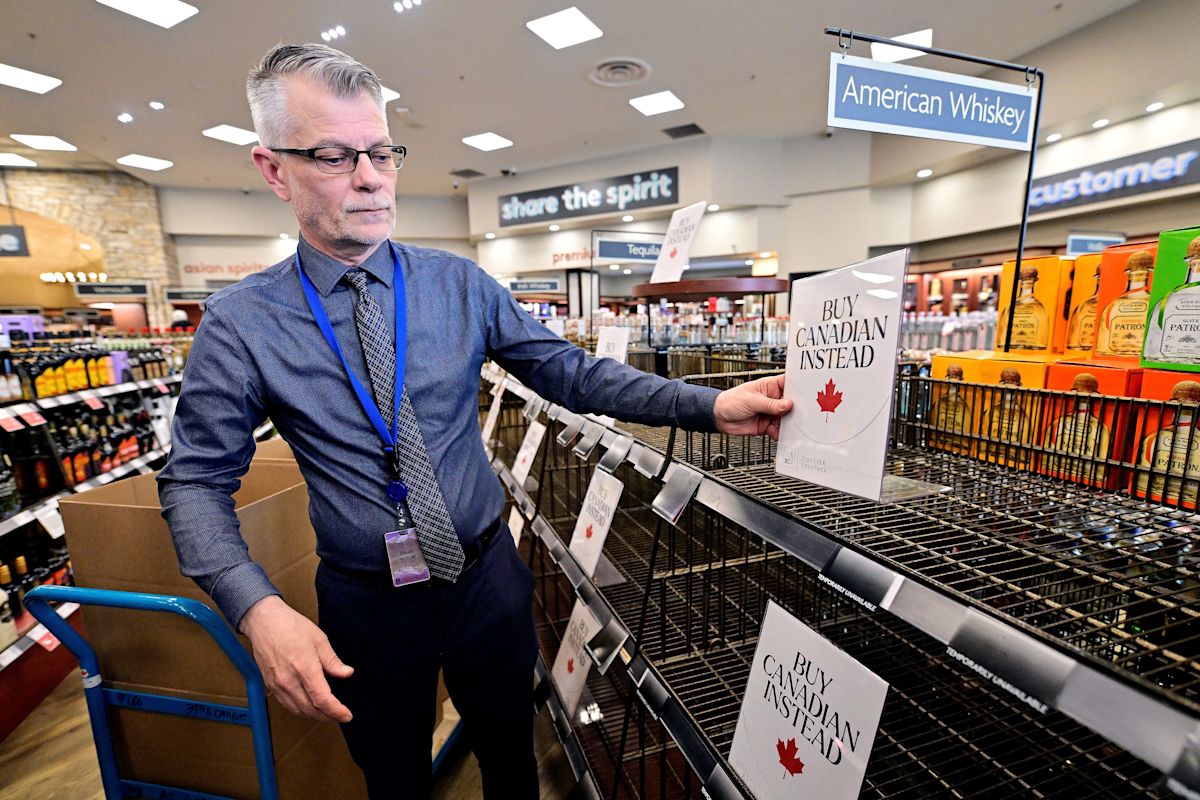
Senior Manager Trevor Hill places a Buy Canadian Instead sign in the American Whiskey section at the BC Liquor in Vancouver, British Columbia, Canada on March 10, 2025.
U.S. alcohol sales dry up in Canada even without retaliatory tariffs
Canadians largely quit buying U.S. liquor during the trade dispute even without tariffs.
Eight of the 10 provinces began boycotting distilled spirits from U.S. suppliers in February after Trump imposed initial tariffs on Canada. One of the other two – Saskatchewan – announced Aug. 26 it would impose 50% tariffs on U.S. spirits as part of the retaliation to the latest tariffs.
What had been a $200-million-a-year market has shrunk to $60 million, according to Chris Swonger, CEO of the Distilled Spirits Council of the United States.
“This discriminatory treatment of U.S. spirits products has persisted for more than a year and a half, causing significant economic harm to our industry,” Swonger said.
Likewise, the United States consumes 93% of Canadian liquors, Swonger said. “A 50% tariff is going to be devastating on the Canadian distilled spirits industry,” he said.
Industry groups on both sides of the border are urging officials to negotiate tariffs back to zero.
This article originally appeared on USA TODAY: Canada fights back in US trade war, targeting specific states






Leave a Reply