
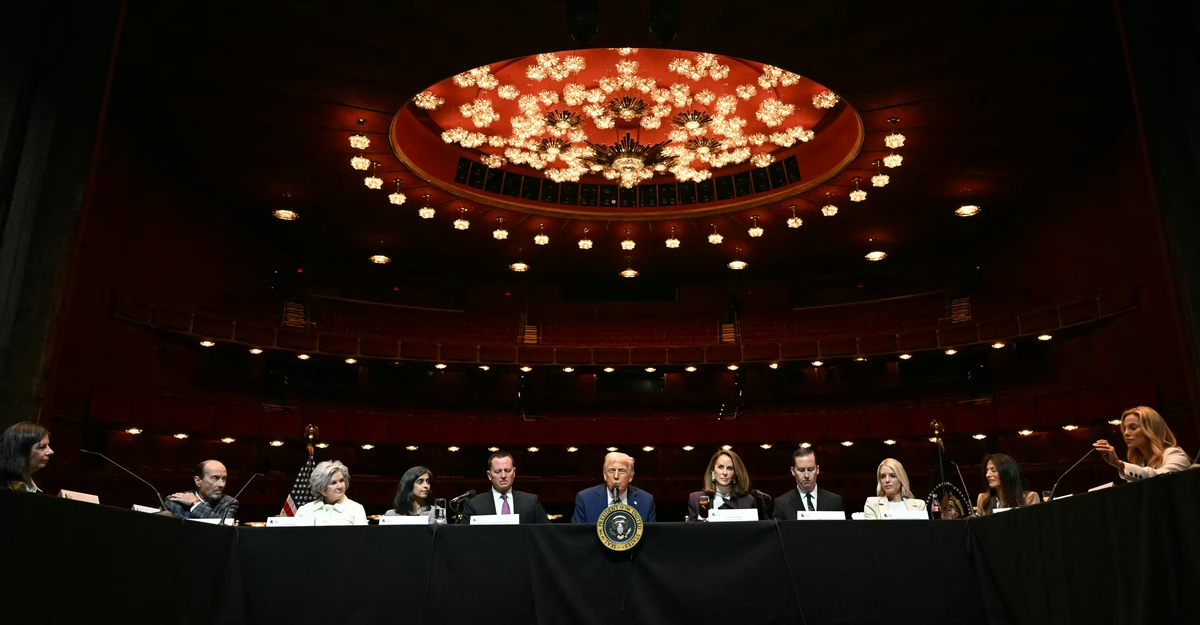
To put the legal fight over the Kennedy Center in operatic terms, it has become more than a little Wagnerian. After another hearing this week about another attempt to add Donald Trump’s name to its marble facade, the fate of the national cultural center remains grim and unresolved, and no finale is in sight.
What could deliver a resolution? That’s still not clear, in part because the defendant in a long-running lawsuit—the Kennedy Center’s board of trustees—keeps making decisions that drag out the ordeal. A judge can restrain the board but has no power to remake it. Congress can remake it, but only through legislative action, which Trump can veto. And meanwhile, his board remains in place—able to make new decisions that invite new challenges that send the parties back to the same judge.
In December, Trump’s allies on the Kennedy Center board—billionaires, White House aides, Fox News personalities, and other figures associated with Trump world—voted to add the president’s name to the building, and in March, they signed off on his plan to shut down the center for renovations. But by May, both actions had hit a wall: In a lawsuit filed by a Democratic member of Congress, Joyce Beatty, who serves as one of the board’s ex officio members, U.S. District Judge Christopher Cooper concluded that the board had exceeded its authority by renaming the Kennedy Center. He also found that its decision to close the center was likely a breach of the trustees’ fiduciary duties, describing that vote as “ill-informed and seemingly preordained.” So they revoted this summer to close down, and they okayed a different plan to get Trump’s name back on the center’s exterior—in three places, actually, even though the relevant federal statute states that “no additional memorials or plaques in the nature of memorials shall be designated or installed in the public areas” of the complex.
Whatever the merits of the renovation plan, the Kennedy Center is plainly in crisis. Trump’s takeover drove away artists, donors, and audiences; staff purges have stripped it of institutional memory. There is a reasonable argument that because its brand has become so repellent, the Kennedy Center might as well close temporarily so that tenants such as the National Symphony Orchestra can have a shot at recovery beyond its walls. But the ongoing litigation has exposed other concerns about the institution’s leadership, who include an executive team led by Matt Floca—whose expertise is in facilities, not arts management—and a board, the chair of which is Trump himself. Although boards at nonprofits are charged with oversight, this one has largely rubber-stamped proposals that have come before it.
After Cooper ordered the board to take a more detailed look at the renovation proposal, it commissioned a new report from a commercial real-estate firm, JLL. (Five years ago, JLL was tapped to try to sell Trump’s Washington, D.C., hotel, though it backed out after the January 6 riot.) This week, Justice Department lawyers representing the board suggested in a court filing that the entire Kennedy Center complex might have to be “taken down” if the renovation plans are thwarted.
Meanwhile, the Kennedy Center has gone largely silent. A tarp still hangs over the facade where Trump’s name was once fastened, a decision that critics have characterized as a petulant display of the president’s vanity. The board has argued in court filings that removing Trump’s name jeopardizes “hundreds of millions of dollars” in donations to a mysterious fundraising vehicle, which it created earlier this year. The board has provided no detailed accounting of how a two-year closure would affect ticket sales, fundraising, or artist relationships—even as reporting from The Washington Post this week revealed that the center’s finances have deteriorated dramatically since Trump’s name was put on the building, issues about which the board was informed.
All of these actions have become central to the lawsuit brought by Beatty, whose lawyers have repeatedly criticized the Trump-appointed trustees for negligence and alleged that the board has misled the public. At the emergency hearing Thursday, Cooper spent nearly two hours questioning both sides, pressing Department of Justice lawyers on why they were rushing to reinstall the president’s name, which the center had said could happen as soon as September 8. (He also questioned whether he even had jurisdiction to stop the board, because in June, the Kennedy Center had appealed his earlier ruling.) Demonstrators made their frustration apparent as they filled the galleys and an overflow room for the hearing, which ended with Cooper requesting that the Kennedy Center extend the date for implementing its latest Trump-recognition plan while he weighs a decision. In a filing later that day, its lawyers agreed to hold off until at least October 8.
The delay further prolongs the issue. But there are worse fates for the Kennedy Center, one staffer—speaking on the condition of anonymity for fear of reprisal—told me outside the courthouse: “A holding pattern is better than them taking a bulldozer to it.”
Each new development and court filing in opposition makes the same structural problem clearer: A judge can restrain the board’s actions time and time again, but “if the problem is a governance problem, there is not much that a court can do,” John Harrison, a law professor at the University of Virginia, told me. The clearest path out of the cycle may instead run through Congress, which established the Kennedy Center as well as the board that governs it.
Harrison described the institution’s governing body as something of a “black box” from a court’s perspective. A judge may issue orders to the people responsible for the entity and enforce those orders, but he generally will not reach inside that structure to prescribe how its decisions should be made when those procedures are established by statute.
That leaves two options for lawmakers, he said. First, Congress could change the Kennedy Center’s governance structure. Alternatively, it could leave the board intact but alter the law governing what the board is permitted to do—for instance, by making the rules surrounding the Kennedy Center’s name more explicit. Any provisions affecting the Kennedy Center could conceivably hitch a ride in a larger legislative package rather than come to the floor as a stand-alone measure, Harrison said, but “it would have to be in a bill. It would have to be done by an act of Congress,” which, for now, seems unlikely.
The issue is partly a product of the Kennedy Center’s unique governance structure. Congress charged the board with maintaining and administering it as both the national center for performing arts and a living memorial to President John F. Kennedy. Thirty-six members are appointed by the president to serve a six-year term, and another 23 serve as ex officio members by virtue of their government office, including the secretary of state; the librarian of Congress; the Smithsonian secretary; the mayor of Washington, D.C.; and the director of the National Park Service. In the past, presidents usually filled vacancies only for trustees who had reached the end of their term, which resulted in a bipartisan mix. But Trump broke with that practice after returning to office last year and firing Joe Biden–appointed trustees before their term was up. He then made another unprecedented move in becoming chairman—a role no other sitting president had previously held—and, along with his hand-picked board, injected an overtly partisan flavor into the institution.
Historically, trustees did not run the Kennedy Center. Neither were they required to be arts professionals, Michael Kaiser, who served as the center’s president from 2001 to 2014, told me. Presidents could select trustees with ties to the Kennedy Center, expertise in the arts, philanthropic capacity, or none of the above, he said: “It’s a mix of people historically. We’ve had boards who are very responsible, very engaged with the staff leadership, very generous, but also representing a wide variety of backgrounds and experiences.”
The board, he stressed, is a governing and oversight body, not a management one.
If the current board members are not sufficiently engaged with the Kennedy Center’s problems, they’re not the first. Trustees were scrutinized during Kaiser’s tenure in 2005 by the Government Accountability Office, which released a report the following year about the Kennedy Center’s management of federally funded capital projects and weaknesses in board oversight. That included low trustee attendance, insufficient monitoring after the board had delegated substantial responsibility to management, and inadequate information to properly evaluate the implementation of capital projects—an observation that echoes what Cooper wrote in his May 29 decision about the current board’s vote to close the center.
The GAO report also quoted one trustee who said that many members regarded their appointment as “honorific” and viewed donating and fundraising as their main responsibilities. Kaiser offered a more nuanced characterization: Many trustees were honored to serve, he said, and some made their greatest contribution financially—“but as a group, particularly through the leadership of the board, there was a sense of a requirement to govern the institution well.”
When Trump remade the board shortly after returning to office last year, he appointed allies including Maria Bartiromo, Sergio Gor, Laura Ingraham, Susie Wiles, and Dan Scavino as general trustees. Second Lady Usha Vance, who had also been named a trustee last year, quietly stepped down recently without citing a reason.
“The Second Lady spent a year on the board concluding her service on February 11, 2026,” her spokesperson wrote to me this week. “She is grateful to the President for her appointment and enjoyed her time with both the Kennedy Center and the Washington National Opera. She plans to continue being a patron of both organizations.”
Lately, Commerce Secretary Howard Lutnick—whose wife serves as a trustee—has also joined Kennedy Center board meetings, “helping out” organizationally, he told me in June. And he appeared at the courthouse Thursday to defend the center’s new resolution while doubling down on its leaders’ warnings that the building would have to be demolished if the center could not raise enough money for repairs.
Since Trump’s takeover, his board has quickly begun exercising its authority in consequential—and ultimately legally contested—ways. Last year, I obtained documents that showed the board had amended its bylaws that May to designate ex officio trustees as nonvoting members. That left voting authority entirely with the presidentially appointed general trustees, clearing the way for them to unanimously add Trump’s name to the Kennedy Center in December. And in March of this year, the board approved Trump’s proposal to close the entire complex for roughly two years while it underwent renovations. (When Cooper ruled against the renaming this May, he also said the board could not prevent ex officio members from voting.)
The scale of that closure warrants substantial board involvement, Kaiser said. During his 14 years leading the center, no renovation had required the Kennedy Center to close for even a day; outside of emergencies such as major snowstorms and the September 11 attacks, it remained open. A capital plan requiring a two-year shutdown carries “mammoth implications” for the institution during the closure and for its ability to recover afterward, he said: “That’s why the board would have to be deeply involved with it.”
Kaiser sees a “terrible imbalance” at an institution that once relied on hundreds of trained professionals to operate its theaters, produce thousands of performances, and raise and earn millions of dollars annually. Now the staff is down to a skeleton crew. “It’s a chicken-or-egg question: Are they doing more because there’s no staff, or is there no staff because the board is doing more?” he said. “There’s no way a board of some 36 people can replace a staff of 700.”
And there’s not much the law can do in the meantime, either. After Cooper’s May ruling, Trump threatened to step away from the center altogether—a death-by-neglect scenario that Lutnick said was still possible if Trump can’t renovate the building during his term. Barring some kind of political breakthrough, the only likely change that could end the stalemate might be one that nobody can hurry along: the end of Trump’s presidency, in 2029.











Leave a Reply