
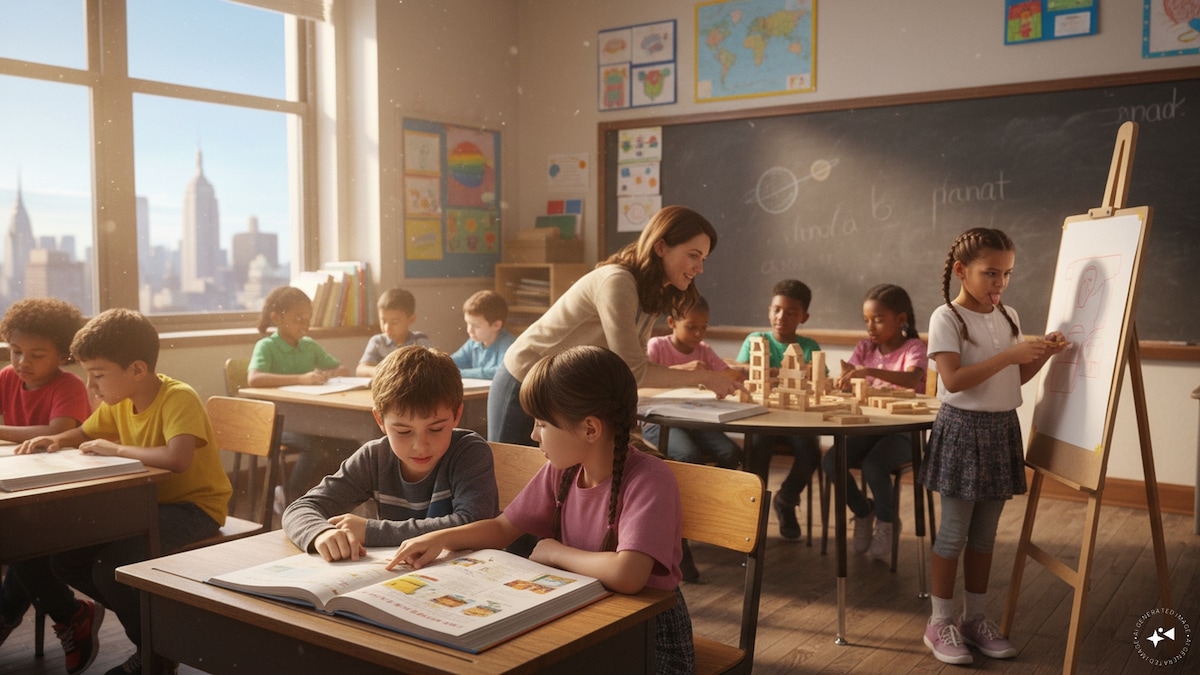
The policy will apply during the 2026-27 school year and affect nearly 600,000 students, or about two-thirds of the city’s public-school enrolment, according to an AFP report.
The policy, announced by Mayor Zohran Mamdani and Schools Chancellor Kamar Samuels, prohibits software using student-facing generative AI in grades 2-K through 8. Companion chatbots will also be prohibited across all grades.
The city said the policy is intended to keep learning centred on teachers, human interaction, critical thinking and students working through problems themselves.
“The tech industry wants us to believe that AI-powered early education is not only inevitable, but necessary. We do not see it that way,” Mamdani said.
“Children need teachers and human connection in order to learn and grow. They need to develop skills alongside their peers, build relationships with educators and wrestle with tough problems on their own,” he added.
High school exception
The restrictions will be different for students in Grades 9-12. All high school students will complete two 45-minute AI literacy modules each year covering how AI works, data privacy, bias and appropriate use of the technology.
The city will also introduce five limited AI pilot programmes for a maximum of 50,000 high school students in general education classes, or about 5% of the public-school student body.
Each pilot can run in no more than five classes per high school, and students must use the approved AI tools under the direct supervision of a trained teacher.
The pilot programmes will not introduce ChatGPT, Claude or similar general-purpose chatbots into school curricula. High school students in career-readiness programmes, including Career and Technical Education, may also use certain AI tools under teacher supervision.
Teachers still use AI
Teachers will be allowed to use AI for lesson planning and operational tasks, but AI cannot be used for grading or student assessments. The policy also allows teacher-led use of computers, tablets and interactive boards for whole-class or small-group instruction.
The city will also discontinue or disable the AI components of more than 38 previously allowed programmes that do not meet its new safety and oversight standards. Educational technology used in schools will undergo further review for safety, transparency, ethics, learning design and instructional impact.
The restrictions do not prevent students from using assistive technology required under an Individualised Education Programme or 504 Plan. Students with disabilities and English language learners will continue to have access to necessary technology and other approved support tools.
Screen limits added
Alongside the AI moratorium, New York City is introducing grade-based limits on individual screen use. Students in 2-K through Grade 2 will have no one-to-one screen time as part of routine individual device use, while the city recommends no more than 30 minutes a day for students in Grades 3-5 and 45 minutes a day for students in Grades 6-8.
The policy includes exceptions for assistive technology, assessments, out-of-school learning and other centrally approved instruction.
The measures follow concerns from parents, educators and other stakeholders about student screen use and the effect of generative AI on learning.
The city had published an earlier AI framework in spring 2026, but the approach drew criticism from parents and teachers who wanted stronger restrictions. Samuels later acknowledged that the earlier communication had “missed the mark”, and the new moratorium replaces that approach.
One-year review
The moratorium is intended to last for one school year rather than become a permanent ban. During 2026-27, a Technology in Schools Coalition made up of students, educators, parent leaders, elected officials, advocates, union partners and experts will assess the impact of the moratorium and the high-school pilots. The coalition will publish recommendations for future school years.
Mamdani said the city wants to determine how AI affects students before expanding its use in younger grades. Governor Kathy Hochul also backed the approach, saying, “We have a responsibility to ensure that rapidly-changing technology supports our children and their learning, rather than getting in the way of it.”
(With input from agencies)











Leave a Reply