

image:
Close up of illuminated fiberoptic thread for illustrating AI.
Credit: Photo by Michael Caterina/University of Notre Dame
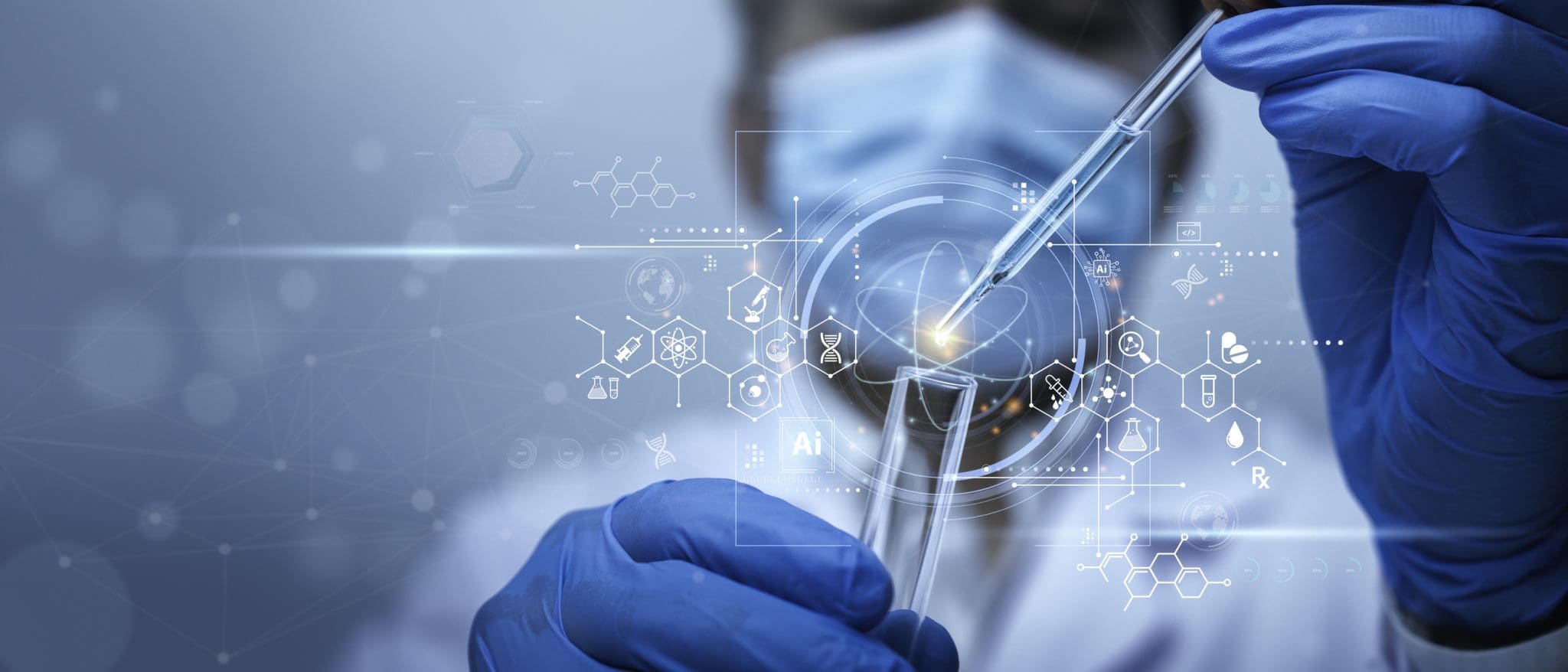
While most believe artificial intelligence (AI) is changing science, researchers at the University of Notre Dame are exploring the reverse.
In an article published in Chemical Reviews, AI and chemistry experts alike discussed how the intricacies of organic chemistry are changing the way researchers design AI technology, leading the way for a new generation of development.
“Organic chemistry presents a particularly demanding set of problems for AI,” said Nitesh Chawla, lead author of the article and the Frank M. Freimann Professor of Computer Science and Engineering. Chawla also serves as the Lucy Family Director for Data & AI Academic Strategy, leading the Data, AI, and Computing Initiative. “Those challenges have driven important advances in how AI represents complex problems, reasons from limited evidence, and accounts for uncertainty. In that sense, chemistry has been a catalyst for better AI—systems that can directly benefit human health, safety, and well-being.”
For AI models to analyze chemistry properly, they must be able to consider several factors, such as complex three-dimensional chemical structures, multiple interacting components, changing conditions, and more than one potential outcome.
But chemists need AI to do more than predict the properties of a compound or the outcome of a reaction. They want to understand why results occur, the mechanisms involved, what conditions matter for those results, and how confident they should be in the prediction.
“When you ask a model to evaluate molecular representations or reaction variables, you are asking it to reason, which forces AI to move beyond black-box predictions. This demand encourages the development of complete systems that are interpretable, respect the laws of chemistry and physics, and connect predictions to established scientific principles,” said Olaf Wiest, coauthor of the article and the Grace-Rupley Professor of Chemistry and Biochemistry. Wiest is also the founder and lead principal investigator of the National Science Foundation Center for Computer-Assisted Synthesis.
To complicate matters further, improving today’s AI models typically relies on scale—larger models, more computing power, and more data. In organic chemistry, high-quality experimental data is limited, often coming from a mix of sources in different formats and structures.
In short, chemistry has challenged AI researchers to think outside the box and innovate, as they cannot rely on scale alone to improve their models.
“These challenges are not unique to chemistry, but chemistry makes them impossible to avoid. Extracting reliable information from limited and imperfect evidence requires us to think more critically about how problems are represented, what prior knowledge can be incorporated, and how much confidence we should place in a prediction,” Chawla said.
These developments are essential for advancements of AI technologies that could support or even fast-track the many areas that depend on the “central science,” chemistry.
For example, self-driving laboratories—automated systems that can execute scientific experiments with minimal human intervention—could accelerate the discovery of new materials and drugs. These agentic systems will need the ability to independently formulate hypotheses, design and perform experiments, interpret results, and improve their process.
Altogether, Chawla says this makes the field of organic chemistry a powerful environment for developing better AI systems that integrate transparent protocols, rigorous validation, and safety constraints.
“The future of scientific AI will likely be hybrid, bringing together statistical learning, symbolic and mechanistic knowledge, human expertise, and experimental feedback,” said Chawla. “What we learn by solving these problems in organic chemistry can make AI systems more reliable, more efficient, and better equipped to serve science and society.”
Other coauthors from Notre Dame include Gisela A. González-Montiel, Kehan Guo, Taicheng Guo, Ting Hua, Xiaobao Huang, Eric Inae, Meng Jiang, Khiem Le, Gang Liu, J. Charlie Maier, Nuno Moniz, Brenda Nogueira, Deng Pan, Bryan V. Piguave, Brett M. Savoie, Andrew B. Schofield, Yili Shen, Alexander Taylor, Xiangliang Zhang, and Yihan Zhu.
The article was published as part of “Artificial Intelligence for Chemistry,” a special issue of Chemical Reviews with the research supported by the NSF Center for Computer Assisted Synthesis.
Article Title
Organic Chemistry as a Catalyst for AI Innovation: Challenges, Methods, and Emerging Paradigms
Article Publication Date
17-Jun-2026
Disclaimer: AAAS and EurekAlert! are not responsible for the accuracy of news releases posted to EurekAlert! by contributing institutions or for the use of any information through the EurekAlert system.






Leave a Reply