
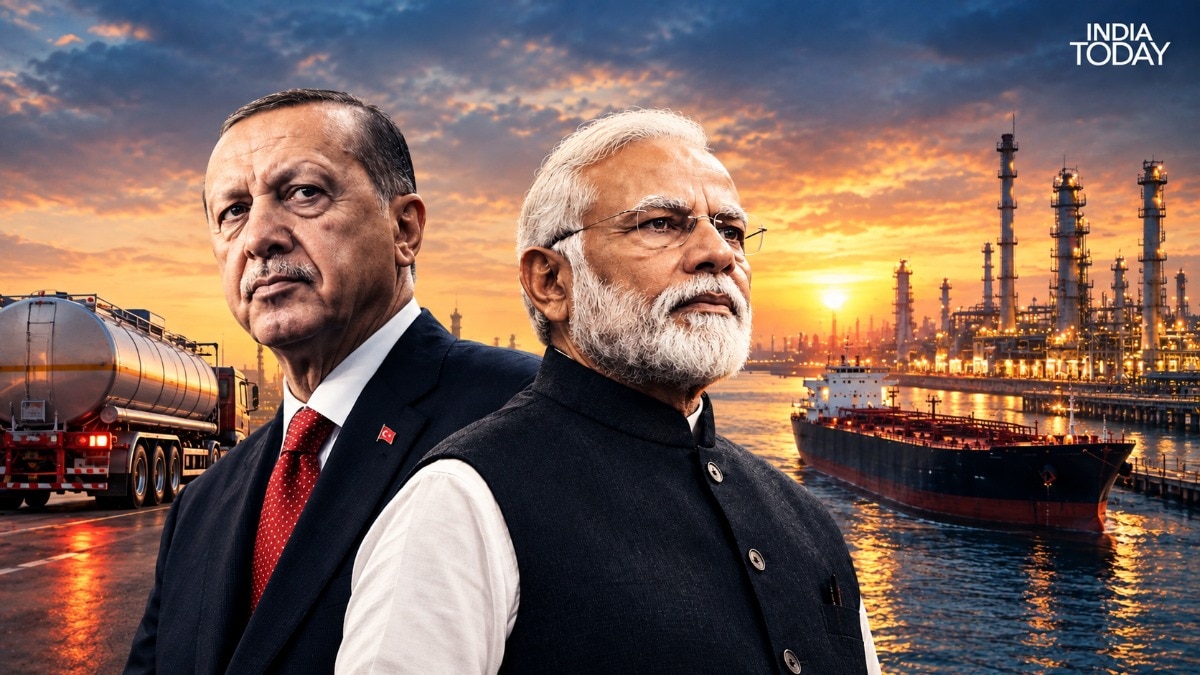
India and the US have become the top two diesel suppliers to Turkey as the country looks to diversify its fuel imports from Russia, whose refineries have come under attack from Ukraine. While Turkey was relying on Indian and American fuel, there are indications that US President Donald Trump might end diesel exports given the rise in prices and calls at home. The chances are that the situation might make Turkey rely more heavily on India for diesel.
Turkey, a Pakistan ally, which for years depended overwhelmingly on Russia for diesel, sharply increased purchases from both India and the US in August after Russian supplies fell and Middle Eastern fuel flows were disrupted.
India emerged as the larger of the two suppliers, according to Kpler’s data, sending more than 120,000 barrels per day (bpd) of diesel to Turkey, compared with about 90,000 bpd from the US. Both were record monthly levels in Kpler’s data going back to 2017.
Now, with Trump backing a proposal to stop American diesel exports, the question that has emerged for Turkey is, if the US barrels disappear, how much more will Ankara have to rely on India?
Trump said on Tuesday that he supported a proposal to halt diesel exports from US refineries and that a decision would be made “one way or another”, Reuters reported. US Treasury Secretary Scott Bessent later said the administration was examining whether a full or partial ban would be feasible. The announcement came ahead of the critical midterm elections in November in the US.
The timing matters for Turkey. Its traditional diesel supplier, Russia, has already seen its share of the Turkish market collapse. Russia supplied about 85% of Turkey’s diesel imports in 2025, or roughly 281,000 bpd, according to Turkey’s energy regulator. But Russian diesel shipments to Turkey fell to about 80,000 bpd in August, taking Russia’s share down to around 20%, according to Kpler.
Turkey, therefore, went looking for replacement barrels.
UK-based data analytics and market insights firm, Energy Aspects, which uses a different methodology, put the August figures at about 74,000 bpd from India and 70,000 bpd from the US. Even on those lower estimates, both were at their highest levels in years.
That makes the proposed US export ban particularly significant for Turkey.
WHY TURKEY’S AUGUST DIESEL IMPORTS MATTER
India was not historically Turkey’s dominant diesel supplier.
But in 2025, India exported 562,421 tonnes of diesel to Turkey, making it the country’s third-largest supplier after Russia and Egypt. India’s exports to Turkey had also been much higher in 2021, at about 2.71 million tonnes, showing that the relationship has fluctuated considerably rather than following a simple upward trajectory.
What is different now is the wider supply shock, because of which the structure of the market has changed.
Turkey still has other potential sources, including domestic refineries and other international suppliers. But if the US restricts diesel exports, India could become an even more important supplier to Turkey.
That is why a US export ban could have consequences well beyond American fuel prices.
AMERICAN FUEL FOR AMERICANS, DEMAND REPUBLICANS
Speaking to reporters on the sidelines of the United Nations General Assembly (UNGA) on Tuesday, US President Donald Trump was reported by Reuters as saying, “I’ve said let’s not send out the diesel. We make a lot of diesel … I’ve called for it. I’ve called for it within my people,” ahead of a meeting with Ukrainian President Volodymyr Zelenskyy. Politico further reported Trump as saying that his administration would issue a decision “fast, one way or the other”.
US Treasury Secretary Scott Bessent was later quoted by CNBC as saying, “We’re examining whether it’s feasible in terms of the overall refining capacity and whether a full or partial ban would work.”
Trump’s comments came after growing calls from Republicans in the US Congress, as well as candidates in the upcoming November 3 midterm elections, to restrict diesel exports and prioritise domestic supplies.
Iowa Senator Chuck Grassley, who is running for re-election, called for an export ban over the weekend, saying high fuel prices were “killing farmers’ income”. Grassley, a corn and soybean farmer, questioned why Trump had not pursued a ban similar to measures used during the surge in oil prices in the 1970s.
“We need our family farmers who feed & fuel the world to be on the strongest footing possible no matter what’s happening across the globe,” Grassley wrote on X.
Similarly, Representative Ashley Hinson, a Republican running for Senate in Iowa, said the state’s consumers were “being squeezed and shouldn’t have to foot the bill at the pump”, reported the BBC.
Alaska Senator Dan Sullivan, also running for the midterms, called for a temporary halt to diesel exports. “American fuel should stay home with Americans,” Sullivan said in a statement on Tuesday, according to Reuters. “The cost of diesel is just too damn high. I’m calling for a temporary pause of American diesel exports so that we can rebuild our reserves ahead of winter and put American and Alaskan families first,” Sullivan said.
Other Republicans have also backed restrictions. The Washington Post reported that Representative Tim Burchett of Tennessee as having introduced legislation last week to restrict diesel fuel exports. Senate Majority Leader John Thune of South Dakota said the Senate was examining proposals that could help bring down prices.
“If that [export ban] would take pressure off of prices, you know, I’m open to exploring it,” Thune told reporters last week.
The New York Times reported that rising energy costs have become a major political headache for Republicans ahead of the November US congressional elections, in which Republicans and Democrats will compete for control of both the House of Representatives and the Senate.
The report cited recent polls showing several Republican candidates, including those running in traditionally safe Republican seats, are now facing tight races against Democrats or independents amid growing concerns about rising energy prices across the country.
AMERICA’S DIESEL DILEMMA, AND AN AWKWARD TIME FOR TURKEY
The proposed ban is being driven by a very different concern inside the US.
American diesel prices have surged above $6 a gallon, while inventories have fallen below their five-year seasonal average. Diesel is particularly important to the US economy because it powers freight, agriculture and heavy machinery.
The problem is that the US is not producing diesel in isolation from the rest of the world. American refineries are part of a global fuel market. Restricting exports could redirect more supply towards US consumers, but it would simultaneously remove barrels from countries that are already struggling to replace Russian and Middle Eastern supplies.
The American Petroleum Institute and other industry representatives have argued that an export restriction could instead discourage refinery production and worsen shortages. Reuters has also reported concerns that such a move could disrupt global fuel markets.
For Turkey, the timing is especially awkward.
Its old fuel relationship with Russia has been disrupted. Its new relationship with India has just reached a record level. And one of its other major replacement suppliers, the US, might now be considering keeping its diesel at home.
If the American barrels disappear, the Indian barrels could become a lot more important.
– Ends











Leave a Reply