
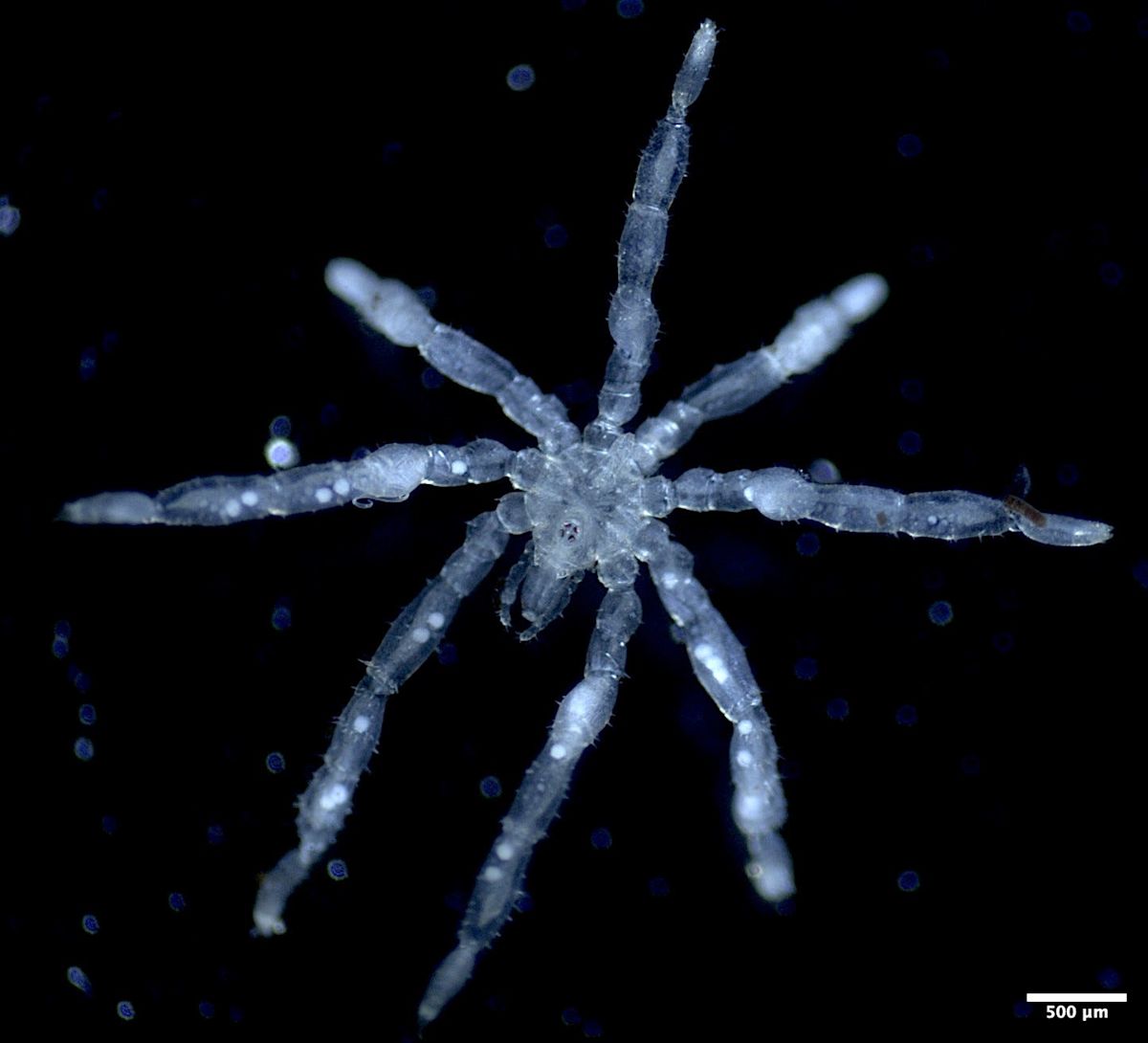
Two new species of sea spiders have been discovered in the Salish Sea, including one with hairy-looking legs, red eyes and a three-lipped mouth.
Researchers at the University of British Columbia identified the species after collecting specimens from marine habitats in British Columbia between September 2023 and August 2024. The discoveries are the first new sea spider species described in the Salish Sea – a large, rich inland sea that stretches along the international border between Washington state in the United States and British Columbia in Canada – in almost a century, according to the researchers.
One of the species, Callipallene pilosuspedes, gets its name from the long, curved spines covering its lower legs, which give the animal the appearance of having hairy feet. It also has red eyes, a short feeding structure with claws and a triangular mouth divided into three lips. The second species, Tanystylum kiixin, was named after an ancient Indigenous village site near where specimens were first collected.
The research, published in the journal Organisms Diversity and Evolution, combines a detailed examination of the animals with DNA analysis to provide more information about a poorly understood group of marine species, the University of British Columbia said in a Sept. 23 news release.

The sea spider Tanystylum kiixin, discovered by University of British Columbia scientists
What are sea spiders?
Sea spiders are ancient marine animals that evolved about 500 million years ago. They are related to spiders, scorpions and horseshoe crabs, but they are not true spiders, according to the University of British Columbia.
The animals can have as many as 12 legs and a tube-like mouthpart called a proboscis that they use to feed. Some shallow-water species are small enough to live as parasites on larger organisms, lead researcher Cormac Toler-Scott said in a statement.
Sea spiders also have unusual reproductive biology. They breathe through their skin, and males carry developing eggs. Females produce eggs through openings in their bodies, which males collect with specialized limbs and attach to their bodies while they develop.
A sea spider with ‘hairy feet’
Callipallene pilosuspedes gets its name from the spines covering its lower legs. The species also has red eyes and a short proboscis with claws that help it grasp food.
Its mouth is triangular and consists of three lips surrounded by tiny sensory structures. Researchers also found that the animal has specialized limbs that it can use to groom.
Under a microscope, researchers observed the limbs wrapping around the sea spider’s legs and using its comb-like spines to clean them.

Callipallene pilosuspedes
The other new species carries parasites
Tanystylum kiixin has smaller, less flexible limbs used for carrying eggs, which also makes it less able to groom itself.
Researchers found dirt, debris and tiny parasites on the animals, with Toler-Scott describing the finding as “an ecosystem within an ecosystem within an ecosystem.”
The species’ name comes from an ancient Indigenous village site near where specimens were first collected. According to the researchers, the specimen’s name is pronounced “kee-hin” and refers to the sound of waves crashing at the base of the village site.
Why the discoveries matter
Toler-Scott said he became interested in sea spiders while researching how climate change and human disturbance could affect marine invertebrates in the Salish Sea.
“I was interested in how sea spiders are impacted by climate change and human disturbance, because marine invertebrates in the Salish Sea are particularly at-risk, and I couldn’t find anything,” he said in a statement.
The researchers used detailed imaging and DNA analysis to study seven sea spider species in the region. They also generated genetic information for species that had not previously been sequenced and created an identification guide for sea spiders in the Salish Sea and along the west coast of Vancouver Island.
The two newly described species have been registered in a global database. Toler-Scott said more species may still be waiting to be documented.
“I only had one field season but there’s definitely more diversity out there that we haven’t documented,” he said.
Reporter Anthony Thompson can be reached at ajthompson@usatodayco.com or on X @athompsonUSAT
This article originally appeared on USA TODAY: New sea spider species has hairy legs, red eyes and 3 lips









Leave a Reply