
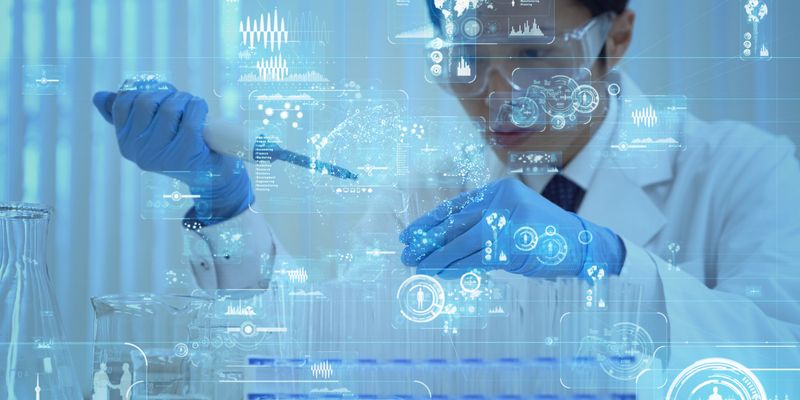
AI is already making significant impacts across many different labs. Learning how to harness the power of AI while maintaining scientific integrity, direction, and outcomes is a key responsibility for lab managers.
To help lab managers learn about how and where they can best apply AI technologies and get more perspective on AI in the modern lab, we talked with Hal Wehrenberg, VP of global services and digital innovation at Tecan.
The life sciences industry has been talking about AI for several years, but agentic AI is now emerging as a new concept. How does agentic AI differ from the AI tools laboratories are already familiar with, and why is it generating so much interest in R&D environments?
Agentic AI builds on the analytical and generative capabilities that laboratories are already familiar with by adding reasoning, context, and the ability to support actions. Rather than simply answering questions or interpreting data, it can combine scientific literature, experimental results, laboratory workflows, and operational data to recommend next steps and help orchestrate routine parts of the R&D process.
As AI accelerates scientific ideation and analysis, an often-hidden opportunity is to apply agents to laboratory operations so the wet lab does not become the bottleneck. Laboratory automation experts know that translating a scientific concept into an executable workflow, and then into scripts, runtime parameters, and instrument execution, often requires considerable expert effort but relatively little scientific creativity. Agentic AI has the potential to automate more of that operational layer, allowing scientists and automation specialists to focus on higher-value work while shortening the time between idea, execution, and learning. Ultimately, that means turning the crank of scientific discovery faster by closing the loop between the dry lab and the wet lab.

Laboratories have traditionally relied on alarms, monitoring systems, and human intervention when something goes wrong. How could agentic AI change the way labs detect, respond to, and ultimately prevent workflow disruptions?
Historically, many laboratory systems have been reactive. They alert users when something has already gone wrong or provide data that helps explain a failure after the fact. That is useful, but it still means time, samples, reagents, and instrument capacity may already have been lost.
Agentic AI creates the possibility of moving from reactive monitoring to proactive intervention. By connecting operational data, instrument telemetry, environmental conditions, workflow history, and experimental outcomes, AI can start to identify patterns that indicate risk before a disruption occurs. Over time, these systems could recommend corrective actions, adjust workflow conditions within defined guardrails, or escalate issues to the right expert before experiments are affected. The opportunity is not simply faster troubleshooting, but fewer disruptions in the first place.
Where do you see the greatest opportunities for AI to improve reliability in laboratory workflows?
The greatest opportunities are in areas where many variables can have a large impact on workflow performance or experimental outcomes. Biological workflows are influenced by many factors, including environmental conditions, reagent handling, instrument settings, timing between process steps, and operator interactions. Modern laboratories generate data around many of these variables, and where historical data is available, AI can learn from previous runs to better understand which patterns are associated with success, variability, or failure.
By connecting operational, environmental, historical, and experimental data, AI can help identify hidden sources of variability and support more consistent execution across complex workflows. That can improve data quality, reduce avoidable failures, and increase confidence in experimental outcomes. In the near term, I think some of the highest-value use cases will be around error prevention, assay robustness, and helping laboratories understand which conditions are most strongly associated with successful results.
The idea of an autonomous laboratory is gaining traction across the industry, but what does an autonomous lab look like, and what steps need to happen before that vision becomes practical?
In the next five to 10 years, I do not think the most realistic vision is a fully self-directed laboratory that operates without scientists. A more practical vision is a highly connected, adaptive laboratory where AI helps plan experiments, translate ideas into executable workflows, coordinate the wet lab, interpret results, and recommend the next best action. Scientists will remain central, not only for oversight, but for scientific innovation: defining new questions, designing novel approaches, and deciding what matters.
To make that practical, laboratories need to stay focused on their scientific problems and goals, not simply chase the promise of AI. In the plan-make-test-analyze-model cycle, advances in the efficiency of the make-test stages will continue to pay off because every AI-generated idea still needs to be executed and validated in the lab. Stronger digital foundations, connected instruments, interoperable software, robust automation, and clear guardrails will all be important. Autonomy will emerge step by step as laboratories make routine translation and execution faster, build trust through proven use cases, and create tighter feedback loops between experimental design, execution, and learning.

Lab Quality Management Certificate
The Lab Quality Management certificate is more than training—it’s a professional advantage.
Gain critical skills and IACET-approved CEUs that make a measurable difference.
As AI becomes more involved in laboratory operations, trust and transparency become increasingly important. What will lab managers need to see before they are comfortable allowing AI systems to make recommendations or take corrective actions within critical workflows?
Lab managers will need to see that AI systems are grounded, transparent, and operating within clearly defined guardrails. In critical workflows, it is not enough for an AI system to make a plausible recommendation. Users need to understand what data the recommendation is based on, why it is being made, what level of confidence the system has, and what the potential impact of the action could be.
Trust will build gradually through practical use cases where AI demonstrates consistent value without creating unnecessary risk. That may begin with recommendations, alerts, or decision support before moving toward limited corrective actions within validated boundaries. The key is to keep humans in control of critical decisions while allowing AI to reduce complexity, surface risks earlier, and support more reliable laboratory operations.
For organizations beginning their digital transformation journey, where do you believe AI can deliver the most immediate and measurable value?
For organizations beginning their digital transformation journey, the most immediate value often comes from focused use cases that improve efficiency, reliability, or decision-making without requiring a complete transformation of the laboratory. That could include analyzing operational data to identify sources of variability, improving troubleshooting, supporting error prevention, interpreting complex datasets, or helping translate experimental intent into parameters that can be passed to instruments through existing APIs or data input methods.
The key is to start with a clearly defined problem rather than starting with AI itself. Laboratories should look for areas where they already have useful data, where delays or failures create measurable cost, and where better insight or faster execution could quickly improve outcomes. Early success builds confidence, creates momentum, and helps organizations move toward more connected, data-driven workflows over time.












Leave a Reply