
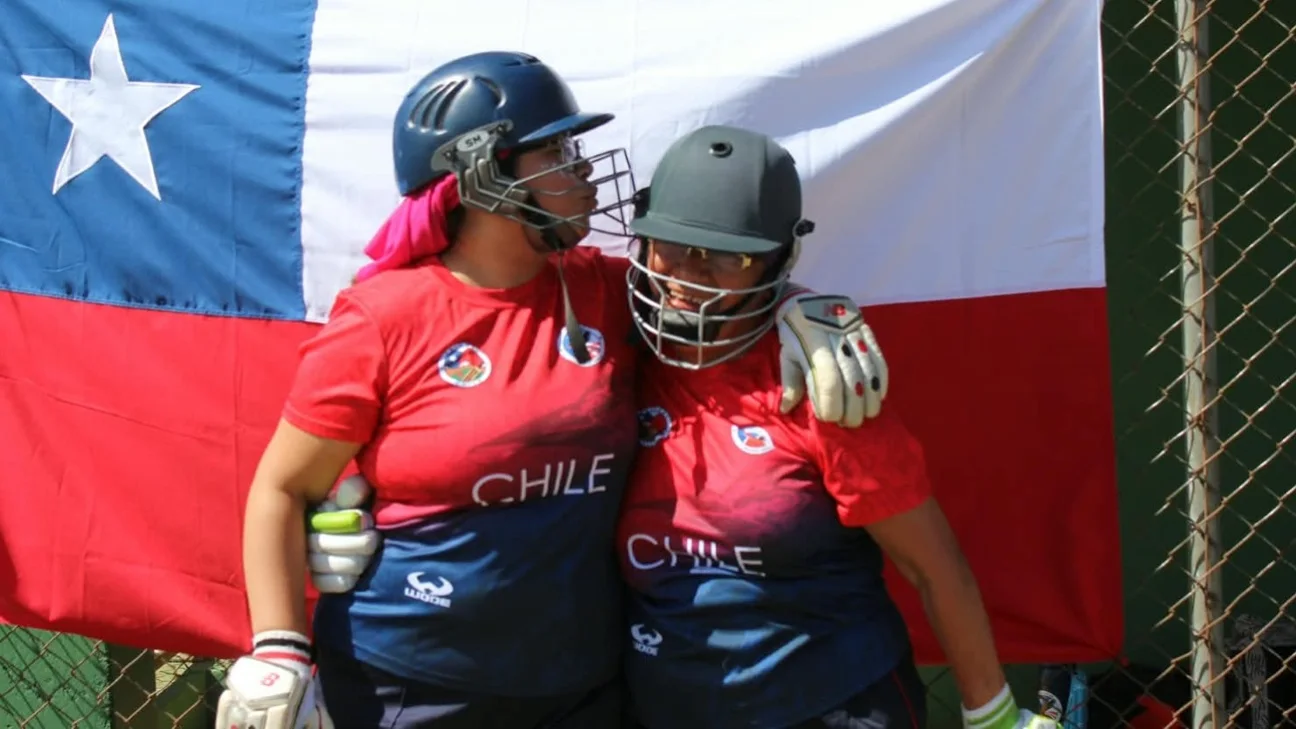
“I thought my responsibility was actually to cook for the friends that are coming to play with [my granddaughter] for the event,” Vildosola tells Cricinfo. “I had heard about cricket because my granddaughter played it, but this was the first time I tried my hand at it, and I’m glad I did it.”
Costa Rica, where she also opened the batting alongside Oyarce. By doing so, she became the oldest active cricketer in the world, at 70, and became the second-oldest player to play any professional cricket after Raja Maharaj Singh, who made his first-class debut at 72 in 1950-51.
Cricket also gave Vildosola a chance to remain active. She had never played any sport professionally, but she took part recreationally in other sports.
For the record, Vildosola scored ducks in both the matches she played, but that isn’t really the point.
“It was unthinkable,” she says of her international debut. “In my youth, 50 years ago at least, it was basketball, volleyball, football… I never thought about playing any sport. Especially cricket, which I had never heard of. But in Latin America, we are generally active. That’s what is driving me towards playing and participating, my main goal is to participate.”
For Oyarce too, having her grandmother become part of the team has been just as unexpected. “My abuela [grandmother] was always active but I never expected her to be part of the team. Her support and her just being around means a lot for me and the team.”
Vildosola’s preferred part is batting, and more specifically, hitting straight down the ground.
“According to my condition and age, I prefer to bat because my joints don’t allow me to bowl,” she says, laughing. “So I’d rather bat than bowl. It was also one of the main reasons I liked cricket because the activity was much more easier than other sports.”
Vildosola and Oyarce also train together when they get time and exchange notes before tournaments. But being 70 means her colleagues are sometimes around 50 years her junior. What does that make her feel?
“Orgullo y agradecimiento [pride and gratefulness],” she says. “Because it’s not easy to do this with people who are much younger than me. My granddaughter and I are almost 50 years apart in age and I have to put myself under her command. But I’m proud to be alongside my granddaughter and that itself is a great privilege.”
“Most don’t even speak English, so the language used in cricket can sometimes get very complicated. First barrier for us, even as a continent, is language. But we use only English names for the equipment and rules, we don’t even use Spanish names”
Patricio Caamaño Viveros, director of Cricket Chile
For Oyarce, meanwhile, having her grandmother on the field comes with its own challenges and plenty of laughs. “From time to time it’s a bit difficult because you’re not used to giving orders to your grandparents. It’s been very entertaining and we’ve both really enjoyed this experience,” she says. “I get a chance to tell grandma what to do on the field and that’s fun.
“But I’m really proud to have her on the field playing as well. I’m very happy to see her achieve important things for her, and I can see her joy every time we go to a competition abroad. Because a lot of times, older adults think they don’t have time to try out sports. And
she dared to do it and continues to show every day that she is capable of doing it.”
Vildosola’s story has been possible in part because of the way cricket has developed in Chile. Like in many countries where cricket isn’t a major sport, the game was introduced to the locals by expats. For example, Patricio Caamaño Viveros, president of Cricket Chile, was introduced to the sport by his Australian boss over 25 years ago, and he took an immediate liking to it.
In 2008, Caamaño and a group of friends officially launched Beach Cricket, a tournament that continues to be played every year in Viña del Mar, a coastal city northwest of Santiago, the capital of Chile.
With few proper cricket grounds available, the beach became the easiest-to-access venue as renting a football field for hours could be expensive. The organisers also wanted to make the tournament as “attractive” as possible to get people interested in the sport, which meant making it a family affair.
“Father, mother, daughter, son everyone can play in one team,” Caamaño says. “This was the way to introduce the game like a development format – to include men, women and children in the same team.”
The tournament attracted a number of locals, and from around 50 participants in its first year, it has now grown to nearly 500. Equipment is sourced through friends in the UK and India, while the tournament has developed its own rules to make the game more accessible and entertaining. For example, there is no lbw, and a batter can only be run out at the bowler’s end.
Caamaño feels the format has helped cricket attract women and children in particular, regardless of age. “Football in Chile is very competitive. In cricket, especially beach cricket, there’s another opportunity here which is to play with your family in a tournament. Be it official or for fun – it gets families and friends together. You get to play on the same team with your mother or your daughter. And everything is done by the people; people teach one another as the game goes on. It’s more about community, and it’s a different experience.”
Caamaño also points out that a story like Valdosola’s has been because of the inclusivity they aim towards in sports in Chile. Her induction into the game was done slowly and carefully, in his opinion. The Mothers and Daughters event, which first brought Valdosola to the sport, helped Chile win the ICC’s 100% Cricket Female Participation Programme of the Year award in 2020.
“With Ivonne, we started step by step – first started with plastic bat and a tennis ball, stuff like that,” Caamaño says. “She used to practice by herself too. She was really encouraged by it. Her playing at 70 years old, it’s incredible for us.”
The Chile women’s team owes its development to being “so close” to each other and working “as a family”. “We know that in terms of sports skills, we still have a long way to go,” Oyarce says. “But being together and supporting each other, we believe that we can continue to grow a lot.”
The challenges, however, are not limited to playing the game, and Caamaño says one of the biggest barriers to cricket’s growth in Chile is language. From watching cricket on TV to learning the laws to understanding the terminology, much of the game’s vocabulary remains unfamiliar to people in the Spanish-speaking country.
“Most don’t even speak English, so the language used in cricket can sometimes get very complicated,” Caamaño says. “First barrier for us, even as a continent, is language. But we use only English names for the equipment and rules, we don’t even use Spanish names.”
One of the things that has kept them motivated to keep playing is the support they get from the other South American teams. They are inspired by the success of the Brazilian women’s team, arguably the strongest team in the continent, and the efforts led by former captain and current president of Brazilian Cricket Confederation, Roberta Moretti Avery.
“There is competition on the field but in South America in cricket, we all try helping each other as much as possible,” Caamaño says.
And then there are stories like Vildosola’s, which have shown how far an inclusive approach to cricket can take the game despite barriers.
Sruthi Ravindranath is a sub-editor at Cricinfo







Leave a Reply