
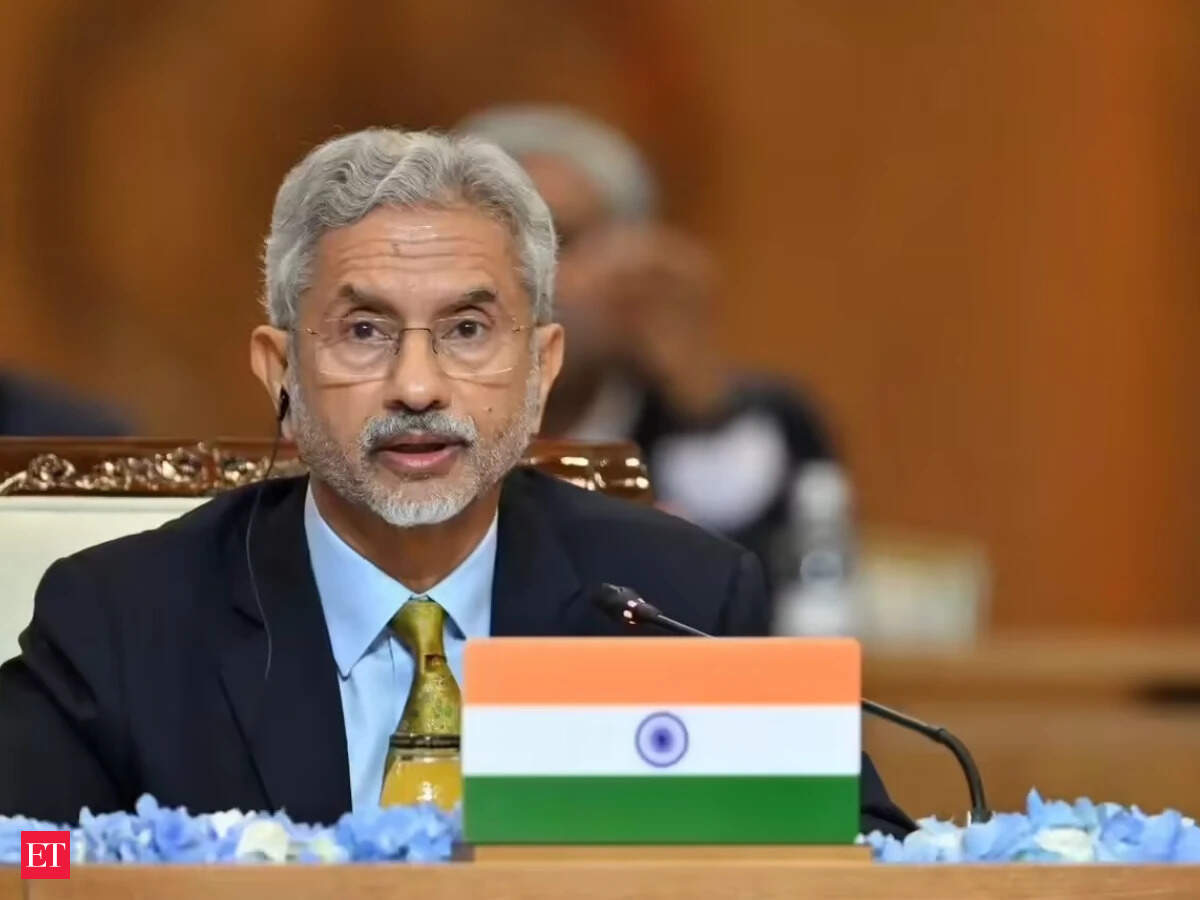
Speaking on India’s evolving role over the next five to ten years during a Q&A session at the Munich Leaders Meeting, Jaishankar emphasized that emerging and middle powers will experience distinct growth trajectories, with India uniquely positioned due to its demographic strength and innovative development path.
“Some powers are more middle, and some are upper middle… Some of the powers have considerable and realistic potential even in the near short medium term to grow very rapidly. In the case of India, because we have decades of high growth ahead of us, and we have all said and done, a demography that will sustain that growth,” Jaishankar stated.
Also read: Jaishankar says India-EU FTA will be a “real game changer” for ties
He noted that India is not bound to traditional industrialization models, advocating instead for contemporary solutions suited to a rapidly shifting global landscape.

“I would even argue, a world that is much more creative, where many new possibilities are there, so that we don’t necessarily have to tread the earlier path of industrialisation. The orthodox path will have to devise something much more contemporary for what awaits us. Among the middle powers, some will peel off, some will stay put, some may drop down a bit. That is the reality. That will be part of the evolution of the global order,” he explained.
Turning to technology governance, Jaishankar cited India’s approach to artificial intelligence as a premier model of leveraging technology for social equity and public welfare, pointing to the vision showcased during the AI Impact Summit hosted in February in New Delhi.”On AI, our position was very amply demonstrated at the AI Impact Summit that we did in February this year… In this country, we have actually used the digital capabilities today to bring about a massive governance and social transformation,” he remarked. “People perceive AI also as something which must become accessible, affordable, and used for a certain socio-economic purpose… It is a sort of AI for humanity; develop user cases which are relatable to people’s needs. That is the kind of vision that we have.”
He further stressed the imperative for policy oversight and safety frameworks in emerging technological domains, noting, “There is also a concern about the safety and security issues that arise. This is too major an issue to leave it to the market, so to speak.”
Elaborating on the growing influence of plurilateral platforms in this shifting international architecture, Jaishankar highlighted the surging global interest in BRICS as proof of a changing mindset seeking broader, more diverse diplomatic engagements.
“The BRICS goes through this: how weighty is it, will it work, does it make a difference, etc. Over a period of time, we have shown it does,” Jaishankar noted.
“The fact that so many countries want to join BRICS, we doubled the membership, and we could have quadrupled it without difficulty, does show today that people want to have different conversations. They want to have other players in the room. They want to do their own thing. The challenge for BRICS now is to develop a deeper and deeper agenda, to fit with the growing space,” he added.
The remarks follow the recent BRICS Summit held in New Delhi from September 12 to 13, which brought together leaders of the expanded 11-member grouping under India’s chairship. Organized under the theme “Building for Resilience, Innovation, Cooperation and Sustainability,” the summit focused on economic cooperation, development, technology, and global governance while building consensus among an increasingly diverse membership.





Leave a Reply