
Context: Union Minister for Electronics and IT launched the World Bank Group’s flagship World Development Report 2026: The Promise of Artificial Intelligence in New Delhi, jointly hosted by MeitY’s IndiaAI Mission.

About The World Development Report (WDR) 2026:
What it is?
- The annual flagship research publication of the World Bank Group, serving as an authoritative global guide on key development policy issues. The 2026 edition, titled The Promise of Artificial Intelligence, analyzes the macro-developmental opportunities, labor disruptions, and structural prerequisites of AI for low- and middle-income countries.
Organisations Associated:
- Published by: The World Bank Group.
- India Launch Partner: IndiaAI Mission under the Ministry of Electronics and Information Technology (MeitY), Government of India.
Key Findings of the Report:
- Adopt and Adapt Strategy: Advises developing countries to adopt existing open-access AI models and customise them for local languages and developmental needs, rather than investing heavily in expensive frontier models.
- Automation Risk and Job Displacement: Finds that just over 4% of Indian jobs face immediate automation risks, compared with over one-third in advanced economies, while entry-level BPO job postings in South Asia have declined by approximately 20%.
- Risks of Excessive Fiscal Subsidies: Warns that generous incentives, including India’s 20-year tax holiday for foreign data centres, could strain public finances, increase electricity costs and disproportionately benefit multinational corporations.
- Limits of AI Sovereignty: Emphasises that domestic data centres alone cannot guarantee technological independence, as countries remain dependent on imported advanced semiconductors, specialised cloud infrastructure and global supply chains.
- Brain Drain of AI Talent: Highlights India’s net loss of 200 elite AI researchers and inventors during 2011–2024, despite possessing the world’s second-largest AI talent pool of approximately 50,460 professionals in 2025.
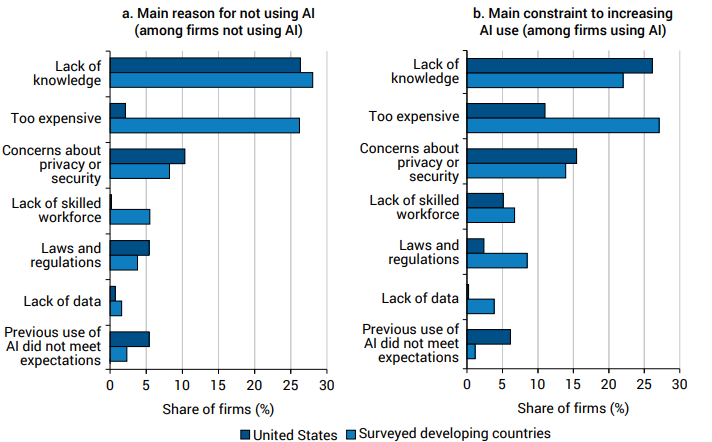
- Global South’s AI Preparedness Gap: Reveals that only one of 25 low-income economies has an active national AI strategy, highlighting significant disparities in institutional readiness and AI governance capabilities.
- Public Perception and AI Regulation: Finds that only 18.8% of Indians express concern about AI, compared with 50.5% in the US, reflecting greater optimism and preference for flexible regulatory guidelines.
Significance:
- Encourages governments to move beyond isolated pilot projects towards population-scale AI applications, leveraging digital public infrastructure such as AgriStack and AI-based weather forecasting.
- Highlights how multilingual, voice-enabled AI tools can address shortages of skilled professionals in healthcare, agriculture and education, particularly among digitally underserved communities.












Leave a Reply