
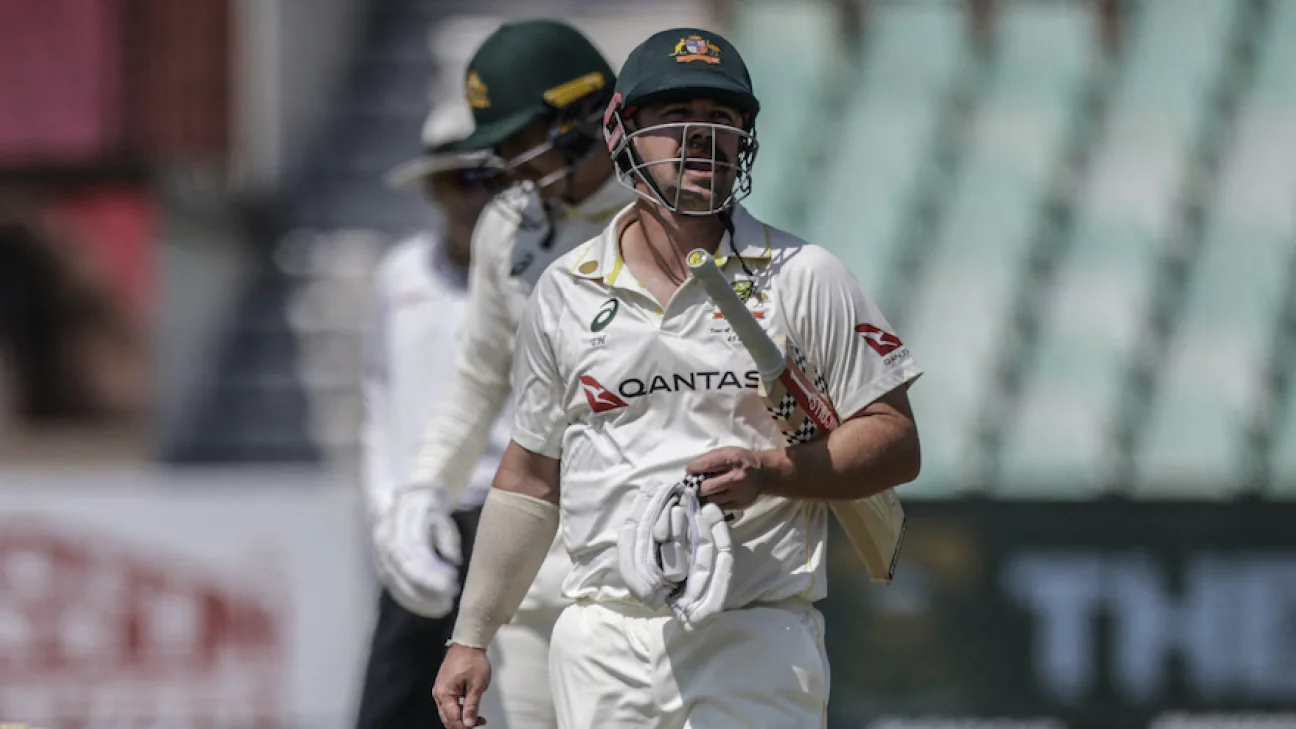
Head had the leanest return of any of Australia’s top order at Kingsmead, with scores of 9 and 11. He tickled down the leg side in the first innings, and then got a leading edge to mid-on in the second.
Closing the gap between his home and away performances is one challenge for Head. But there are also numbers to suggest that if the flexible batting order that Australia are talking up becomes a reality, he could be a candidate for an in-game move.
Head’s Test career as an opener remains in its infancy, with three hundreds against England showing what is possible. Overall, he has done it for 13 matches, and his current run in the established role since the elevation in the Ashes stands at just eight games.
Head is, quite rightly, proud of his early days as an opener. He was magnificent in the Ashes. Since then, there has been a leaner run with the three drag-on dismissals against Bangladesh followed by the twin low scores in Durban. But for him, where he bats doesn’t change anything.
“I’ve always been process-based rather than outcome-based,” Head told Cricinfo prior to the series. “So in the short time I’ve done it [open], I feel like I give myself a chance every innings – whether it be face balls, getting through spells – and that’s no different at No. 5. So I’ll always be outcome-based. Sometimes scores might not reflect how I’m feeling or batting. It’s a bloody hard game.
“It can be as easy as ten balls, 20 balls, whatever the time I need, as long as the process is good. Whatever the outcome says at some point, you get the results that you want. They sometimes take longer than other times, but otherwise I’m around the process. So just continue that.”
Head also backs himself to work through whatever scenarios he’s faced with at the crease. “I feel like I’m a good problem solver,” he said. “I feel like someone that changing conditions and change of emotions and all those doesn’t really impact me once I get out to the middle.”
Australia are not reinventing the wheel with the notion of a flexible batting line-up, although it has been discussed as conditions-based if those change during a game rather than, for example, just setting up a declaration.
“Andrew McDonald and [chair of selectors George Bailey] put a lot of work into it. It’s not something that would just get dropped on a player. They’ll know leading into a Test match what it looks like, and in the days leading in to lock down their game plan. There’s plenty of planning around it. If it ever happened in between innings, it would be the same thing. The communication is always something that this group is really strong [at].”
In reality, Australia’s batting order is probably not as fluid as is perhaps being made out, with Marnus Labuschagne and Steven Smith unlikely to move from No. 3 and 4, respectively. But more broadly, Wade believes there is changing attitude among batters.
“I think it’s traditionally openers open and then you go from there, but we’ve seen over the last little bit that we’ve been able to adapt really quickly,” he said. “More importantly, the players take it on so easily, and credit to them.
“Conditions have changed so much over the last ten years, especially at the domestic level. We’re finding guys are going up and attacking more. Obviously, the way England attacked Test cricket was completely different to maybe what we’ve seen before. I think it’s just the evolution of the game.
“Maybe conditions have dictated guys to go up into that role and maybe attack a little bit more, which means guys shuffle around. Where it lands in the next four or five years, no one knows.”
Andrew McGlashan is a deputy editor at Cricinfo







Leave a Reply