
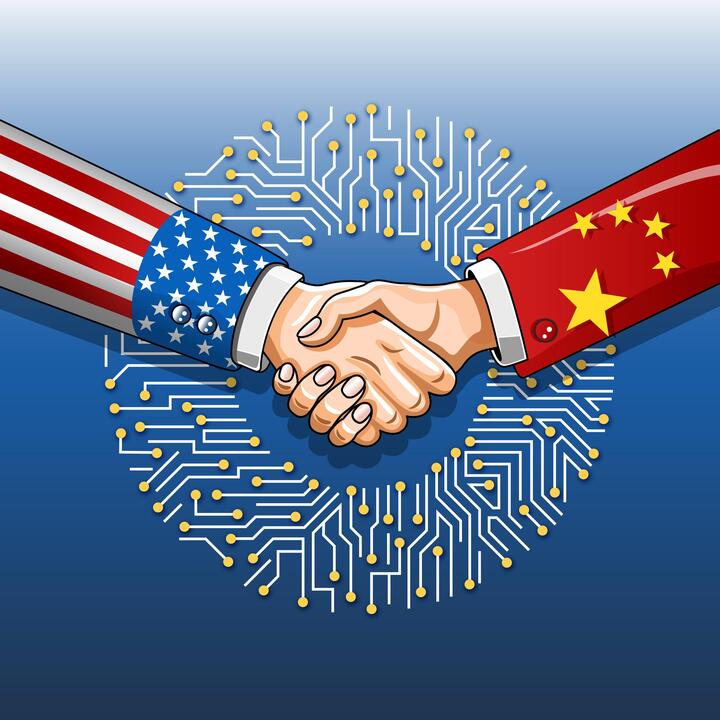
The most dramatic global competition of our era isn’t simply the race between the US and China to dominate artificial intelligence. It is the race to develop safeguards before AI capabilities outrun them.
The US cannot abandon the AI race. Nor should it allow China to set the rules for the world’s most important technology. But Washington and Beijing need to recognise that they face shared risks and vulnerabilities, and act accordingly.
During the Cold War, the US and the Soviet Union were adversaries armed with weapons capable of destroying one another. They didn’t need to trust each other to understand that accidental nuclear war would be catastrophic for both.
Instead, they established hotlines and created protocols intended to prevent miscalculation.
AI now requires a 21st-century version of that arrangement – and the encouraging news is that dialogue has begun. American and Chinese security experts have proposed safeguards that include keeping AI out of nuclear launch decisions, maintaining meaningful human control over critical military systems and establishing a bilateral hotline for AI-related crises.
It’s imperative that, as the two global AI superpowers, Washington and Beijing have ongoing direct communications at the highest level. But the two governments now need to go further, despite challenges and mutual distrust.
The US and China should create a narrow agreement governing only the most powerful frontier AI systems. It should require rigorous testing before deployment for capabilities such as autonomous cyberattacks, biological-weapons assistance and attempts to evade human control. The two countries should agree never to delegate nuclear-launch authority to AI and should establish rapid notification procedures when developers discover capabilities that could pose a catastrophic threat.
In addition, the AI link between the two countries should go to the very top of any administration. China is not an ally any more than the Soviet Union was. That is why such an agreement shouldn’t require sharing models, intellectual property or national security secrets. Nor would it prevent either country from competing vigorously in commercial AI.
What would danger look like? The development of an AI-created bioweapon or unauthorised agentic lab infiltration would require an urgent response, with coordination at the highest level of both governments to contain it.
Most important, we should recognise that AI itself isn’t independent of human control. The most powerful systems depend on physical infrastructure: enormous data centres, electricity, cooling and immense computing capacity.
Whatever system is developed, a bilateral AI arms control accord would also require close coordination between the White House and the heads of American frontier labs, including Anthropic, OpenAI and Google. Beijing, in turn, would have to partner with Chinese AI giants like DeepSeek and Alibaba’s Qwen.
There is a tendency in Washington to view every discussion of AI safety through the lens of competition with China. Beijing likewise suspects that American safety proposals are an attempt to preserve US technological advantage. That is precisely why a narrow bilateral framework is needed now.
The US should race to develop AI. It should race even faster to make sure humanity remains in control of it.
Asha Jadeja is a Silicon Valley venture capitalist.
The Washington Post









Leave a Reply