
Legendary London restaurateur Jeremy King tells an excellent story about a speech he once gave to his employees. “I could replace you all with robots,” he told them. “They’re never late, they’re not constantly surreptitiously looking at their phones, they don’t forget anything, they don’t call in hungover.”
“But I’m not going to,” he continued. “Because they also have no empathy, no instinct, no intuition, and they can’t love.”
Tech promised to remove human friction. But for the elite, friction is often the point: a person who remembers your table, a tailor who insists on three fittings, a hotel where the manager knows your mother’s name, a handwritten note. Platforms and apps were meant to make life seamless, but they also made it anonymous and lonely.
The Cut’s Kathryn Jezer-Morton coined the term “friction-maxxing,” in an article that went viral this year. It means doing things the old-fashioned way and resisting the proliferation of time-saving tech to preserve meaningful human experiences.
For two decades, Silicon Valley has sold us precisely the opposite idea—that the best service is the one requiring almost no personal attention whatsoever. Tap. Swipe. Check yourself in. Order from the QR code. Let the algorithm remember your preferences.
And yet, at the very top end, the trend seems increasingly to be reversing.
If the purpose of dinner were simply to be fed, the best restaurant would be the one that got you out fastest. If the purpose of buying a suit were merely obtaining clothing, three fittings would be terrible service. Luxury deliberately refuses that logic.
Sherry Turkle, M.I.T. professor and author of Artificial Intimacy: Who We Become When We Talk to Machines, sees the return of human friction as inevitable.
“Wealth searches out scarcity,” she says. “When wealth associated hi tech with a new form of attention, they dreamed of robots that would answer their every whim and take them out of the world of needing a lower class of caregivers. It was friction-free, you wouldn’t have to rub up against strangers. Now, as nearly everyone has a 24-hour helper on their phone, a chatbot who will pretend to care, we dream of the truly scarce: human beings who really care.”
At the higher end of the market, it seems, human interaction itself is now a luxury good.
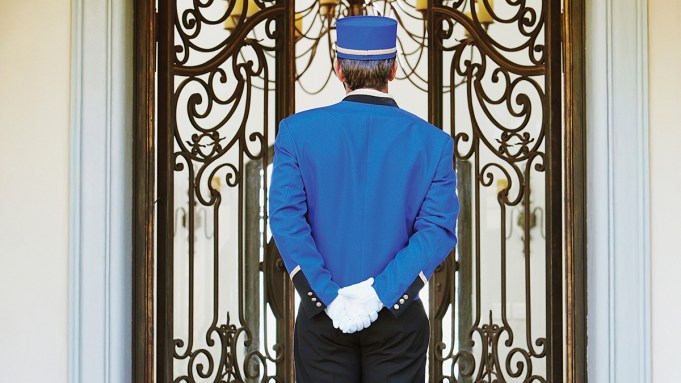
Rory Sutherland, author and president emeritus of Ogilvy Consulting, talks of “the doorman fallacy,” where a hypothetical management consultant, defining the role of the hotel doorman as someone who just opens a door, replaces them with a cost-saving technology implementation. “The only problem with this is that doormen, in reality, create value in all manner of different ways. They hail taxis, they recognize frequent guests, they perform a measure of security, and they exchange important information with other doormen on potentially criminal guests,” he says. “Consequently, the management consultants would often lay claim to the cost savings when they installed the automatic door, but they weren’t around to suffer the consequences.”
What we have witnessed in the past few years is that technology is replacing what are known as weak ties—the casual acquaintances, friendly neighbors, shop assistants, and loose professional networks that provide low-stakes social contact. The problem is that it turns out that these interactions are incredibly important—invaluable, even, to our happiness. The market is beginning to realize that, far from being without value, they are exactly what delivers real luxury.
Marie-Louise Sciò, creative director and C.E.O. of Pellicano Hotels, says that technology has become an important part of hospitality over the past decade, making the guest experience more efficient. “Digital tools have transformed the way we book, communicate, and manage hotels, and they continue to be incredibly valuable—especially behind the scenes,” she says. “However, as technology has become more present, it has also reminded us of the importance of preserving the human side of hospitality…. [It] can support us, but it cannot replace intuition, empathy, or the feeling of being genuinely looked after by another person.”
In a world of endless technical advancement, who could have predicted that the greatest luxury of all would be a pleasant conversation with a human? Maybe the world isn’t going mad after all.






Leave a Reply