
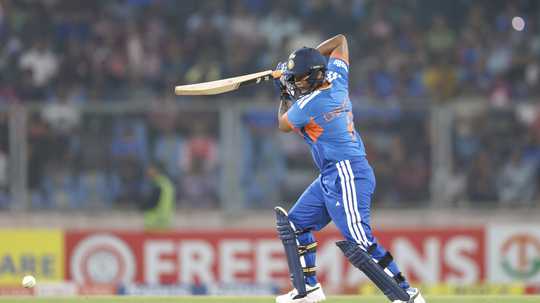
On April 1, 2021, Railways cruised to a comfortable 6-wicket win in their chase of 251 against Bengal to stake a place in the domestic one-day championship final. The win was along predicted lines. The only bright spot in Bengal’s performance was Deepti Sharma’s 148-ball 113 against a fairly strong bowling attack composed fully of international-level bowlers – present and future.
With the ball, Deepti was taken apart for 61 runs from her eight overs without returning a wicket. Yet, the Bengal coach, Charanjeet Singh, knew one thing: it was Deepti, the batter, whose performance had let the team down.
It was a harsh assessment coming in response to a century, but for as long as she was in the middle, he had noticed that she had let pass ample scoring opportunities. An additional 25-30 runs from her could have made the contest more competitive than it turned out to be.
At first, when Charanjeet informed Deepti of his observation, the southpaw was defensive, believing that the Railways bowlers had done well to tie her down. But for the coach, it was just as obvious as it was for opposition bowlers – that Deepti wasn’t able to access scoring opportunities on the off-side well.
Over the next few months, self-realisation also kicked in. Being shuffled in vain in the line-up in the national team, Deepti was undergoing a sort of identity-crisis as a batter then. Not that much had changed in her game, but she was unable to keep her game up with the rapidly progressing standards of batting in women’s cricket at the international level.
Having made her debut as a 17-year-old, Deepti had taken to the demands of international cricket swiftly. In 2017, she even stroked 188 against Ireland – which still stands as an Indian record. Her compact technique, coupled with her ability to deal adeptly with spin, pace and movement, had made her an ideal top-order option. But as the power-game developed rapidly in women’s cricket over the next half-a-decade, Deepti’s limitations with the bat had started to come exposed.
For as talented as Deepti was with the bat, she was a slow starter, a slow runner between the wickets, and someone who lacked a power game. Whether as an opener, a middle-order bat or a finisher, there was an aspect of liability she brought in along with her technical assurance.
The lack of versatility in her gameplay meant that she was shuffled to every position in the line-up from No 1-9 in ODIs, without an emphatic answer as to where she fit in best for the team’s cause. Moreover, the limitations of her batting had started to hurt the Indian team repeatedly, often undoing the quick starts provided by Smriti Mandhana or Shafali Verma.

As talented as Deepti was with the bat, she was a slow starter – one of the aspects that needed addressing. ©Getty
Her running between the wickets had become slower than what it used to be earlier, and as the scoring rate tightened in the middle overs, the other middle order batters were forced to induce a greater element of risk into their game. Many times, the momentum of the innings was lost when she was in the middle.
The absence of a power game rendered her batting largely pointless in the lower order. As she kept getting shoved up and down the order, the best way to utilize Deepti’s batting abilities remained unanswered, and with it, India lost the advantage of adding depth to the line-up, which Deepti offered to the side on paper.
The concerns were alarming, and after a point, she didn’t need an external critic. She had realised the vulnerabilities for herself, and decided to find a fix. Realising the need to level up, she sought Charanjeet’s intervention with a specific request. “Deepti wanted to work on her bat-speed, lifting, pulling the short ball. We worked on that during the COVID-19 pandemic,” Charanjeet reveals of Deepti’s demands when she joined his academy.
There were other areas as well that Charanjeet had identified. “We wanted to work on her off-side game – to play the cut shot, and also hit the ball through the mid-off region.”
Charanjeet has trained Richa Ghosh since she was a 13-year-old. Naturally, he understood a thing or two about the power-game. However, even as Deepti does not possess a similar body-type or natural strength, Charanjeet stuck to the same methods: practise range-hitting with different types of balls – hockey balls, tennis balls, etc.
The logic to this bizarre exercise, he explains, was to prepare her for all the variations that may come her way. “Playing with the hockey ball helps improve ball speed. If it doesn’t come timely off the bat, and you’re not in shape, it shows up more drastically. In a match, bowlers can vary their pace; some balls can come in slowly, while some others might come faster. So my aim is to get them to hit it for a six, irrespective of the pace or the bounce – and negate the element of surprise of variations.”
Irrespective of whether it is Deepti or Richa, the core philosophy of that training is to ensure a superior hand-eye co-ordination without feet movement, while maintaining balance and bat swing.
He has employed a similar method to improve Deepti’s accuracy as a bowler as well; getting her to bowl with balls of different sizes and weights, including stones. One of his drills includes getting Deepti to bowl through the gap of a tyre. “One aspect of that was to ensure that she developed the skill and the accuracy, but more importantly, it also helps build the confidence that she can get the job done irrespective of what she bowls with.”
Whether the training methods helped or not, it certainly started showing results.
In ODIs – Before June 2022 vs Since June 2022
| M | R | AVG | SR | W | AVG | ECO | |
|---|---|---|---|---|---|---|---|
| Before June 2022 | 74 | 1783 | 31.25 | 64.9 | 81 | 4.20 | |
| Since June 2022 | 50 | 989 | 24.30 | 83.53 | 85 | 4.79 |
In T20Is – Before June 2022 vs Since June 2022
| M | R | AVG | SR | W | AVG | ECO | |
|---|---|---|---|---|---|---|---|
| Before June 2022 | 58 | 498 | 20.86 | 90.21 | 60 | 6.13 | |
| Since June 2022 | 100 | 857 | 17.09 | 121.90 | 129 | 6.24 |
Even as Deepti herself has credited Charanjeet’s methods for her improvement as an all-rounder, Charanjeet admits that the growth is down to Deepti’s hunger to improve. “Her biggest strength is that she doesn’t give up,” Charanjeet says. “She wants to win all the matches, and has a drive to constantly develop. She loves taking challenges – whether it’s with batting or bowling. She’s not the one to ever say I’m tired and will keep practising.

Funky training methods were extended to Deepti’s bowling as well ©Getty
“Even with her fielding. She trains even when it’s raining. She will spread out a plastic sheet and practise on that so that she doesn’t get hurt even if she slips. She can go to any extent to improve as a cricketer.”
Even with the national team, Deepti is among the last to leave the nets, rolling her arms well after the rest of her teammates and support staff are ready to leave, often becoming the go-to operator against head coach Amol Muzumdar’s late batting warm-ups.
However, even after five years of working on her power-game game, Deepti is far from a finished product as a modern-day batter. Now slotted usually at No. 7, in the role of a power-hitter, she is far from the most dangerous lower-order basher in the world. Nonetheless, her effectiveness in that position and role have drastically improved.
Same is the case with her off-side game. Improved but still holding limitations. It’s far from where she would want to be, or where the Indian team would truly be able to cherish her value. The ceiling is much higher, as evidenced from her critical performances that come up every now and then for India and UP Warriorz.
Charanjeet doesn’t shy away from that admission, and believes that her development as a batter is still work-in-progress. “While playing, you tend to make minor mistakes. When you keep tracking those minor flaws, it goes a long way,” he says. “Sometimes, her arm speed tends to fall while bowling. But when I notice that on television, I bring that to her notice.
“Same is the case with her batting. Her stance tends to change every now and then. Sometimes she crouches a bit low, sometimes her bat is a bit far away from her body. She still needs more repetitions for those shots so that her muscles get into a habit that’s required for the bat swing.”
However, for a player who has owned up to her flaws, and is ever-willing to put in the hard yards, he isn’t a coach too worried about his ward.




Leave a Reply