
Agentic AI is one of the most talked-about topics in healthcare. The question is: “What’s it doing in trials today?”
Over the past few months, the agentic AI conversations in clinical trials have shifted from possibility-oriented to proof-oriented. This shift is driven, in part, by promising early deployments in real trials.
In fact, agentic AI has moved from concept to deployment faster than most of the industry expected, with Gartner projecting that a third of enterprise applications will include agentic capabilities by 2028.
How we got here
Clinical development has always run on human coordination, with nearly half of budgets going to site management, personnel, and recruitment.
Over the past two decades, EDC and eCOA digitized trial data capture. Automation and machine learning then took on rule-based tasks, and, more recently, generative AI began drafting documents, summaries, and other content.
Yet, despite all this, the execution still fell to human beings.
Agentic AI is the next step in that evolution. Because AI agents can reason, adapt, and act within workflows and across multiple systems, they can drastically reduce how much of that coordination requires a person.
An early agentic example
Risk-based monitoring (RBM) clearly shows agentic AI in action.
In RBM, clinical research associates (CRAs) often say they want to spend their time on oversight and judgment, not administrative work. In reality, 40-60% of CRA time goes to administrative work across 13 or more disconnected systems. They constantly jump between systems, stitch data sets together, hunt for outliers, and pull together preliminary visit reports.
Simply put, agentic AI takes that work off their plates. In fact, the first use cases coming back from clinical trials show how.
A top global pharmaceutical sponsor and a contract research organization (CRO) each explored whether agentic AI could improve operational efficiency. Both started with clinical monitoring, seeking a partner that understood how Clinical Research Associates (CRAs) work and could build AI around real workflows.
Real results from real deployments
Like many sponsors and CROs, both organizations faced growing pressure to improve monitoring efficiency without compromising quality or compliance. Rather than automating isolated tasks, they designed deployments around the end-to-end workflows their CRAs perform, including preparing for remote monitoring visits, reviewing data, identifying issues, and prioritizing actions. CRAs stayed in control throughout: the agent flagged risks and recommended next actions, but every action required human approval and was captured in a full audit trail.
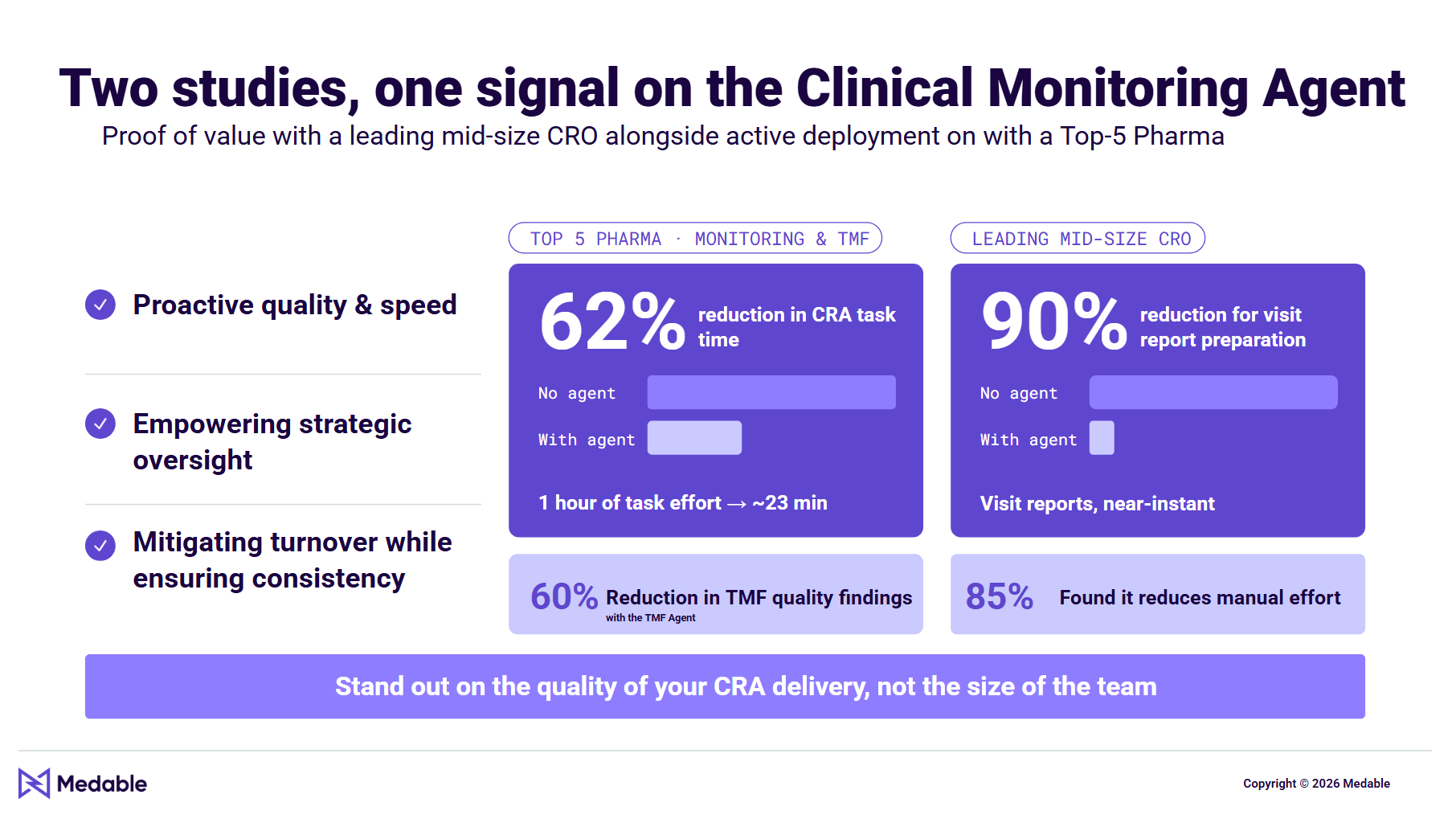
For the sponsor, CRA task time fell 62%, and a one-hour review dropped to 23 minutes. Every surveyed user was satisfied or very satisfied, and 93% said they would use the agent weekly.
For the CRO, trip report preparation and writing time fell 90%, and overall CRA task time fell 59%.
While each organization measured a slightly different mix of tasks, overall efficiency gains landed within a few points of one another, reinforcing that these results reflect a consistent, repeatable pattern of impact rather than a single favorable data point.
The important step: Making a roadmap
Neither organization started by building. Both started by listening: each held workshops with CRAs and clinical operations teams, then refined the agent’s use case and roadmap together. The work followed three phases:
● Discover: Map each organization’s operational needs and pain points with the CRAs and clinical operations teams who live them every day.
● Define: Agree on a shared vision of what success looks like, including a structured plan for evaluation, iteration, and rollout.
● Design and iterate: Run continuous design sessions, refine the agent based on real user feedback, and iterate quickly before production evaluation, keeping the agent easy to use and focused on augmenting existing clinical teams.
The foundation for the future is here
As agents absorb operational work, the human role increasingly shifts from operator to orchestrator. A CRA who once owned source data verification, query management, and site-staff training across a handful of sites can extend that oversight across many more, spending more time on judgment, site relationships, and patient safety.
Those looking to start don’t need an enterprise-wide strategy. Instead, they can start with one workflow where their team loses the most time to coordination, such as visit reports or data review. Next, they can sit down with the people who do that work and map where it hurts. Lastly, they must define what success looks like before building anything and decide who will own the agent once it’s live.
These steps are exactly what early adopters have done, and they’re what’s driven them to success.














Leave a Reply