
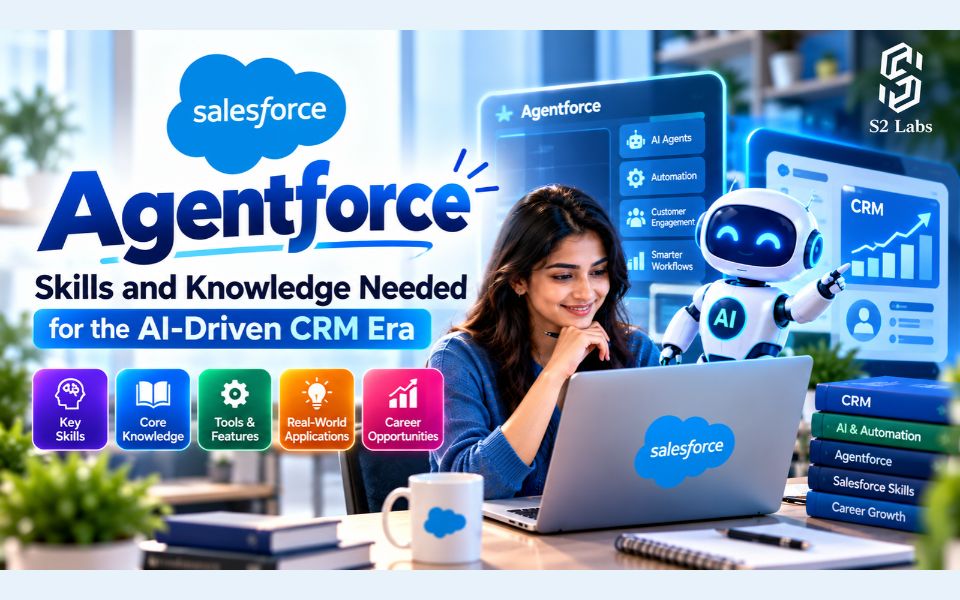
Artificial intelligence is changing how businesses manage customer relationships, automate processes, and deliver personalized experiences. Salesforce Agentforce is part of this shift, enabling organizations to build AI agents that can understand requests, work with business data, and perform tasks within defined workflows.
As companies explore AI-powered CRM solutions, professionals need to understand more than traditional Salesforce administration and development. They must also learn how AI agents interact with customer data, business rules, automation tools, and existing Salesforce applications.
Developing the right combination of Salesforce knowledge, technical skills, and AI awareness can help professionals prepare for the evolving CRM ecosystem.
What Is Salesforce Agentforce?
Salesforce Agentforce is a platform for building and deploying AI agents that can support customer service, sales, and other business operations. These agents can respond to requests, retrieve relevant information, and take actions using configured instructions, available data, and connected Salesforce capabilities.
Unlike conventional automation that follows predefined rules, AI agents can use large language models and contextual information to determine appropriate actions within their permitted scope. Their behavior still depends on the quality of their configuration, available data, permissions, and safeguards.
For Salesforce professionals, understanding Agentforce means learning how AI capabilities fit into existing CRM processes and how to configure them responsibly.
Essential Skills Needed for Salesforce Agentforce
1. Strong Salesforce Platform Fundamentals
A solid understanding of the Salesforce platform is the starting point for working with Agentforce. Professionals should understand objects, fields, records, relationships, user permissions, and the Salesforce data model.
Knowledge of Salesforce security is equally important. AI agents may interact with customer information or business records, so developers and administrators must understand profiles, permission sets, sharing rules, and access controls.
These fundamentals help professionals build AI solutions that work within an organization’s existing security and operational requirements.
2. Understanding Prompt Design and Instructions
AI agents rely on clear instructions to interpret requests and determine how to respond. Professionals should learn how to define an agent’s role, responsibilities, boundaries, and expected outcomes.
Effective instructions should explain what an agent can do, which actions it should avoid, and when it should ask for additional information or escalate a request to a human.
Testing instructions against different scenarios is also important. Clear, specific instructions can improve consistency and reduce misunderstandings during customer interactions.
3. Salesforce Flow and Automation
Salesforce Flow is an important skill for professionals working with Agentforce because it supports business process automation and can provide structured actions for AI-driven workflows.
Professionals should understand how to create flows, define entry conditions, manage variables, handle errors, and work with records. They should also know how to test automation before connecting it to an AI agent.
Combining conversational AI with established automation can help organizations streamline repetitive tasks while maintaining control over important business processes.
4. Data Management and Data Cloud Knowledge
AI agents need relevant and reliable information to produce useful results. Poor data quality, incomplete records, or inconsistent information can affect the usefulness of AI-powered interactions.
Salesforce professionals should understand data quality, data relationships, access permissions, and the importance of maintaining accurate CRM records. Familiarity with Salesforce Data Cloud can also help professionals understand how data from different sources can support more contextual customer experiences.
The goal is to make relevant information available to the agent while respecting privacy and access restrictions.
5. Basic Apex and API Knowledge
Not every Agentforce implementation requires advanced coding, but technical knowledge can help professionals handle more complex requirements.
Salesforce developers should understand Apex fundamentals, SOQL, REST APIs, and integrations. These skills can support custom business logic, connections with external applications, and solutions that extend standard platform capabilities.
Knowing when to use declarative tools and when custom development is necessary is an important part of designing maintainable Salesforce solutions.
6. Testing, Monitoring, and Responsible AI
Building an AI agent is only one part of implementation. Professionals must also evaluate its responses, validate actions, and monitor its behavior in different situations.
Testing should cover normal requests, unexpected inputs, permission restrictions, incorrect data, and situations requiring human intervention. Teams should also review access controls, sensitive information handling, and the potential consequences of automated actions.
Human oversight remains important, especially when an agent performs actions that affect customers, financial records, or critical business workflows.
How to Start Learning Salesforce Agentforce
Beginners can start by learning Salesforce fundamentals, including data modeling, security, and basic administration. Next, they can practice Salesforce Flow and explore how AI agents use instructions, data, and configured actions.
Working on small projects is a useful way to connect these concepts. For example, a learner could design a customer inquiry agent that retrieves approved information, categorizes requests, and routes complex cases to a support representative.
After building the initial solution, learners should test different scenarios, review permissions, document limitations, and improve the configuration based on results.
Structured learning and hands-on practice can help professionals understand how Agentforce works beyond its basic features.
Conclusion
Salesforce Agentforce is creating new opportunities to combine CRM knowledge, automation, data management, and artificial intelligence. Professionals who develop these skills can better understand how AI agents fit into business workflows and how to build solutions that remain secure, reliable, and useful.
A strong foundation in Salesforce, combined with practical experience in Flow, prompt design, data management, and testing, provides a useful starting point for exploring AI-driven CRM development.
To build these skills, explore Salesforce Agentforce Training and strengthen your understanding through guided learning and hands-on practice.












Leave a Reply