
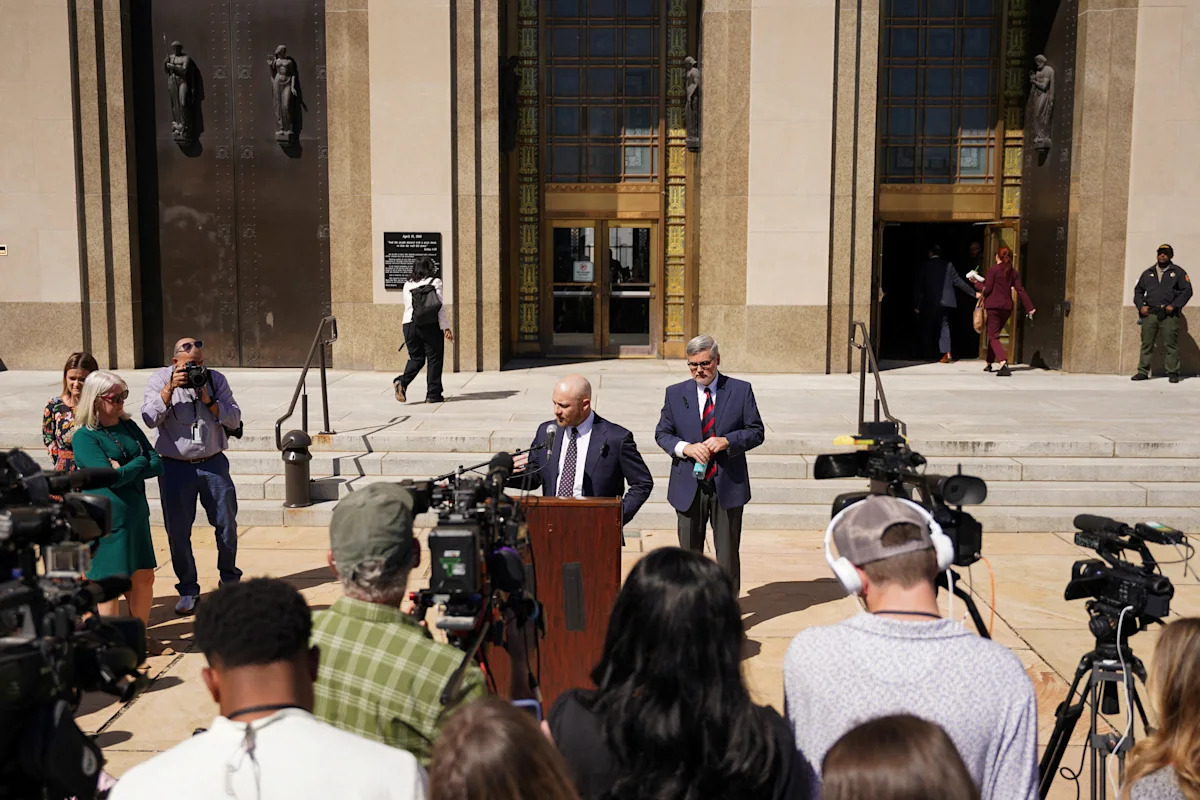
Do Americans have a First Amendment right to watch or know how executions are conducted? A botched execution in Tennessee in late September and the Trump administration’s initial push in October to livestream an execution by military firing squad have thrust the issue into the spotlight.
Just over half of U.S. states allow the death penalty, though only 14 have carried them out since 2019, according to the Brennan Center for Justice’s State Court Report. Experts told USA TODAY the rules surrounding executions – who can witness them and what information can be publicly disclosed, for example – vary by state.
They said the government ultimately has extensive control over what information leaves prison walls and expressed concern that state secrecy impacts both the condemned and the public at large.
“Executions are the most severe and final criminal punishment that’s available, so there’s a strong public interest in overseeing how that’s carried out,” Reporters Committee for Freedom of the Press senior staff attorney Lin Weeks said.
Government granted more control over execution access, info over time
Pentagon chief Pete Hegseth announced in October that former Army Maj. Nidal Malik Hasan, convicted in 2013 of murdering more than a dozen people in a mass shooting at a military base, would be executed by firing squad in December in the first military execution in more than 60 years. Hegseth also said the military planned to livestream the execution, though President Donald Trump later reversed the decision.
The notion of a livestreamed military execution is reminiscent of the public spectacles that executions once were before officials took them behind closed doors in the 19th century. The Lincoln assassination conspirators, for instance, were publicly hanged in 1865.
In modern times, journalists are meant to “serve as the public’s eyes and ears” by witnessing and reporting on the more private proceedings, according to Corinna Lain, a University of Richmond law professor and author of “Secrets of the Killing State: The Untold Story of Lethal Injection.”
States began using lethal injection in the second half of the 20th century, and it has since become the most common execution method. That shift has “brought a tidal wave of secrecy” to the process, Lain said.
Each state that administers capital punishment has its own protocol, which may outline approved execution methods and the number of witnesses present, including if and to what extent the news media can participate.
Pentobarbital is used in executions. So why was Christa Pike’s execution botched?
Courts have issued conflicting rulings on such access, with some granting the government more control and others mandating additional public accessibility.
An appeals court ruled in 1977 that a reporter did not have a First Amendment right to record and potentially broadcast an execution in Texas, saying that the First Amendment “does not accompany the press where the public may not go.”
On the other hand, an appeals court ruled against Arizona officials in 2019, saying witnesses have a First Amendment right to hear the execution process and that the state’s restrictions “impermissibly burden that right.” At the same time, the court said there is no First Amendment right of access to certain information, such as the drugs used in the process or the personnel involved.
Indiana and Wyoming do not allow media witnesses, though journalists in Indiana may attend if the inmate invites them. Lain said such restrictions “clearly impede the freedom of the press.”
“It inevitably burdens the public’s right to know whether the state is torturing prisoners in their name,” she said.
A coalition of news organizations sued over Indiana’s restrictions in 2025. Both a district and appeals court upheld the state’s ban.
The appeals court’s June opinion said “allowing uninvited strangers with no immediate connection to the underlying crime to watch a prisoner die risks offending the dignity of their final moments.” The appeals court also said it was a “fair and compelling” argument that public oversight “may lead to more humane and competently administered executions.”
Clashes between state, media reports
Advocacy groups and news outlets are among those that have called for more government transparency when it comes to executions.
Death Penalty Information Center Executive Director Robin Maher referenced the taxpayer funding behind executions in an interview with USA TODAY, saying that the public is therefore “owed a duty of honesty and transparency and accountability.”
“This is the greatest use of government power and authority that there is, to take the life of another human being,” she said.
Lain similarly described media witnesses as a vital presence, considering that executions are when “the state is at its powerful moment, but also because there are proven instances where the state has not been truthful about what has happened in an execution.”
In 2021, the Oklahoma Department of Corrections initially described the execution of John Marion Grant as “without complication,” while media witnesses reported that he convulsed and vomited. Then-Corrections Director Scott Crow later called those accounts “embellished.”
No media witnesses were present when Texas executed Quintin Jones earlier that year, though state officials characterized the incident as an error.
Pursuant to Tennessee law, there were seven media witnesses at the botched execution of Christa Pike, a Tennessee woman convicted in the 1995 killing of Colleen Slemmer, in late September. They reported that officials closed the curtains to the death chamber around 20 minutes after Pike delivered her final words. During that period, she constantly kicked her feet and described feeling like her arm was “about to burst open.” The curtains were opened after several minutes but closed again shortly after.
Media witnesses said they could still hear Pike snoring and breathing for nearly an hour longer, at which point they were asked to leave the area. Pike was taken to a hospital in critical condition and remained unconscious for several days, after which point she returned to the prison to receive further medical care.
Her case, according to experts, demonstrates the need for greater transparency.
“I do think that the public understands now better than maybe it did a few weeks ago how the secrecy and the silence of officials is related to the botched executions, like the one we saw with Christa Pike,” Maher said. “I would hope that there will be more public pressure on officials to be more forthcoming.”
BrieAnna Frank’s role covering First Amendment issues at USA TODAY is made possible by a collaboration among Freedom Forum, Journalism Funding Partners and the USA TODAY Network. Freedom Forum does not provide editorial input. Reach BrieAnna at bjfrank@usatoday.com and @brieannafrank on X and Bluesky.
This article originally appeared on USA TODAY: Execution secrecy tests the public’s First Amendment rights




Leave a Reply