WASHINGTON — Republicans are aggressively touting a popular provision in their sweeping SAVE America Act to overhaul elections nationwide: requiring photo identification to vote.
It’s a policy long opposed by Democrats in Congress, who liken it to nefarious Jim Crow-era laws aimed at preventing African Americans from voting.
But that message is increasingly falling flat with the American public, including Black voters, as photo IDs are increasingly required for common activities, like flying.
A Pew Research Center poll in August tested a variety of election rules and found that 83% of U.S. adults support “requiring all voters to show government-issued photo identification to vote,” while 16% oppose it. That’s up from 77% support in a 2012 Pew poll.
Support now includes 71% of self-identified Democrats, 83% of independents and 76% of Black voters.
“It kind of feels like the only Americans not to support voter ID requirements are Democrats here in Congress,” Senate Majority Leader John Thune, R-S.D., said on the floor.
NBC News asked more than two dozen Democratic lawmakers whether they would accept some kind of photo ID rule to vote. Just one voiced openness to it: Sen. John Fetterman, D-Pa.
“If they really want to have a real conversation, and if they align it that 83% of Americans support showing basic ID — you know, I’m not going to tell 83% of Americans that they’re crazy, or they’re trying to suppress votes, or they’re Jim Crow,” Fetterman told NBC News. “I’m not going to describe people like that.”
But even Fetterman said he’ll oppose the SAVE America Act as written, citing other provisions in the sprawling bill.
While Republicans have focused on the popularity of the voter ID provision, Democrats note that the SAVE America Act would also require proof of citizenship — a passport or birth certificate — to register, a much higher burden of proof than photo ID. President Donald Trump has also called for it to be amended to include major new restrictions on mail-in voting and provisions against trans athletes and gender-affirming surgeries for minors.
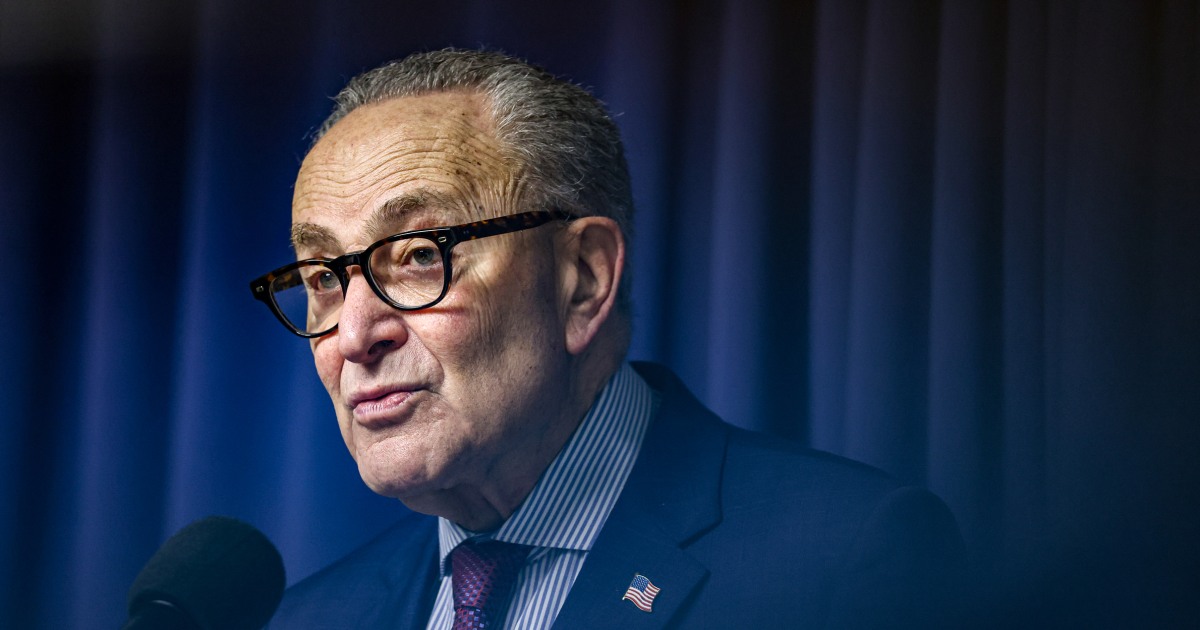
“The SAVE Act is nothing more than Jim Crow 2.0. It could disenfranchise millions of American citizens,” Senate Minority Leader Chuck Schumer, D-N.Y., said last week.
Citing the Pew poll, Thune said that likening it to Jim Crow “insults the overwhelming majority of Americans — including minorities — who look at voter ID and see nothing more than common sense.”
On a press call on Saturday, Schumer pivoted to other provisions in the SAVE America Act when asked about the popular photo ID proposal, namely one that would empower the Department of Homeland Security to screen states’ voter rolls and flag suspected noncitizens for disqualification.
“This is not a voter ID bill,” the Democratic leader said. “This is about purging the voter rolls in a massive way, so you never even get the chance to show a voter ID when you showed up to vote because you’d be knocked off the rolls.”
Former Senate Democratic aide Tré Easton said there’s a viable compromise on voter ID that his party should be open to.
“I think Democrats should absolutely embrace a form of voter identification. I get why it’s been such a boogeyman, and the way it’s implemented matters,” said Easton, who is now vice president for public policy at Searchlight Institute, a think tank that aims to expand the Democratic Party’s appeal.
As one possibility, he floated “a national ID card” tied to Social Security or another federal program, which he said could serve as “a one-stop shop for all your business with the government.”
He added, “States would obviously handle individual voter registration, but having a national ID card is not unheard of.”
Still, for most Democratic lawmakers and the outside experts they trust, the GOP push is a solution in search of a problem. Noncitizen voting in federal elections is already illegal and extremely rare, according to an analysis by the liberal Brennan Center of a database produced by the conservative Heritage Foundation.
“There’s no one ID that I think is being advanced at this point that is universally possessed by enough Americans to make that a mandatory requirement in each state,” said Janai Nelson, the president of the NAACP Legal Defense Fund, suggesting alternate ways to verify voters, like signature verification.
Brookings Institution senior fellow Norm Eisen added on the same Schumer-led call, “There’s no need for this bill. It would hugely burden voters, election officials, and everybody else. It is not a voter ID bill, and there is no voter ID problem.”
Sen. Angus King, a centrist independent from Maine who caucuses with Democrats, responded with a flat “no” when asked if any kind of nationwide photo ID mandate for voting would be acceptable to him.
“We don’t have it in Maine. Here’s what we have in Maine: We have Election Day registration, no voter ID, unlimited absentee voting by mail and drop boxes,” King said, citing studies that show voter fraud is statistically negligible. “The old saying in Maine is: If it ain’t broke, don’t fix it.”
Other Democrats said they take issue not with the concept of voter ID, but rather the way Republicans are trying to do it.
“You should have to prove that you are who you say you are when you vote. I’ve never opposed that,” said Sen. Raphael Warnock, D-Ga. “But they use voter identification as a pretext for determining the electorate that they think will keep them in power. That’s why, for example, a student ID is not good enough, but a military ID is. So, I can tell you, as someone who ran in Georgia and saw what they tried to do with my runoff, that there’s some people that they don’t want to vote.”
Rep. Brad Schneider, D-Ill., chair of the moderate New Democrat Coalition, stopped short of backing any nationwide photo ID requirements to vote. He said that “what the Republicans are trying to do is not what they’re saying they’re trying to do.”
The SAVE America Act would “by intention and design, seek to disenfranchise, in many cases, the 80% of women when they get married change their name, and 5% of men get married change their name,” Schneider said. “Folks who, for whatever reason, might change their name, change their gender identity.”
Opponents of the bill note that a person’s birth certificate or passport may not match their married last name, and it can be costly and time-consuming to get those documents updated.
“It’s targeting people to make it harder to vote,” Schneider said. “In addition, that bill required every state to turn over the voter rolls to the federal government.”
Rep. Marc Veasey, D-Texas, said he witnessed Texas Republicans in the state Legislature trying to craft ID rules to rig the electorate — for instance, by allowing handgun licenses but not state-issued ID from the University of Texas to register to vote.
“We don’t want for Republicans to try to game the system by looking for ways to exclude people,” Veasey said. “Because of the legacy of Jim Crow and segregation, there are many places where I live in Texas, and in other parts of the South where, you know, someone’s birth may have been recorded inside of a family Bible, or they may have been born by midwife. They may not been able to have been born inside of the county hospital.”
“Most people are just going to give up,” he said. “They’re not going to go through those steps. They’re just going to say: ‘Forget it, I just can’t vote because I was born during the time of segregation and there was no person there to record my birth.’”