Writing, speaking, and acting from clarity and alignment – not just strategy
We often treat storytelling as a communication skill.
Something you learn, to be able to persuade better. Pitch better. Market better.
But … where do you think storytelling originated?
In this article, I’m going to share with you the most important, foundational aspects of Storytelling which I’ve found, tested, learned, and developed over the course of my career, which has been focused on Storytelling & Identity for the past 14 years.
I’ve trained, taught, coached, guided, and overall helped literal thousands of people become better Storytellers – from direct writing training, to coaching, brand narrative consulting, to my hundreds of articles, courses, books and e-books, and even to my Storytelling methods being infused in Storylab.ai’s storytelling and content marketing tools.
A question that inspired much of my deepening work on storytelling these past few years, and that resonates throughout the story you’re about to read:
What if we changed the way we write, tell, and live our stories?
You will see that this is not only handy, but necessary – to make sure we reach the clarity and growth we’re actually looking for, when we’re talking about “better storytelling”.
Now. First off:
Chapters
Why is it important we get better at Storytelling now?
We now live in a time when words are cheap.
Content can be generated easily, endlessly.
AI can produce passable, even good narratives, in seconds.
What that means is: The scarce resource is no longer the ability to produce text.
It’s no longer about who can come up with the constellation of words that sounds the most coherent, that flows the best, or that sounds most convincing on the surface.
And if we don’t upgrade our understanding of and capacity for Storytelling, we’re going to end up left behind. And I don’t mean left behind, as in ‘behind our competitors, in business’. I mean across a vast scope of fundamental areas of life, both personal and professional.
Spiritual, even. Yes, I said it and I meant it.
Which would be such a shame, because Storytelling is such a fundamental human capacity – it’s only natural for us all, to do, in some way or another. I promise.
And yes, if used properly, it can still get you all of those business, professional, financial gains you’re probably at least partially here for.
Where to begin? Well first, let’s start with some necessary debunking.
Wait, what do we actually mean when we say “Storytelling”?
People seem to see ‘Story’ and ‘Storytelling’ as something like; ‘Organizing words in some order that provokes the image of a sequence of events, with a certain tension built in, to elicit some emotional response’.
And then they use it as such in places where a Story needs to be more, as it is related to Identity, Direction, and Transformation.
Story can not function in these realms, because it is not aligned with the things with which it needs to be aligned, nor is it approached, developed, and embodied in the way that it should.
- This is why burnout-prevention and leadership-improvement programs fail.
- This is why rebrands, digital transformation projects, and AI pilots stall or backfire.
- This is why growth feels harder at the exact moment resources or demand increase.
As within, so without; as in business, so in life.
So;
What if we changed the way we write and tell stories?
Storytelling did not originate in marketing departments.
Nor in Hollywood writing rooms.
Not even in ancient religious texts.
It originated around fires, on hunting trips and campaigns; in market squares and weaponsmiths’ workshops, in shared work and shared risk – as a way for humans to make sense of what was happening, decide what mattered, and coordinate what to do next.
And, importantly, for humans to enjoy that sensemaking process.
Transformational Storytelling: a narrative sensemaking process for growth
Here’s what I have come to see, and believe:
Transformation is not a one-time reinvention. Neither is Storytelling. Or Identity. Life. Growth. Love. Even Light. There is a rhythm underlying all of them. We see different results when we work with that rhythm, not despite it.
Storytelling works when we align our internal shifts, and our internal rhythms, with the rhythmic re-imagining, re-embodying, and re-emerging of our story. Again and again.
Big misconception:
We tend to think of storytelling as something external.
Something we do after the fact. Something we shape for others.
A narrative layer applied to life, business, identity, or brand.
That’s not what I mean when I talk about Transformational Storytelling.
This is the method for narrative sensemaking in areas such as brand, leadership, or personal or business growth which I have developed over the years, and that aligns with the ways of working I see some others also apply, which seem to do the same key things, under different wordings and frameworks.
Here’s what I do mean by that term:
Before storytelling is expression, it is orientation.
It helps us answer three simple, ancient questions:
- What is going on here?
- Why does it matter to us?
- What should we do now?
When a story works, it aligns those answers – within ourselves first, and then between us and other people.
Story as a living practice, not a finished artifact
Here’s another crucial shift:
Transformational Storytelling has no final endpoint.
It doesn’t land in:
- A one-off workshop.
- A completed document.
- A finished brand story.
- A fixed identity statement.
It is a circular, ongoing, embodied practice.
You tell a story. You live it.
Reality responds.
You reflect.
You revise.
This continuous loop (oh, yes, because the final step indeed sets you up to go back to step 1) applies to:
- Personal identity.
- Leadership development.
- Cultural evolution.
- Brand and content strategy.
- Thought leadership.
The mantra stays the same: Re-imagine, re-embody, re-emerge. Begin again.
When story, identity, and action align, growth stops being erratic, or performative.
It becomes inevitable.
So; what happens if we stop treating stories as static outputs — and start treating them as living feedback systems?
- Growth becomes adaptive instead of brittle.
- Strategy becomes responsive instead of rigid.
- Identity becomes something you participate in, not something you defend.
This is why the name matters.
Transformation is not a destination.
It is motion.
Well then, how do we craft, build, tell, and even live, a story that works? On the basis of what structures, principles, and insights do we keep updating them? I could not be more happy you asked. Let’s dive into it.
Storytelling is not about saying more; it’s about seeing clearly

Start here:
Most weak storytelling is not caused by poor wording.
It’s caused by unclear thinking.
We try to communicate before we’ve understood.
We try to convince before we’ve made sense of things ourselves.
That’s why so many messages sound polished but feel hollow.
They are constructed outwardly, without being grounded inwardly.
A strong story, by contrast, feels less like something invented and more like something recognized.
You don’t feel pushed into it.
You feel oriented by it.
The purpose of storytelling is alignment
A useful way to think about storytelling is not as “sending a message,” but as aligning three elements:
- What you are trying to do, and why.
- What others are experiencing or needing.
- A direction that makes sense for both.
When those line up, action becomes easier. People don’t need to be forced. They understand where they are, and where they could go. This is true whether you are leading (yourself or) a team, explaining a strategy, writing an article, or raising a fund.
The domain changes.
The mechanism doesn’t.
The five human principles of a story that works
Over the years, I’ve found that good stories – whether told in conversation, writing, or strategy – consistently rest on five very human foundations.
1. Clarity Creates Trust
If something cannot be explained simply, people assume it is not fully understood.
In many ways, I feel that assumption is generally correct. Even when speaking about the most complex of subjects.
Case in point:
Think of the deepest, most intricately complex subject you know. Perhaps quantum physics. Or something within the realm of psychology, or philosophy.
Growth Strategy for a SaaS start-up or scale-up. The psychology of human relationships.
What do the top-most experts in these fields do so incredibly well?
They are able to explain what is immeasurably complex in such a way that a reasonably smart 12-year-old can understand it. Because they understand their field and subject so well, and they understand the different level of understanding their audience may have – and they understand how to translate between those two.
Clarity is not dumbing things down.
It is disciplined thinking, expressed without unnecessary noise.
A clear story tells people:
You can rely on this. It has been thought through. Lived, breathed, and felt through.
2. Emotion Creates Memory
This is a point that I and many, many others involved in storytelling and the teaching thereof, have made over and over again – and yet one that is worth pausing at, once again.
People rarely remember information.
They remember what something meant to them.
Emotion is not decoration added on top of a message.
It is how the brain decides what is worth keeping.
And this goes for both the writer and teller, and the audience of the story.
If a story doesn’t carry some felt significance – curiosity, relief, concern, excitement – it passes through without leaving a trace.
3. Tension Creates Attention
Connection to the necessity of emotion, is tension. A story isn’t a story without it.
Every meaningful story contains movement.
- Something is at stake.
- Something is not working yet.
- Something could change. Or should. Or both.
Without tension, there is no reason to listen.
There is only description.
Be mindful of the following: Tension is not drama. It is relevance.
4. Novelty Creates Insight
This does not mean that you have to dazzle your audience with a shiny new way of telling your story. Or to bombard them with new facts, data, insights. It means simply this:
A story must offer a new angle, even on familiar ground.
It might not present new data.
But it must help people see something differently.
Otherwise, you are repeating knowledge, not creating understanding.
5. Direction Creates Action
Stories exist because humans need to decide what to do next.
Read that again. Or read the first few passages of this article again. What did we say storytelling actually is? Before it’s a pitch, a blog article, an ad campaign, or even a movie script: Storytelling is a way for humans to make sense of what is happening, why that matters to us, and what to do next.
A story that doesn’t change perception, behavior, or at least intention may be interesting – but it is incomplete.
Ask yourself this: what were the movies that you saw over the course of your lifetime, that stuck with you?
The best stories don’t just describe reality.
They help shape what follows.
Now, next to the five principles, there are a few key points to keep in mind always when crafting or telling a story. Structure – and smart ways to get the best structure for your goals and audience – is important, and we’ll cover it in a second. But first;
A very, very often very, very much underrated aspect of good Storytelling:
Listening is half the craft (and often the missing half)

We tend to associate storytelling with speaking or writing.
But better storytelling usually begins with better listening.
To situations.
To people.
To patterns that are already there.
One practical approach I’ve used for years is simple:
Ask. Listen. Summarize. Delve deeper.
Ask questions.
Listen without preparing your reply.
Reflect back what you think you heard.
Then explore further.
This does two things:
It improves understanding – which, as we’ve covered above, generates the clarity we need.
And it makes the eventual story grounded in shared reality, not assumption.
You can not tell a meaningful story about something you have not truly paid attention to.
You can’t tell a story that will mean something to a person, whom you have not paid the necessary attention to, either.
Structure is foundational – but structure itself, is not the story
Over the years, I’ve researched, seen and tried literal dozens of frameworks for storytelling and writing. The ‘Why, How, What’; the ‘Problem, Solution, Result’, and the ‘Hero’s Journey’ being the most useful ones I’ve found.
Structure is super important. And a framework for structure can guide you, act as your scaffolding, and at the same time give you limits that help inform you on what not to include in your story – equally as important as what you do say.
Recently, I heard someone say;
“What I’ve come to learn is that you actually say a lot with what you choose not to say.
It’s like painting with negative space. The silence, or negative space –
It often conveys a lot of the meaning or message.
Sometimes even more than the space that we do fill out.”
And I found it so true it found its place in this article. Despite my strict editing rules.
Frameworks are useful.
Beginnings, middles, and ends are useful.
Clear sequences like need → solution → result are useful.
They keep us from rambling.
They make stories easier to follow.
But structure is scaffolding. As powerful, useful, and foundational as scaffolding, and at the same time just as even the best scaffolding in the world; it can never be at the core.
You can build a perfectly structured narrative that still feels empty if it lacks lived experience, honest stakes, or genuine intent.
Structure organizes meaning.
It does not create it.
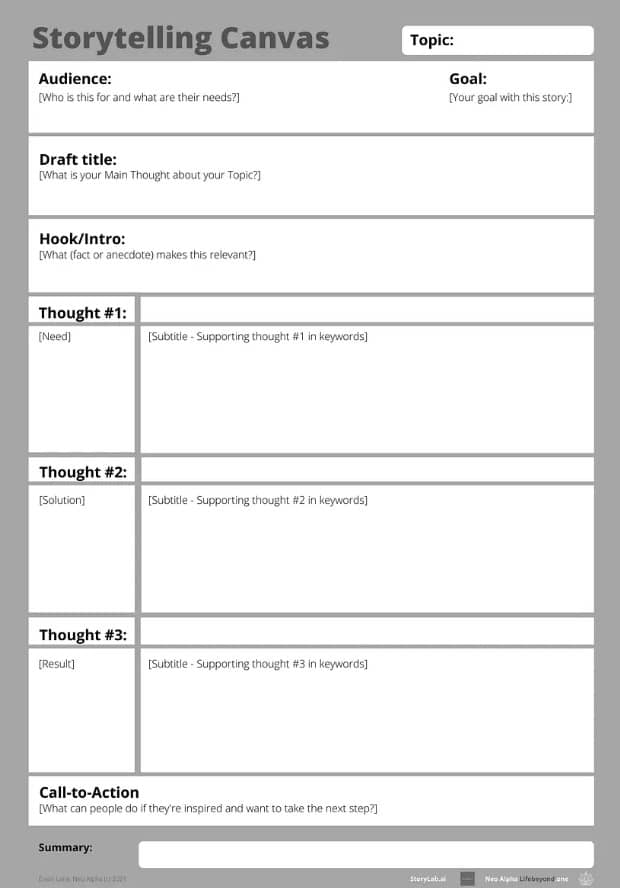
If you feel you need help structuring your story, head over to Storylab.ai and review the Seven Point Strategic Storytelling Structure – download your canvas below for free. It’s helped hundreds if not thousands of fledgling writers, speakers, pitchers and storytellers like you, craft a better story, faster.
Free Download: Storytelling Canvas (Seven Point Strategic Storytelling Structure)
Why this matters even more today
We now live in a time when words are cheap.
Even great graphics, video animations and FX, making Hollywood professionals literally throw a fit and put up strikes.
Content can be generated easily, endlessly.
AI can produce passable narratives in seconds.
Messaging is “optimized” everywhere.
What that means is: The scarce resource is no longer the ability to produce text.
It’s no longer about who can come up with the constellation of words that sounds the most coherent, that flows the best, or that sounds most convincing on the surface.
It is the ability to produce communication that comes from somewhere real — from actual experience, observation, and commitment.
In other words:
The advantage is no longer who can write.
It is who can mean what they write.
Transformational Storytelling: the additional layer
This is where storytelling moves beyond being a technique, and becomes a discipline.
Strategic storytelling asks:
Does this message work?
Transformational storytelling also asks:
Is this message aligned with what we know, what we’ve seen, and what we’re trying to change?
It connects three layers:
- Clarity — does this make sense?
- Credibility — is it grounded in reality?
- Alignment — is it true enough that we can act on it, sustainably?
When those three come together, stories stop feeling like communication exercises and start functioning as shared direction.
Where you see this in practice
Take environments like entrepreneurship or venture investing.
On the surface, narratives there revolve around markets, models, and strategy.
But the stories that actually build trust, and support sustainable growth – go further.
They reveal why a particular group of people sees an opportunity.
What they have experienced firsthand.
What gives them the necessary conviction to pursue it despite uncertainty.
The same pattern shows up in leadership, education, creative work, and personal change.
Different contexts.
Same human dynamics.
A simple way to begin
Before crafting a message, pause and ask:
- What am I actually trying to make sense of here?
- What have I seen or learned that feels important?
- Who else does this matter to?
- If this is understood, what should happen next?
Answer those honestly, and the structure will almost build itself.
In the End:
What is the meaning we are trying to change?
Storytelling is not about sounding impressive.
It is about making meaning visible.
So that others can recognize it.
Respond to it.
And, if it resonates, move with you.
A good story communicates an idea.
A strong story aligns people.
And an aligned story is what allows change to happen — not by force, but by understanding.
Author bio:
 Erwin Lima: What inspires Erwin is helping people, teams and brands to become the best version of themselves. Guiding them with curiosity, empathy, and Growth Storytelling.
Over the past 10+ years as a copywriter, author, consultant, and coach, he’s helped dozens of Brands, Teams, and individual human beings to grow their sense of motivation and focus, but also their reach, engagement, and revenue— through the power of their own story. You can find Erwin on LinkedIn and on his website.