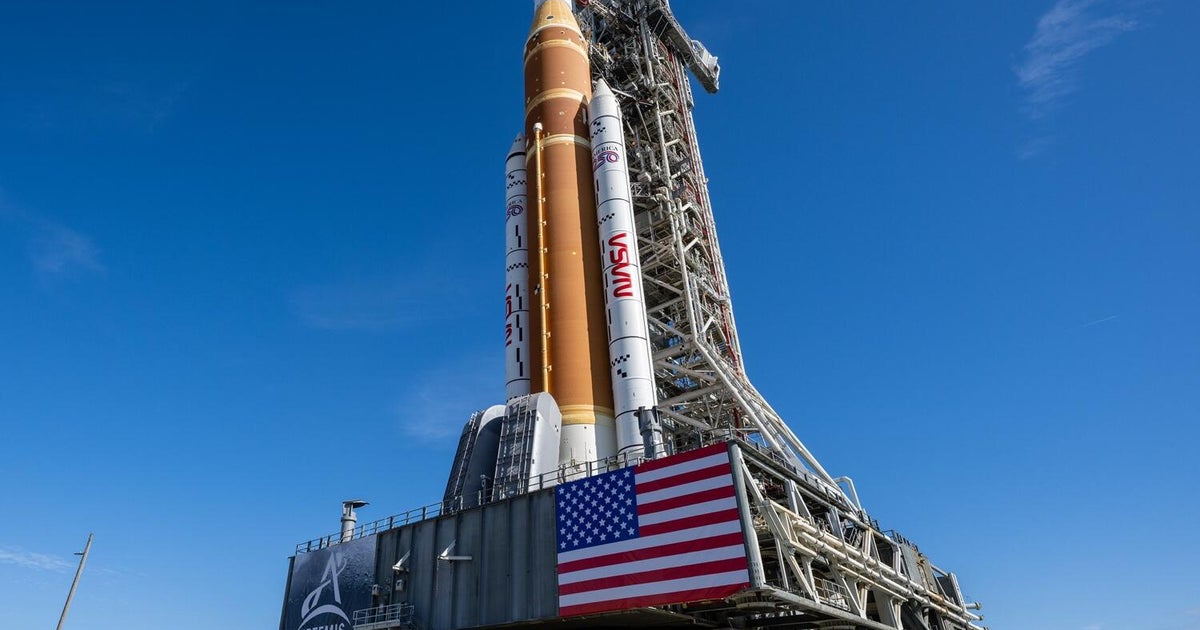
NASA’s repaired Artemis II moon rocket began a glacial 12-hour trip back to the launch pad early Friday at the Kennedy Space Center in Florida, setting the stage for a delayed April 1 launch to send four astronauts on a historic nine-day flight around the moon and back.
Mounted atop a powerful Apollo-era crawler-transporter, the 332-foot-tall Artemis II Space Launch System rocket and its mobile launch platform began inching out of NASA’s Vehicle Assembly Building around 12:20 a.m. EDT, nearly four-and-a-half hours late because of high winds along Florida’s Space Coast.
Spaceflight Now
The 4-mile trip to Launch Pad 39B was expected to be complete by around noon or shortly thereafter. At that point, NASA and contractor engineers and technicians planned to begin work to connect fuel lines, power and data cables, and to rig the pad for launch amid a battery of tests to verify good connections and healthy components.
NASA managers say earlier problems and repairs that required a follow-on fueling test have been resolved and that the next time the SLS rocket is loaded with more than 750,000 gallons of liquid hydrogen and oxygen propellants, it will be for takeoff.
Artemis II commander Reid Wiseman, Victor Glover, Christina Koch and Canadian astronaut Jeremy Hansen went into pre-flight medical quarantine Wednesday night. They plan to fly to the Kennedy Space Center a week from Friday, and if all goes well, they hope to strap in for blastoff at 6:24 p.m. April 1, the opening of a two-hour launch window.
The flight will mark the first time astronauts have flown atop an SLS rocket and aboard an Orion crew capsule after a single unpiloted test flight in 2022.
In that flight, the Orion crew capsule was not equipped with a life support system. The Artemis II astronauts will devote their first full day in space to checking out the spacecraft’s propulsion, navigation, communications and life support systems before heading off to the moon.
The Artemis II flight will be the first piloted moon mission since the last Apollo crew landed on the moon in 1972. While Wiseman and his crewmates will swing around the moon and return to a Pacific Ocean splashdown without going into lunar orbit, an on-time launch will allow them to travel farther from Earth than any humans before them.
If the flight goes well, NASA plans to launch another SLS rocket and Orion crew next year to test rendezvous and docking procedures with one or both moon landers being built by SpaceX and Blue Origin. That flight will be followed by at least one and possibly two moon-landing missions in 2028.
But first, the Artemis II crew must show the rocket and Orion spacecraft are up to the task with a successful trip to the moon and back.
NASA 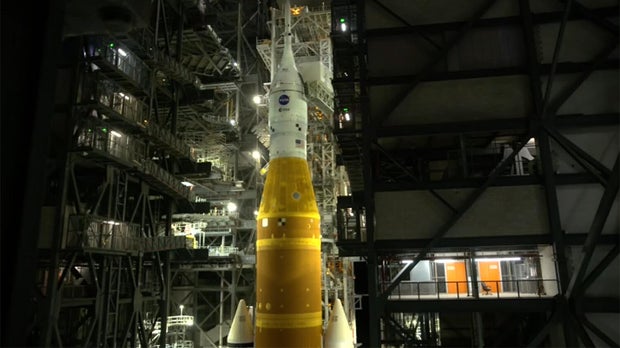
The flight originally was planned for early February, but it was delayed after hydrogen fuel leaks were detected during a dress rehearsal countdown. That problem was fixed at the pad and the rocket sailed through a second fueling test without any major problems. That set the stage for a launch around March 6.
But after the fueling test, engineers ran into a fresh problem when they were unable to pump high-pressure helium back into the SLS rocket’s upper stage. Pressurized helium is routinely used in rockets to push propellants to engines and to help clean and dry tanks and propellant lines when needed.
Unlike the first stage leak, engineers could not access the second stage at the launch pad. So the entire SLS rocket had to be hauled back to the Vehicle Assembly Building, where extendable platforms provided the needed access.
The helium issue was traced to out-of-place seals in a quick-disconnect fitting and was quickly repaired. Engineers also replaced batteries in the rocket’s self-destruct system, recharged a variety of other batteries and replaced seals in the first stage liquid oxygen propellant umbilical mechanism.
Because of the constantly changing positions of Earth and moon, along with lighting and solar power constraints, NASA only has until April 6 to get the Artemis II mission off the ground. After that, the flight will slip another three weeks or so when conditions will once again be favorable for launch.