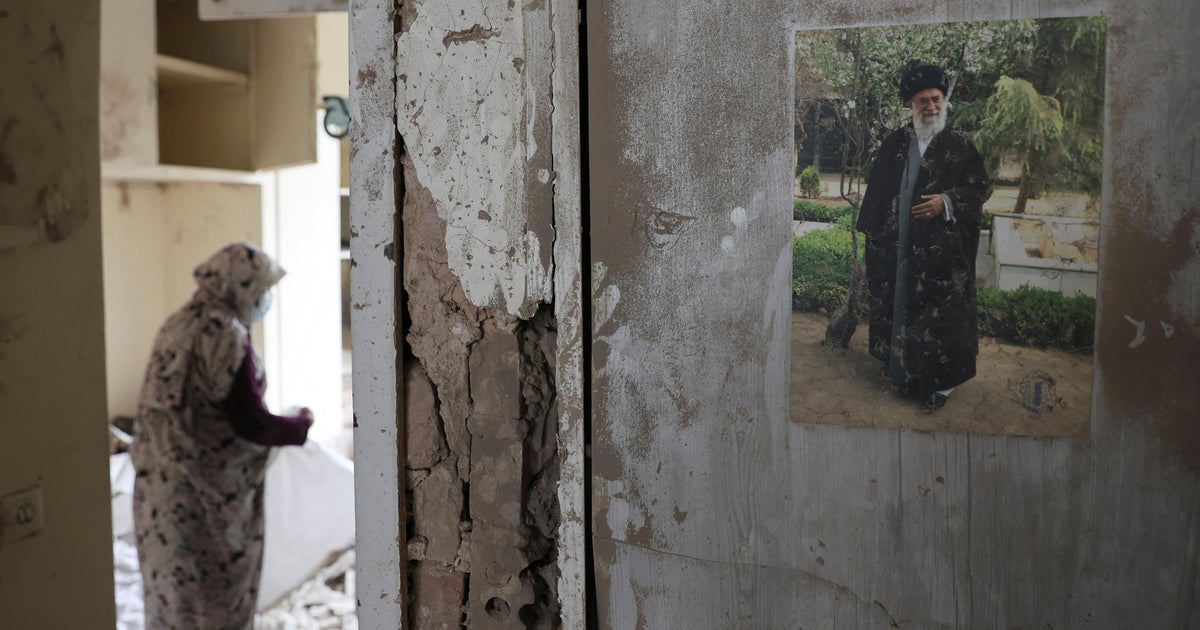
Since the U.S. and Israel launched their strikes on Iran at the end of February, the Israeli military has announced the killings of a number of top Iranian officials, from Supreme Leader Ayatollah Ali Khamenei on the first day of the war, to the spokesman for the Islamic Revolutionary Guard Corps on Friday.
Israel says the operations are carried out through intelligence-driven targeted strikes.
The intelligence that reveals targeted individuals’ locations falls into two different categories, according to Glen Segell, an academic and political analyst based in Israel with a background in operations and information security.
The first category is “where you actually have an informant on the ground who’s passing in information to say this is the person’s current location, and the second one is going to be some form of electronic tracking, whether it is through mobile phones or a regular phone or even satellite or drone surveillance,” Segell said. “If you look at the Iran situation, there are lots of people on the ground who are reporting on each other.”
Segell told CBS News that, in addition to informants, Israel gathers intelligence on Iran in collaboration with partners, “including Iran’s neighbors, including the United States and various NATO sources. You can also monitor other countries’ monitoring of Iran. For example, a communication between Russia and Iran. So it becomes a very, very big picture of what is going on.”
He said there is also “a multitude” of domestic resistance movements inside Iran that help provide information on the whereabouts of targeted people and equipment.
It’s a problem for the Iranian regime that new Supreme Leader Ayatollah Mojtaba Khamenei may have alluded to Friday, saying in a statement shared on social media that “security must be taken away from internal and external enemies” of the Islamic Republic.
But Israel is not able to carry out the kind of direct intelligence gathering in Iran that it does in other locations, Segell told CBS News, due to geography.
“The distances involved make it very hard for a small country like Israel to do the type of intelligence that it does in Gaza. In Gaza, it’s neighboring territory and there is a lot of flow of individuals between the two sides. So, I’d say Israel actually is looking for other sources, but the other sources are very, very good, and they also consider Iran as a major, major anniversary.”
One of those other sources, Segell said, is Saudi Arabia.
“Saudi Arabia is probably the largest gatherer of intelligence on what’s happening in Iran, especially after Iran launched the drones against Saudi oil fields a few years ago,” he said.
Regardless of how the intelligence is gathered, “it’s the Israelis who are doing most of that campaign against Iranian officials,” Mark Cancian, a retired U.S. colonel and senior adviser with the CSIS think tank’s Defense and Security Department, told CBS News.
He said to carry out these killings, “you have to know where [the targets] are at a moment in time. You can’t know where they are and then strike them three hours later, because they’ll be gone. You have to have a very short, what they call ‘kill chain,’ from the time that your sources are reporting that your target is at a certain point and the time you can actually strike.”
The attacks can take the form of “a missile launch, it might be an aircraft overhead or something like that. But it’s that quick connection that you need, and the Israelis, in Iran, have sources on the ground and are able to do that.”
Cancian said Israel is carrying out most of the targeted strikes on Iranian officials unilaterally, because “their intelligence is just so much better. They can close this kill chain in a way that [the U.S.] can’t.”
But he said it also has to do with the way the U.S. and Israel have “divided the battlefield, at least geographically. We are doing what the Pentagon calls the ‘southern front,’ which is basically the coast and the southeast part of the country [Iran]. And Israel is doing the north and west part of the country.”
What that means, retired four-star U.S. Army Gen. Joseph Votel told CBS News, is “right now the United States is heavily focused on targets down around the coast, and certainly related to the Straits of Hormuz. That’s probably less of a concern for the Israelis … They continue to be focused, I think, on leadership. Disrupting leadership.”
Segell said that Israeli focus on eliminating Iranian military and intelligence leaders is down to a hope that “the person who replaces him is more sensible … You are hoping that the replacement will basically say, ‘Let’s talk, let’s negotiate, let’s have diplomacy, let’s find a way out of this.’ And in many cases, it does happen. I mean, if you take out a terrorist leader, you’ll find that things become more subdued … The movement is still there, because it is ideological, but the person who is taking over is less radical. We’ve seen this with al-Qaeda. We see this with ISIS. And this was the intention also in terms of taking out Nasrallah in Hezbollah.”
“This was the idea also with taking out the ayatollah,” Segell said, adding that in his view, the IRGC continues to hold much of the power in Tehran, “which is why [we see] these large assassinations against the military leadership, the intelligence officers, the various ones involved in the ballistic missile launchers and so forth. And the sooner the Iranians reach that stage of understanding, you may not need a revolution. You might actually have a change in the regime’s view of the world without the change in their regime, which becomes entirely acceptable to everyone.”
But other analysts have raised concerns that slain senior figures in Iran could instead be replaced by less-experienced, and even less willing to negotiate, subordinates.
Northeastern University political scientist Max Abrahms told Britain’s Independent newspaper this week, citing past experience from Afghanistan, Pakistan, Israel and the Palestinian territories, that violence against civilians by authoritarian regimes often spikes after targeted killings by foreign powers.
“Leadership decapitation is risky,” he told the newspaper. “When you take out a leader that prefers some degree of restraint and had influence over subordinates, then there’s a very good chance that, upon that person’s death, you’re going to see even more extreme tactics.”
And other analysts note that, so far, there has been no public indication of cracks forming within what’s left of the Iranian regime, nor any sign of a major public uprising to topple it.
Some past conflicts that saw the U.S. and its Western partners rely heavily on airpower, however, such as the NATO war on Libya in 2011, show the situation can change suddenly for unpopular governments under the cumulative effect of relentless attacks.
There are also concerns that toppling a regime that’s been so firmly in control of the country for nearly half a century, with no obvious new administration waiting to take over, could simply create chaos.“
I think the Israelis, their notion is that if they take out enough of the senior officials, that eventually the successors will not have the legitimacy and connections that the original leaders had, and that will either cause them to agree to a more favorable settlement for us, or might even fracture the regime so you have different factions,” Cancian told CBS News. “So far, that has not happened, but I think that’s their strategy.”