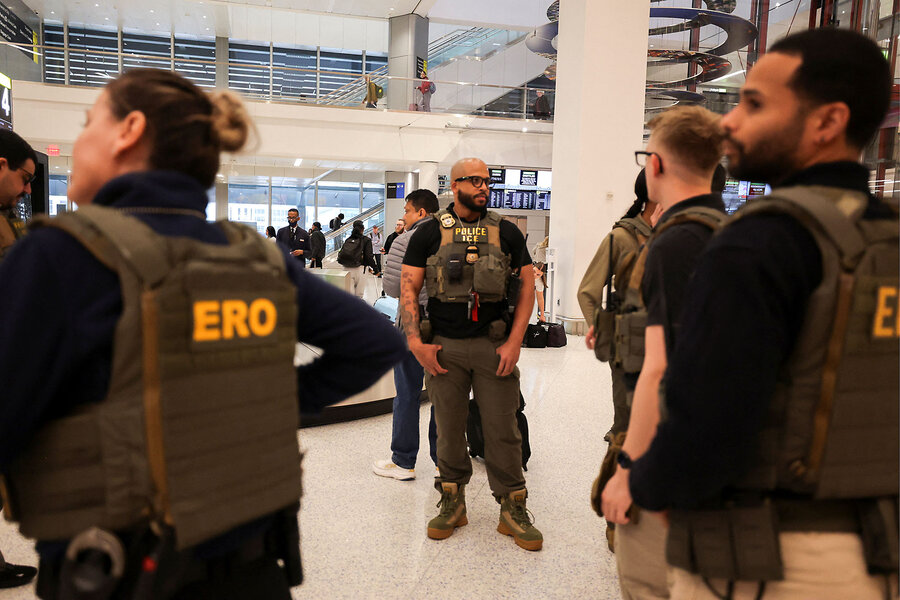
Last month, Democratic lawmakers blocked federal funding for the Department of Homeland Security over the public conduct of immigration enforcement officials. Six weeks into that stalemate, the president has placed those officers and agents squarely back in public view – at the country’s busiest airports.
As Immigration and Customs Enforcement personnel arrived at their new posts across the United States on Monday to aid fellow federal workers, delays wore on at terminals from New York to Houston. Despite mounting discontent from constituents facing travel setbacks, members of Congress don’t appear close to a compromise to fund DHS, which houses both ICE and the airport workers of the Transportation Security Administration.
Expected negotiations didn’t happen on Monday after President Donald Trump said he wanted to wait until a new DHS secretary is confirmed. Oklahoma Sen. Markwayne Mullin was confirmed Monday night.
Why We Wrote This
The arrival of Immigration and Customs Enforcement personnel, expected at more than a dozen major airports in the U.S., was the latest move in a standoff between Republicans and Democrats over funding for the Department of Homeland Security. Despite the high-profile deployment, negotiations remained stalled.
Meanwhile, those TSA employees continued to work without pay, as staffing issues appeared to keep many security lines at a crawl.
“I think it increases talking points for Democrats who are critical of ICE,” says Cayce Myers, a political communications expert at Virginia Tech University. “I think it’s also going to increase the talking points for President Trump, who is saying that he’s having to resort to these alternative means to keep TSA going.”
At the end of the week, both the House and Senate are scheduled to head into a two-week Easter recess, meaning the DHS shutdown could stretch into mid-April. At that point, it would be the longest government shutdown ever.
Airports still affected
Federal immigration agents arrived, or were expected to arrive, at more than a dozen airports on Monday. DHS declined to confirm the locations, citing operational security, but reporters tracked ICE arrivals at airports, including in Phoenix, Chicago, Atlanta, Philadelphia, Houston, New York City, and New Orleans. (An incident Sunday at LaGuardia Airport in New York, in which a jet that was landing hit a fire truck on the runway, was not related to the DHS funding shutdown.)
“While the Democrats continue to put the safety, dependability, and ease of our air travel at risk, President Trump is taking action to deploy hundreds of ICE officers, that are currently funded by Congress, to airports being adversely impacted,” said Lauren Bis, the acting assistant DHS secretary, in a statement. Atlanta’s Hartsfield-Jackson International Airport on Monday urged travelers to arrive at least four hours early because of “TSA staffing constraints.”
The city’s mayor said the incoming ICE personnel includes two groups: Enforcement and Removal Operations, whose officers focus on civil immigration enforcement, and Homeland Security Investigations, whose agents pursue a broad range of criminal investigations.
ICE will help TSA officials with tasks such as “line management and crowd control within the domestic terminals,” said Atlanta Mayor Andre Dickens. “Federal officials have indicated that this deployment is not intended to conduct immigration enforcement activities.”
Mr. Trump has suggested otherwise as he’s pitched the plan himself. He said he would move ICE agents into airports to provide security and to arrest unauthorized immigrants, “with heavy emphasis on those from Somalia.” The president also said that border czar Tom Homan was in charge.
Mixed reactions from officials
In Louisiana, where ICE personnel were sent to the international airport in New Orleans, Republican Gov. Jeff Landry said he would welcome the National Guard at airports in his state to ease security lines – with the president’s approval.
The White House appeared open to sending in troops.
If ICE isn’t enough, “I’ll bring in the National Guard,” Mr. Trump told reporters on Monday.
In Chicago, Mayor Brandon Johnson said he has concerns about the federal deployment.
We will “use every tool we have to ensure that people, no matter their immigration status, can travel to and from Chicago safely and without harassment from the federal government,” Mayor Johnson said in a statement to the Monitor. He said Chicago’s O’Hare International Airport could expect around 75 ICE officers “across multiple shifts” beginning on Monday, in support roles that did not include screening.
Officers have been “walking through the parking lots, walking through the terminals,” says Scott Mechkowski, a former deputy field office director at ICE. “They’re looking for security threats … like unattended bags.”
Meanwhile, “I know they’re enthusiastic” about the airport plan, says Pete Stewart, another retired ICE officer, speaking of those with whom he remains in touch. He says the new assignment could boost enforcement numbers.
While checking IDs at airports, ICE officers will “be able to get more arrests,” he says. “It’s a lot easier. … It’s not like you have to go pound on people’s doors and do traffic stops.”
Groups that advocate for immigrants pushed back, including the American Civil Liberties Union.
Sending ICE to airports is meant to “inspire fear among families,” said Naureen Shah, ACLU director of policy and government affairs for immigration, in a statement. “This is the exact opposite of what the American people are clamoring for, which are real, enforceable changes to rein in ICE and Border Patrol’s cruel deportation and detention obsession.”
A union for TSA workers criticized the deployment of ICE personnel to airports – even as it reported that more than 50,000 employees have worked without pay for more than a month, and that hundreds have left.
“Putting untrained personnel at security checkpoints does not fill a gap. It creates one,” said Everett Kelley, national president of the American Federation of Government Employees. TSA workers deserve to be paid, he said, “not replaced by untrained, armed agents who have shown how dangerous they can be.”
AFGE isn’t the only union to pan the plan. In a joint statement, flight attendant union leaders said dispatching ICE agents to airports “creates contradictory missions, as attempts to question passengers about immigration status may distract them from ensuring airport security.”
Standoff situation
After DHS law enforcement personnel fatally shot Alex Pretti, a Minneapolis nurse, on Jan. 24, Senate Democrats refused to pass an annual funding bill, which would have allocated $64.4 billion to the department, without significant changes to hold ICE and Customs and Border Protection more accountable to the public.
Democrats’ demands include banning agents from ICE and CBP from wearing masks, and requiring them to obtain judicial warrants signed by a judge – instead of administrative warrants signed by department officials – to enter people’s homes. These two requests have been sticking points for Republicans, who say those measures will constrain immigration agents and expose them to doxing.
On social media on Monday, Mr. Trump asked ICE not to wear masks at airports, though he said he was a “BIG” proponent of masks for agents dealing with violent criminals.
DHS has been shut down since Feb. 14. In addition to ICE and CBP, the shutdown affects other agencies housed within the department, including the Federal Emergency Management Agency and the TSA.
Even without renewed DHS funding, ICE and CBP have enough money, through last year’s Republican tax-and-spending bill, to continue immigration enforcement operations.
Democrats have repeatedly proposed bills to fund other parts of DHS while lawmakers negotiate reforms to ICE and CBP. Republicans generally say the agency must be funded as a whole, though some, including Sen. John Kennedy of Louisiana, have expressed support for voting to fund portions of DHS.
“I think it does start to weigh heavily on the psyche of voters back home that we’re lurching from one shutdown to another,” says Kevin Madden, a GOP strategist and a former adviser for Mitt Romney’s 2012 presidential campaign. He says Democrats in particular risk “paying a price” with voters for refusing to fund the department.
Meanwhile, Mr. Trump has taken a central role in negotiations.
The president “has done everything he can to own the shutdown at TSA and the lines at airports,” says Jesse Ferguson, a Democratic strategist.
On Sunday, Senate Majority Leader John Thune proposed to Mr. Trump that Republicans could vote to fund other aspects of DHS and wait to pass funding for ICE and CBP in a separate budget bill. The president refused, demanding that Congress fund all of DHS and adding that they need to first pass the SAVE America Act, a bill that would mandate people prove their U.S. citizenship to register to vote, and to show ID at the polls. It faces strong opposition in the Senate.