Robert started placing bets through a friend’s illegal sportsbook in high school, and he kept using illegal books in college until he was old enough to bet legally.
At school in North Carolina, which legalized sports gambling in 2024, he, his fraternity brothers and others placed multiple bets or parlays on professional and college basketball and football games. He knows people who have run away from sizable debts, ghosting bookies for big money. And he has a friend who sold an illegal book – his roster of bettors – for $25,000.
“On a college campus, you’re going to a lot of these college football games. You’re going to college basketball games, and any game that you’re watching, you’re probably betting on it,” said Robert, whose name has been changed.
Why We Wrote This
Legal sports gambling is flooding broadcasts with ads during major sporting events like March Madness. Experts say they are concerned a younger audience of high school and college students is being drawn into gambling.
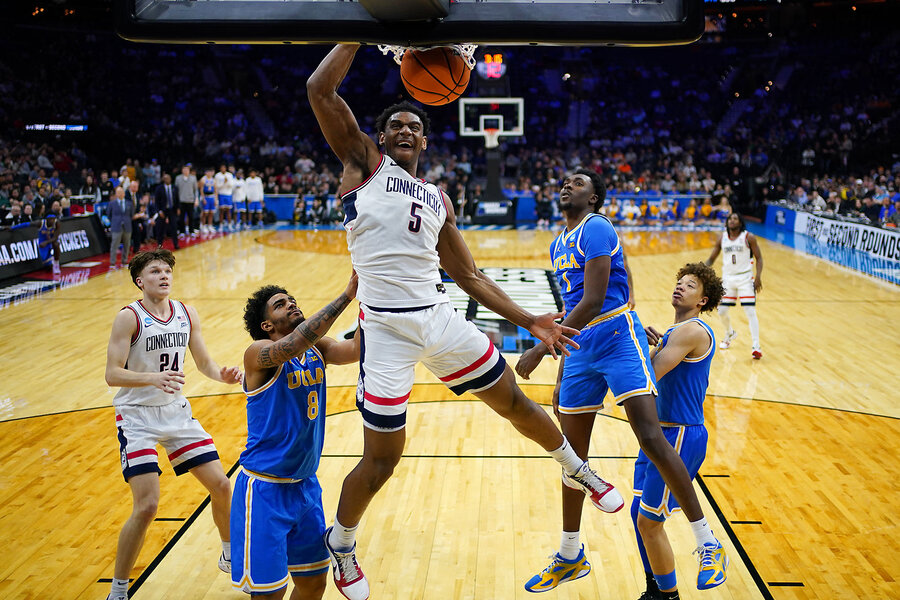
March Madness, the men’s and women’s year-end college basketball tournaments that are currently ongoing, is expected to garner a record $3.3 billion in sports bets, according to the American Gaming Association. But March is also Problem Gambling Awareness Month, and there is growing concern that the rapid proliferation of legal sports gambling is reaching an increasingly young audience.
“I would say amongst my friends and others, it’s an epidemic,” Robert contends.
There’s a shift underway among young people, “instead of being sports fans they are sports gamblers,” says Andrew Miller, associate professor for Sacred Heart University’s School of Communication, Media and the Arts.
In the past, people gathered to cheer on their team during March Madness – and many still do – “but now there are groups staying together to watch it as gamblers,” Dr. Miller says. “Instead of cheering for their team, they might be cheering for an individual player to get 10 rebounds or more or less, so they have the over-under.”
Warnings signs
A week before March Madness began, University of Missouri Chancellor Mun Choi issued a stern reminder to his students about the potential harms of sports betting, which is new to the state.
Dr. Choi asked people not to try to influence the outcome of games or to harass or threaten student-athletes about their performance, a sign of gambling’s campus prevalence.
Dr. Miller, the Sacred Heart professor, leads an annual sports gambling poll. This year’s survey found that 62% of Americans say that gambling ads impact young viewers. Almost half of respondents, 46%, said they are concerned about the volume of ads during major events such as the Super Bowl or the NCAA basketball tournaments.
A national survey by the National Council on Problem Gambling in 2024 showed that nearly 20 million adults in the United States say they have experienced “at least one problematic gambling behavior ‘many times’ in the past year.”
NCPG released another set of survey results this month showing that two-thirds of adults in the U.S. admit to participating in some form of gambling before age 21.
“We certainly have concerns,” says Cait Huble, director of public affairs for NCPG, which is neutral on legalized gambling.
“The fact that younger generations are seeing gambling so normalized in society – it’s at every game, it’s ever-present in advertising and the access is so much easier than it’s ever been because you have access on your phone. It’s just more present in our culture,” she stresses.
The American Gaming Association, which promotes and lobbies on behalf of the gambling industry, did not respond to a request for comment.
Growing recognition
What Ms. Huble doesn’t see are states or the federal government making a concerted effort to remind people that gambling is a high-risk activity. She says that gambling addiction does not currently receive federal funding, unlike substance and alcohol abuse.
States fund gambling addiction efforts, but the available resources are uneven. Recently, a bipartisan group of lawmakers in the U.S. House introduced the Points Act, which would use one-third of the excise tax revenue on sports betting – most recently a total of $300 million – to fund efforts.
“It’s certainly what we would consider a major public health issue, both underage and adults not being fully aware and understanding the risks and the likelihood of harm,” Ms. Huble adds.
A number of schools are trying to be proactive when it comes to student gambling. Last year, Penn State University started screening and offering free services for students concerned about gambling.
“During the conversations with students about problematic behaviors, gambling was repeatedly mentioned. Penn State is aware that the national trend for collegiate gambling is rising, and we are concerned about the impact that it can potentially have on our students’ mental, emotional and physical wellbeing,” Lizbeth LoRusso, the university’s assistant director for health promotion and wellness, told the Monitor via email.
“We discuss the student’s gambling behaviors, help them identify patterns, triggers and contributing factors (drinking or cannabis use) and offer healthier coping skills and harm reduction strategies,” she said.
A “reward system” without a “brake system”
When Robert bet on sports, he says it made “the games more enjoyable to watch, and that thrill is fun.”
Researchers find that this type of thrill triggers a part of the brain that activates a reward system, making this behavior addictive and contributing to compulsive behavior, according to the American Psychological Association.
Impulse control and cognizance of long-term consequences are not yet fully developed among youth, even in their 20s, says Natalie Spiteri-Soper, the chief clinical officer at Kindbridge Behavioral Health, a national telehealth platform that specializes in treating gaming and gambling problems.
Dr. Spiteri-Soper says this problem is amplified when you take young people and throw them into a situation like March Madness.
“They’re getting inundated with gambling messages. They’re getting flooded with constant things that say ‘this feels good.’ The reward system is getting fed, but they don’t have the brake system,” she says.

Families can look for signs other than just a need for more money that could indicate their child has a gambling problem. They include depression, sadness, loss of control, isolation, anxiety and distress, especially when losses pile up. Dr. Spiteri-Soper says parents should check on young people who are normally very social but suddenly isolate themselves.
“Gambling is not really about money. It’s about the feeling I get when I gamble, either I feel like I belong, I’m a part of this excitement, maybe I’m escaping the pressure of college and work and my relationships,” Dr. Spiteri-Soper warns.
Increasing convenience
Charlotte, a current graduate student, finished college in May in Rhode Island. Sports betting platforms FanDuel and DraftKings aren’t legal in Rhode Island, so in college she would drive across the state line into Massachusetts to place bets.
“I started off with just single-bet games, and then you start to learn the techniques and stuff, and then I started putting in parlays. I fell into a more of a ‘yeah, I’m going to keep doing this,’ right around the Super Bowl,” she says. She spoke of her gambling on condition of anonymity, and her name has been changed.
Once, in college, she bet a 13-leg parlay – a move that links together multiple bets for a potential high payout, but with high risk because losing any leg loses the wager. She bet $150 and won $2,000. The most she has ever lost at one time gambling was about $150 on sports betting and $400 at a casino playing blackjack, she says. A former friend of hers dropped out of school because he owed a bookie who ran an illegal book $10,000 and had to get a job to pay it off.
“I’ve seen how bad it gets for some people,” she says.