

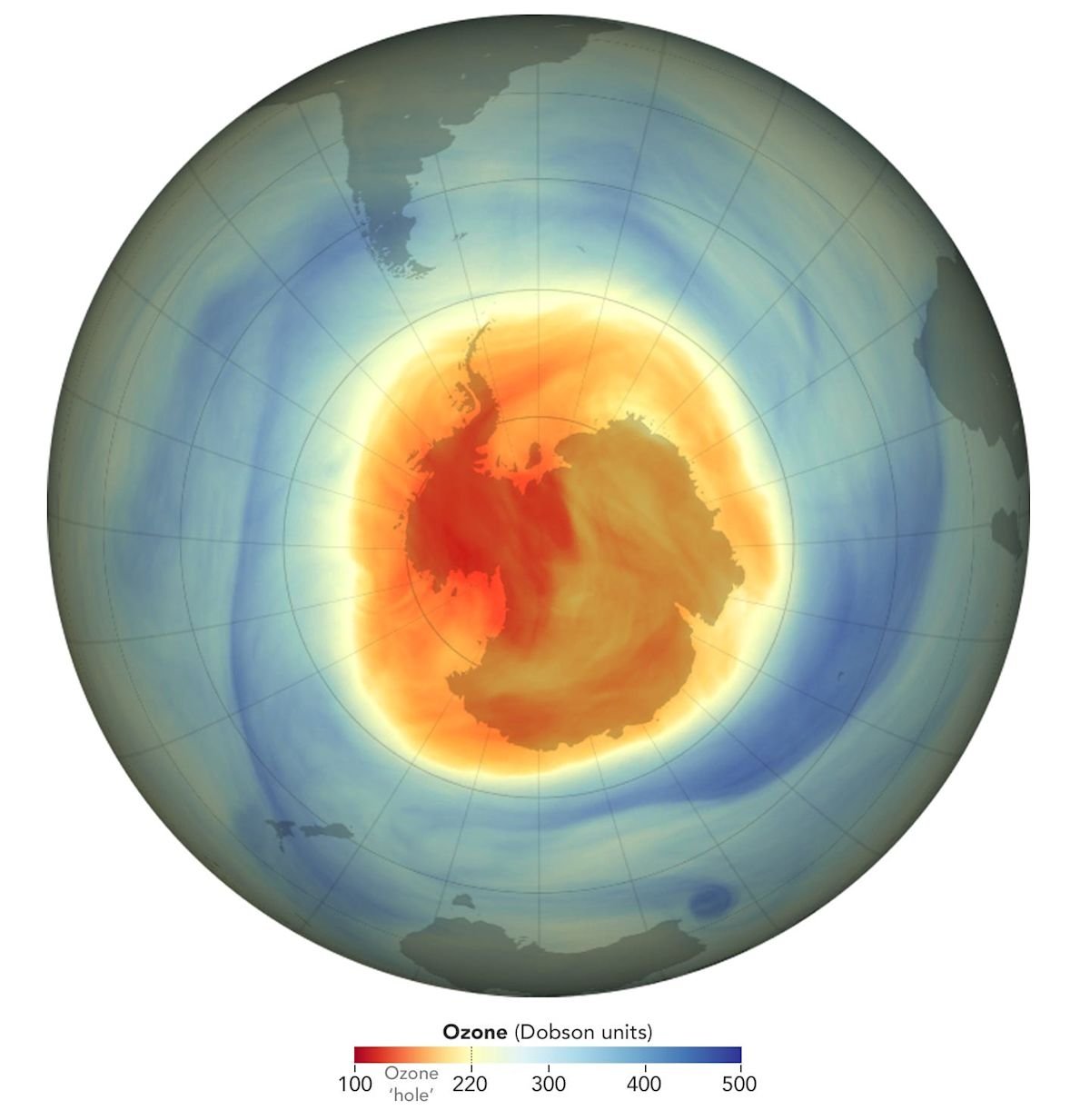
There’s a polar vortex over the South Pole too, and in 2026, it caused the infamous Antarctic ozone hole to grow to an abnormally large size.
“An unusually powerful polar vortex has extended ozone depletion in the Antarctic this season, allowing the hole to grow to proportions we haven’t seen in a decade,” said Paul Newman, a senior scientist at the University of Maryland and longtime leader of NASA’s ozone research team, in a news release.
The Antarctic polar vortex helps create the cold conditions that allow chemicals from human-made compounds to deplete stratospheric ozone, according to NASA. Located high up in the atmosphere, the ozone layer blocks potentially harmful ultraviolet energy from reaching the Earth’s surface.
The ozone hole is an area of unusually low ozone above Antarctica and is caused largely by persistent man-made chemicals that destroy ozone way up in the atmosphere. It has been steadily recovering after a global effort to ban those chemicals that started in the 1980s.
The large size of the hole this year does not reverse the projected long-term recovery of the ozone layer in the coming decades. Full recovery of the ozone layer should occur by around 2070, according to the World Meteorological Organization.
“The annual ozone hole has been forming later in the season in recent years, which tells us the ozone layer is healing,” Newman said.
How big was the ozone hole in 2026?
The ozone hole reached its greatest extent for the year on Sept. 18, 2026, at 10.5 million square miles. That’s about 90% as large as the largest ozone hole ever recorded, which occurred on Sept. 9, 2000.
“The 2026 ozone hole is large but could have been 1 to 2 million square miles larger if ozone-depleting substances were as prevalent in the atmosphere today as they were at their year 2000 peak,” Newman said.

A data visualization shows the area and shape of the ozone hole on September 18, 2026, the day of its annual maximum extent. Scientists define the ozone hole as the area in which ozone concentrations drop below the historical threshold of 220 Dobson units.
Why is the ozone layer important?
The ozone layer acts like a sunscreen, blocking potentially harmful ultraviolet energy from reaching our planet’s surface. Without it, humans and animals can experience increased rates of skin cancer and other ailments such as cataracts, NASA said.
The naturally occurring ozone high up in the atmosphere is the “good” ozone and is in contrast to the “bad” ozone near the surface, which is man-made pollution that can cause respiratory problems, according to the National Oceanic and Atmospheric Administration.
A global effort to fix the ozone layer
Scientists first discovered the dramatic thinning in Earth’s protective ozone layer and the ozone hole in the 1970s. They determined the production of chlorofluorocarbons (CFCs) used in refrigerators and aerosol sprays caused the problem.
In the late 1980s, 196 countries signed the Montreal Protocol, a treaty that limited the production of CFCs around the world. Businesses soon came up with safer alternatives for spray cans and refrigerators.
The hole fluctuates in size from year to year. It’s typically at its largest after the cold of winter and smallest after summer. The World Meteorological Organization says that temperatures in the Antarctic stratosphere vary each year, so some years the ozone hole is relatively small and other years relatively large.
Was the Antarctic vortex unusually strong in 2026?
“It was exceptionally strong, cold, and large this season, driven by unusually suppressed wave activity,” Laura Ciasto, a meteorologist with the National Weather Service’s Climate Prediction Center, told USA TODAY.
Amy Butler, a research scientist at the NOAA Chemical Sciences Laboratory, explains it further: “The polar vortex was unusually large this year in part because planetary-scale weather systems that typically well up from the lower atmosphere and break up the vortex were especially weak in August and September,” she said.
“That weak wave action kept the strongest polar vortex winds further from the South Pole by several degrees of latitude, creating a larger area for conditions ideal for ozone depletion to occur.”
How is the Antarctic polar vortex different than the one over the Arctic?

NOAA Corps Lt. Michael Doneghey (right), the South Pole observatory station lead, holds a weather balloon while NOAA station technician Luke Longren carries a package containing an ozonesonde — an airborne instrument that measures ozone levels — just prior to launch on October 18, 2026.
“In many ways the Antarctic polar vortex is just like the Arctic polar vortex,” Ciasto said. “It forms every late summer/early autumn (February/March in the Southern Hemisphere), sticks around throughout the austral winter, and then breaks down every late spring/early summer (November/December).”
The defining difference is stability: the Antarctic polar vortex experiences relatively few disruptions, such as major mid-winter sudden stratospheric warmings (SSWs), Ciasto told USA TODAY. “While the Northern Hemisphere sees a major mid-winter SSW roughly every other year, Antarctica has experienced only one recorded major SSW (September 2002), alongside a handful of minor warmings.”
Doyle Rice is a national correspondent for USA TODAY, with a focus on weather and climate.
This article originally appeared on USA TODAY: The polar vortex is causing trouble at the South Pole








Leave a Reply