I’ve never covered a rocket launch before, so I wasn’t quite sure when to exhale. About three minutes into the Artemis II mission, with the ship about to enter outer space, I took my cue from Reid Wiseman.
“We have a beautiful moonrise. We’re headed right at it,” the mission commander said, his voice crackling into an auditorium at the Johnson Space Center in Houston.
The Artemis II mission, bringing four astronauts on a lunar flyby, is scheduled to last 10 days. For nine of those days, the Johnson Space Center in Houston, Texas – home to the NASA mission control center – will be the place to be. On launch day, with most cameras focused on the blastoff from Cape Canaveral, Florida, the work here commenced in a quieter – but critical – way.
Why We Wrote This
In the first endeavor to orbit the moon in more than half a century, four astronauts launched on the Artemis II mission from Cape Canaveral. A Monitor journalist watched the historic step toward a lunar mission from the Johnson Space Center in Houston.
The Artemis missions represent NASA’s next bold step. A return to the moon for the first time in a half-century – this time with plans to eventually stay. Artemis II will send a four-person crew around the moon and back, perhaps venturing further into space than any humans in history. Artemis IV aims to land humans on the lunar surface in 2028. From there: a nuclear reactor, a moon base, a launchpad into deep space (first stop: Mars).
Many commentators this week have drawn parallels between Artemis II and Apollo 8, which orbited the moon in 1968 ahead of Apollo II’s lunar landing the following year. The Johnson Space Center today seems to embody this theme of old and new, of legacy and reinvention.
From the outside, the complex doesn’t seem to have changed much from its 1960s heyday. The sprawling campus is still populated by squat, rectangular buildings made of solid concrete, brutalist to their core. Inside, however, the sleek logo for the Artemis program is everywhere, its futuristic font making you want to double check you’re still in the 21st century. The faces of the crew – Mr. Wiseman, pilot Victor Glover, and mission specialists Christina Koch and Jeremy Hansen – look back at you from pictures and one life-sized cardboard cutout. They look ready to boldly go.
I’d traveled to Houston from my home base in Austin to report on Artemis II for the Monitor. Since becoming the Monitor’s Texas Correspondent in 2016, I’d always wanted to cover NASA (Houston is known as Space City after all). Artemis II felt like the perfect opportunity to watch history get made in my own back yard. I enjoy reading about space technology and exploration in my free time, and while I’m not a PhD-level space nerd, I think I could understand the science enough (with help from experts) to cover the mission professionally.
With the likely exception of Building 30 – home to the Mission Control Center and off-limits to reporters on Wednesday – the JSC was quiet most of the day. Around 4:30 p.m. local time, a half-mile from Building 30, NASA employees and journalists began making their way over to the Teague Auditorium, where a live feed of the launch pad at Kennedy Space Center in Florida was shown on a screen next to an empty podium.
About a dozen employees and journalists, along with three television camera crews, gathered in the large auditorium. 5:14 p.m. came and went without the countdown clock starting, but it was a minor delay before the seconds began ticking down.
If the crew was nervous, they didn’t sound it. As the launch teams completed their final checks and issued their respective, iconic, “go for launch” proclamations, Mr. Hansen, the first Canadian astronaut on a lunar mission, added a twist. “We are going for all humanity,” he said.
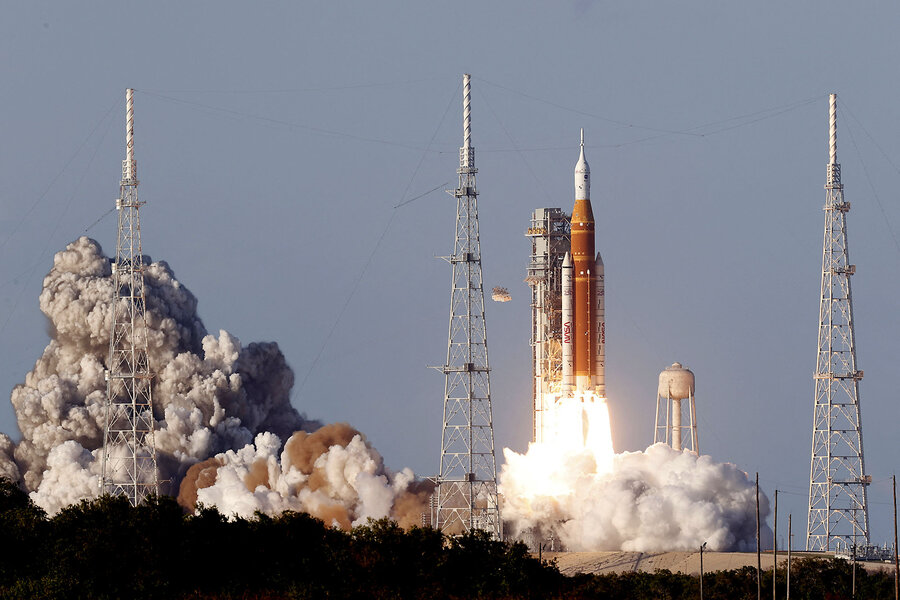
From my perch in Houston, the launch pad at Cape Canaveral looked beautiful. The towering Space Launch System rocket stood framed by a clear blue sky and capped by a speck of white: the Orion spacecraft (dubbed “Integrity” by the crew), their home for the next 10 days.

Back at the Teague Auditorium, at T-1:30 phones are taken out of pockets. Cameras are pointed at the screen, recording. A NASA launch commentator tells viewers that the “four brave explorers” are 248,000 miles from the moon and about to ride “the most powerful rocket NASA has ever built.”
The commentator counts down from 10, then a burst of a light, a belching roar, and Artemis II rides a fireball high into the blue sky. The small crowd in the auditorium whoops and claps. A tension still hangs in the air as the fireball dissipates into a thick white smoke plume billowing behind the rocket. Is everyone safe yet? Finally a voice crackles over the radio, delivering space jargon that made it sound like everything is going well, but left me nonplussed.
“Integrity,” said Mr. Wiseman, “guidance converged, performance nominal, upper stage RCS ready,” he said.
Three minutes and 50 seconds into the mission, the crew crossed the boundary into space, the announcer proclaimed. Eight minutes and two seconds into the mission came main engine cutoff (also known as the time the main booster rockets detach and drift into space). The crowd oohed as a camera showed the rocket – and what appeared to be a cloud of glittering debris – drift away.
Twenty-three minutes into the mission, the Artemis II crew has climbed about 600 miles above Earth,traveling at more than 16,000 miles per hour. From here, the astronauts will orbit Earth twice, testing the Orion’s systems, before beginning an approximately four-day journey to the moon.
Hard numbers and fun statistics are swirling in my head. The record for farthest journey from Earth is 248,655 miles, which Artemis II could break if it follows a certain trajectory. The Orion capsule is about the size of two minivans. The lunar flyby will occur with the ship about 4,000 miles above the lunar surface. To the astronauts, the moon will look about the size of a basketball in your outstretched hand.

Space exploration is complicated. But there are ways to make it understandable. And it’s a piece of cake to make it exciting. At Cape Canaveral, astronaut Nichole Ayers wiped tears from her eyes a few minutes after launch. A NASA astronaut since 2022, she took part in the fifth all-women spacewalk at the International Space Station. Ms. Koch took part in the first in 2019.
Ms. Ayers considers all four of the Artemis II crew her friends, she said during NASA’s live coverage, after they had climbed out of sight and into history.
“What a way to welcome in the Artemis generation,” she added.