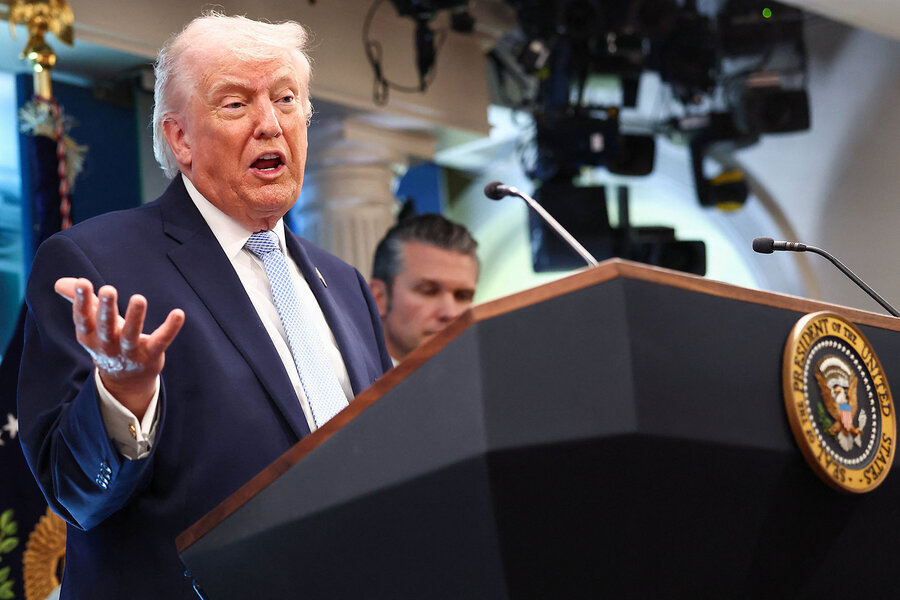
“A whole civilization will die tonight, never to be brought back again,” President Donald Trump announced on Tuesday morning. “I don’t want that to happen, but it probably will.”
The president’s latest threat against Iran, issued on social media, hit like a rhetorical bomb, as his 8 p.m. Eastern time deadline was looming for a deal with the Iranian regime to open the Strait of Hormuz oil lane. Mr. Trump appeared to back up his words with an overnight attack on Iran’s key oil hub, Kharg Island, as well as bridges across the country, according to news reports.
Recent days have brought a level of brinkmanship unusual even for Mr. Trump. But the pattern is familiar: Threaten dramatic action, gaining leverage over the other side as leader of the most powerful country in the world, and then (most likely) announce a deal or enough progress toward one to merit a delay. Mr. Trump used a similar playbook in the trade war he launched a year ago. But the stakes have never been higher than they are now, as the Iranian regime contemplates its next move.
Why We Wrote This
President Donald Trump has long regarded his reputation for unpredictability as an asset in negotiations. His latest threat to destroy Iran’s civilization marks a new level of brinkmanship, as the deadline looms for a deal with the Iranian regime to open the Strait of Hormuz.
And there are questions about whether Mr. Trump’s strategy might be losing its effectiveness – or could be escalating out of his control. With tariffs, he earned a reputation for ultimately backing off on his most severe threats, generating the “TACO” meme: “Trump Always Chickens Out.” The mockery has reportedly gotten under his skin, and could provide further impetus for the president to carry out his threat and act in dramatic fashion against Iran.
At the least, the president has upped the rhetorical ante in a way that caused critics and even many supporters to react with genuine alarm.
“Wake up: he is calling for A NUCLEAR STRIKE,” wrote Anthony Scaramucci, a Trump critic who served briefly as his communications director in the president’s first term, on X. “Seek his removal immediately.” Other noteworthy conservative Trump critics, including former Rep. Marjorie Taylor Greene, also suggested invoking the 25th Amendment to the Constitution to remove Mr. Trump from office.
Or, it could all be a big bluff. Mr. Trump has long regarded his reputation for unpredictability as an asset in diplomacy. He might even be encouraging speculation that he’s losing his mind, leaning into the “madman theory” of negotiation. That term was coined during President Richard Nixon’s tenure to describe his reported approach to the North Vietnamese as he sought their surrender during the Vietnam War. The concept: Convince your adversary that you’re irrational and could do anything, even go nuclear, in order to gain concessions.
Last year, amid the tariff wars, Treasury Secretary Scott Bessent put it somewhat differently, saying that Mr. Trump likes to project “strategic ambiguity” in his words and actions. “Nobody’s better at creating this leverage,” Secretary Bessent said.
In recent weeks, the president has veered between regular claims that the United States has already “won” in Iran and that “productive” talks are underway, and dire threats of escalation. The contradictory pronouncements caused early swings in the markets; data show the oil market has settled into a substantially higher price than before the Feb. 28 start of the war.
Some presidential historians see Mr. Trump’s approach as less strategic than reactive. They also say the madman theory has never produced positive results.
“Trump really is a person who lives in the moment, who reacts to what he perceives as the opportunities or threats involved in the moment,” says Glenn Altschuler, an emeritus professor of American Studies at Cornell University. “That’s why you get a lot of inconsistencies.”
Under President Nixon, the madman theory in dealing with Vietnam didn’t bring an end to the war.
Today, it has even less potential to work than it did during the Cold War for three reasons, according to Andrew Latham, a political scientist at Macalester College. First, information flows more freely. Second, the U.S. faces a less stable adversary than the Soviets. And third, Mr. Trump, unlike Mr. Nixon, has not established an otherwise orderly American system that would make his threats credible.
“The madman pose only works if it is exceptional,” writes Professor Latham in The Conversation. Mr. Trump’s constant public statements, and the fierce public discussion they generate, can “devolve into noise,” he adds.
Mr. Trump’s use of profanity in a social media post on Easter Sunday morning highlighted his ability to shock, underscoring his threat to Iran that it must open the Strait of Hormuz, or else. But it might have been counterproductive at home, generating an unusual amount of criticism from his Christian conservative base.
In a social media post on Monday, Tony Perkins, president of the Family Research Council, said he was praying for the president and urged his followers to do the same.
“While his Sunday Truth Social post on Iran may be designed to transmit bravado toward the Iranian regime to bring the conflict to an end, the continuing decline in language and decorum of our leaders is very troubling and should not be acceptable,” wrote Mr. Perkins, a Trump supporter.