Oil prices drop below the $100 a barrel mark as stocks soar on ceasefire news
Oil prices plunged Wednesday, staying well above pre-war levels but dropping below the $100 a barrel mark, and stocks soared after the United States and Iran said they had agreed to a two-week conditional ceasefire that should see Tehran temporarily reopen the vital Strait of Hormuz.
U.S. West Texas Intermediate lost almost 20% and global benchmark Brent Crude oil shed as much as 16%, with both trading around the $95 mark early Wednesday as investors heaved a huge sigh of relief after more than five weeks of war that has hammered supplies.
The euphoria sent global equities rocketing on hopes the crisis that has shocked the global economy for more than a month will come to an end.
Stocks in Seoul jumped 6.9% and Tokyo 5.4%, while Taipei added more than 4% and Mumbai 3.8%. Hong Kong advanced more than 3%, while Sydney, Shanghai, Bangkok, Manila, Jakarta, Singapore and Wellington were also sharply higher.
London, Paris and Frankfurt extended the global rally, while U.S. futures soared.
Middle East stocks also rallied, with Dubai jumping 8.5%, the biggest intraday increase since December 2014, according to Bloomberg.
CBS/AFP
Shipping slowly resumes through Strait of Hormuz, monitoring service says
A maritime monitoring service said Wednesday that vessel movement was resuming in the Strait of Hormuz, with two ships moving through the vital waterway.
“Early signs of vessel activity are emerging in the Strait of Hormuz following a ceasefire,” MarineTraffic said on X.
“Initial movements are now being recorded,” it said. “The Greek-owned bulk carrier NJ Earth crossed the Strait at 08:44 UTC, while the Liberia-flagged Daytona Beach transited earlier at 06:59 UTC, shortly after departing Bandar Abbas at 05:28 UTC.”
MarineTraffic said that “hundreds of vessels remain in the region, including 426 tankers, 34 LPG carriers, and 19 LNG vessels, many of which had been effectively stranded during the disruption.”
Both ships that transited the strait on Wednesday passed close to Iran’s Larak Island, which analysts have said the regime is using as a “toll booth” to collect fees for safe passage.
The Associated Press, citing a regional official directly involved in the negotiations, said the plan allows for both Iran and Oman to charge fees for ships to transit the strait. The official told the AP that Iran intended to use the money from its fees for post-war reconstruction.
Gulf states respond to missile and drone attacks; Iran says oil refinery attacked
The United Arab Emirates said Wednesday afternoon its air defenses fired at an incoming Iranian missile barrage. And Kuwait’s military said its forces responded to an “extensive wave” of drone attacks.
A gas processing facility in Abu Dhabi was ablaze after incoming Iranian fire, officials said. The fire stopped for a time, but then restarted.
Missile alerts were issued in the United Arab Emirates, Israel, Saudi Arabia, Bahrain and Kuwait after the ceasefire announcement.
“Air defense systems are currently responding to a missile threat,” the UAE’s emergency and disaster authority said in a post on X. “Please remain in a safe location and follow official channels for warnings and updates.”
Iran then said an oil refinery came under attack, with Iranian state TV reporting that an oil refinery on Iran’s Lavan Island was attacked on Wednesday. The report said firefighters were working to contain the blaze but no one had been hurt. It did not say who launched it.
CBS/AP
Explosions heard on two Iranian Gulf islands, including near an oil refinery
At least three explosions were heard around Iran’s Lavan Island Oil Refinery, the country’s state media reported Wednesday, hours after President Trump said the U.S. and Iran had agreed to a conditional two-week ceasefire.
It was not immediately clear whether U.S. or Israeli forces had launched new attacks on the island, which sits less than 10 miles off Iran’s coast in the Persian Gulf, west of the entrance to the Strait of Hormuz.
Iran’s Mehr news agency said several explosions were also reported on Siri Island, southeast of Lavan and much closer to the mouth of the Strait of Hormuz. It said the cause of the blasts remained unclear.
“Considering the need for both sides to adhere to the declared ceasefire, and according to the Armed Forces, any aggression against the country will be met with a regrettable response,” Mehr said.
Vance calls Iran ceasefire a “fragile truce,” says some inside Iran “lying” about the deal
Vice President JD Vance, who is on a trip to Hungary, called the ceasefire a “fragile truce,” adding that the Iranian foreign minister had responded favorably to the agreement, but that others in the country had been “lying” about what had been accomplished militarily and the ceasefire.
“This is why I say this is a fragile truce,” he said. “You have people who clearly want to come to the negotiating table and work with us to find a good deal and then you have people who are lying about even the fragile truths that we’ve already struck.”
Vance said that if Iranians are willing “in good faith to with us,” he believes they can make an agreement.
“What the President has also shown is that we still have clear military, diplomatic and, maybe most importantly, we have extraordinary economic leverage,” Vance said. “So the President has told us not to use those tools. He’s told us to come to negotiating table. But if the Iranians don’t do the exact same thing, they’re going to find out that the President of the United States is not one to mess around. He’s impatient. He’s impatient to make progress.”
EU leaders welcome ceasefire announcement: “A step back from the brink”
The EU’s top diplomat described the U.S.–Iran agreement on Wednesday as “a step back from the brink.”
“It creates a much-needed chance to tone down threats, stop missiles, restart shipping, and create space for diplomacy towards a lasting agreement,” said Kaja Kallas, who is vice president of the European Commission and the EU high representative for foreign affairs and security policy.
She said she spoke to Pakistan’s foreign minister and thanked him for securing the deal, but urged that “the door to mediation” remain open, “as the underlying causes of the war remain unresolved.”
European Commission President Ursula von der Leyen said she welcomes the ceasefire, which “brings much-needed de-escalation.”
She also said she thanked Pakistan for mediating, adding, “Now it is crucial that negotiations for an enduring solution to this conflict continue.”
Egypt calls ceasefire “a significant step towards” bringing the Iran war “to a complete end”
Egypt’s foreign ministry called the U.S.-Iran ceasefire agreement “a significant step” toward ending the war permanently on Wednesday, with a spokesperson saying Cairo would seek to capitalize on the diplomatic momentum.
“The decision by the United States and Iran to agree to a ceasefire is a significant step towards de-escalation in the region. We must now allow diplomacy to take its course. We shall continue to uphold our faith in diplomacy and allow dialogue to prevail,” the spokesperson told CBS News, adding that Egypt would “exert its utmost efforts to capitalize on this positive momentum to diffuse existing tension and bring the war to a complete end.”
What Iran says the U.S. has agreed to as the basis for the ceasefire and 2-week negotiations
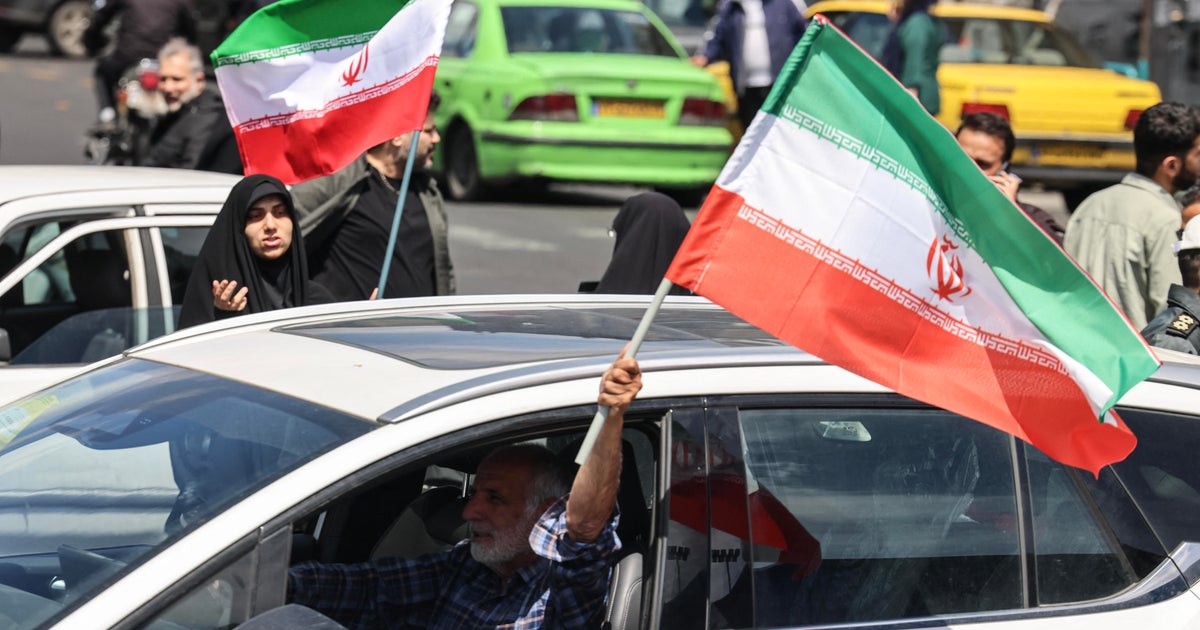
Iran’s Supreme National Security Council shared a long statement on Tuesday lauding the conditional ceasefire agreement with Washington as a “great victory” 38 days after the U.S. and Israel launched their joint war on the Islamic Republic.
An English version of the statement posted online by Iran’s semi-official Tasnim news agency, which is affiliated with the country’s powerful Islamic Revolutionary Guard Corps, said Tehran had “forced the criminal America to accept its 10-point plan, in which the United States is committed in principle to guaranteeing non-aggression, continuing Iranian control over the Strait of Hormuz, accepting (uranium) enrichment, lifting all primary and secondary sanctions, terminating all resolutions of the UN Security Council and the IAEA Board of Governors, paying compensation to Iran, withdrawing American combat forces from the region and stopping the war on all fronts, including against the heroic Lebanese Islamic resistance [Hezbollah].”
The Council’s statement added that, “until the details of this victory are finalized, there is still a need for perseverance and prudence on the part of the authorities.”
ATTA KENARE/AFP/Getty
Announcing the agreement on his Truth Social platform, President Trump called the 10-point plan, which was conveyed earlier in the week to Washington by Pakistani intermediaries, “a workable basis on which to negotiate.”
“Almost all of the various points of past contention have been agreed to between the United States and Iran, but a two week period will allow the Agreement to be finalized and consummated,” Mr. Trump said.
Trump says he agreed to a “double sided CEASEFIRE” with Iran
President Trump said Tuesday that he had agreed to a “double sided CEASEFIRE” with Iran, less than two hours before his deadline for Iran to make a deal with the U.S. or face massive strikes on its power plants and bridges.
“I agree to suspend the bombing and attack of Iran for a period of two weeks,” the Mr. Trump wrote on Truth Social, arguing that the U.S. had “already met and exceeded all Military objectives.”
He said the ceasefire, which he agreed to at Pakistan’s request, was “subject to the Islamic Republic of Iran agreeing to the COMPLETE, IMMEDIATE, and SAFE OPENING of the Strait of Hormuz.”
Iranian Foreign Minister Seyed Abbas Araghchi confirmed that Iran had agreed to halt “defensive operations,” likely referring to its drone and missile strikes on U.S. allies in the region, if the U.S. stops attacking Iran.
Araghchi said Iran’s armed forces would coordinate “safe passage through the Strait of Hormuz,” but it was unclear what that coordination might involve. Analysts say Iran has, for the past week or more, allowed select vessels to transit the strait for hefty fees, using its Larak island as a “toll booth.”