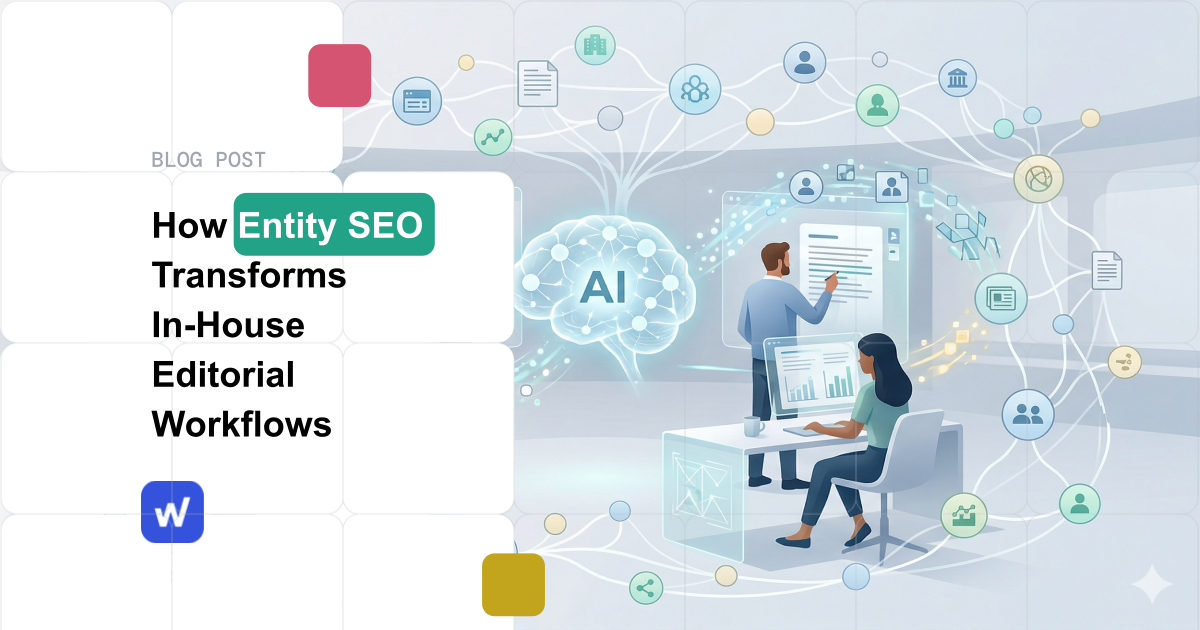
The Problem Every In-House Content Team Recognizes
You know the tension. Leadership wants more content across more topics and more channels. Your SEO team knows the pages need to cover more entities to compete. Your writers are already stretched. And somewhere in the middle, quality is the thing that quietly gets sacrificed.
Most teams try to solve this by picking a lane: either protect quality and accept a slower publishing cadence, or turn on AI-generated content and hope the brand voice survives. Neither works. The first leaves gaps your competitors fill. The second produces volume that search engines increasingly discount and readers ignore.
There is a third option, and it starts with rethinking what content is actually for.
Every Piece of Content Serves Two Audiences
This is the insight that changes how you design workflows. Each blog post, product page, or FAQ you publish serves two audiences simultaneously:
- People who need clear answers, useful information, and reasons to trust your brand.
- Machines that need structured, entity-rich, semantically connected content to understand what your brand knows and how it relates to topics users are searching.
When you write only for readers, you may produce great editorial content that leaves search value on the table. When you write only for rankings, you get pages that rank temporarily but fail to build trust. The content that compounds in value does both, and the way to make that happen is not heroic effort from individual writers. It is workflow design.
What an Entity-First Content Workflow Actually Looks Like
An enterprise content workflow typically runs through ten or more stages, from briefing to page build. The mistake most teams make is treating every step the same: either all-human or all-AI. The better model sequences them based on what each stage actually requires.
Upstream: Let AI do the research
Before a single word is written, AI can run entity gap analysis against target queries to identify which entities, topics, and semantic relationships your competitors cover that you do not. It can surface keyword opportunities, analyze SERPs, and map topic clusters. A content strategist then reviews this intelligence, applies editorial judgment, and builds a brief that reflects both the data and your business priorities. The brief is smarter. The strategist spends time on decisions, not data gathering.
Midstream: Humans and AI in tandem
For structured content (FAQs, product descriptions, landing pages), AI generates validated first drafts from your knowledge graph data. For long-form editorial work, it produces entity-enriched outlines and supporting research. Human writers then shape the narrative, refine voice, and ensure the piece meets your editorial standards. Automated content evaluation scores each draft for entity coverage, SEO effectiveness, and readability before it moves to review. Your editors focus on quality, not checklists.
Downstream: Automate the technical layer
Schema markup (JSON-LD) is generated and embedded automatically across all content types. Internal links are built programmatically using semantic relationships from the knowledge graph, not arbitrary anchor text. This is where most manual QA time gets spent today. Automation handles it before the page reaches your web team.
👉 Listen to this episode of The Search Session with Beatrice Gamba and Gianluca Fiorelli to explore how knowledge graphs become actionable for real business use cases.
Why This Is an Entity SEO Strategy, Not Just a Content Strategy
The reason this workflow produces content that compounds is that every piece reinforces your knowledge graph. Each article is not just a standalone page. It is a node in a connected semantic architecture that tells search engines and AI models what your brand is an authority on, how your topics relate to each other, and which entities you own.
Practically, this means every new blog post identifies which entities it should reference and reinforce. Structured data makes those entities machine-readable. Internal links reflect real topic clusters rather than arbitrary editorial choices. And validation ensures the finished content aligns with the knowledge graph your brand is building over time.
This is what makes entity-based SEO different from keyword-stuffing. Keywords target queries. Entities build authority. When your content operations connect editorial planning to knowledge graph development, you are not just publishing pages. You are constructing the semantic infrastructure that drives discoverability across traditional search, AI overviews, and agentic interfaces.
👉 If you’re exploring how AI is reshaping content teams and workflows, read this article where Valentina Izzo answers one of the biggest questions: is AI the end of the content marketing team?
Where to Start if You Are an In-House Team
You do not need to rebuild your entire workflow overnight. Most teams can start making this shift with a few concrete changes:
- Audit one content workflow end to end. Map every step from brief to publication. For each step, ask: is this a judgment task or a data task? The data tasks are where automation belongs. The judgment tasks are where your team adds the most value. Stop asking people to do both.
- Run an entity gap analysis before you write. Before your next content brief, compare your existing pages against the top-ranking results for your target query. Identify which entities, topics, and semantic relationships competitors cover that you do not. This takes minutes with the right tooling and transforms the quality of your briefs.
- Start connecting editorial planning to a knowledge graph. Even if you start small, the goal is to make each new piece of content strengthen a shared data layer rather than exist as a standalone page. Over time, this compounds. Your 50th article is not just your 50th article. It is the 50th node in a semantic architecture that makes every previous article more discoverable.
- Automate structured data as a default, not an afterthought. Schema markup should not be something your dev team implements manually after content is published. It should be generated programmatically as part of the publishing workflow. Same with internal links. If these are still manual at your organization, that is the highest-leverage thing to fix first.
The tools that support this kind of workflow already exist. Knowledge graph platforms like WordLift, combined with your existing CMS and analytics stack, can handle the data layer while your editorial team stays focused on what it does best: strategy, voice, and narrative quality.
Build the System, Not Just the Content
The teams that scale content quality over the next few years will not be the ones with the biggest budgets or the most writers. They will be the ones that stop treating content as individual pages and start treating it as a connected system, one where every article serves readers and strengthens the entity architecture underneath.
That shift is not a technology purchase. It is a workflow design decision. And the best time to start making it is the next piece of content on your calendar.
👉 Ready to see how this could work for your team? Book a discovery call with our team and explore how to turn your content workflow into a scalable, entity-driven system.