NEWYou can now listen to Fox News articles!
A U.S. Air Force crew had only seconds to react after their F-15E Strike Eagle was hit by enemy fire over Iran Friday. Both airmen ejected.
The escape from the aircraft — triggered in an instant — set off a high-risk rescue mission deep inside hostile territory, as U.S. forces raced to recover the crew before Iranian forces could reach them.
In those few seconds, the ejection seat transforms from a last-resort safety system into an explosive escape mechanism — launching the crew out of the aircraft and into open air before a parachute deploys.
RESCUE EXPERT SAYS MOST DANGEROUS MOMENT COMES AFTER ‘JACKPOT’ CALL IN RECOVERY BEHIND ENEMY LINES
That is the sequence the pilot and weapon systems officer aboard the F-15E over Iran would have experienced after their aircraft was struck Friday, forcing them to eject and triggering a high-risk rescue operation over the weekend. The incident — and the successful recovery of both airmen in recent days — offers a rare look at what happens in the split second a pilot ejects, and the extreme forces they endure to survive.
“It’s a violent event,” Pete “Gunz” Gersten, a former F-16 pilot who flew special operations missions, told Fox News Digital.
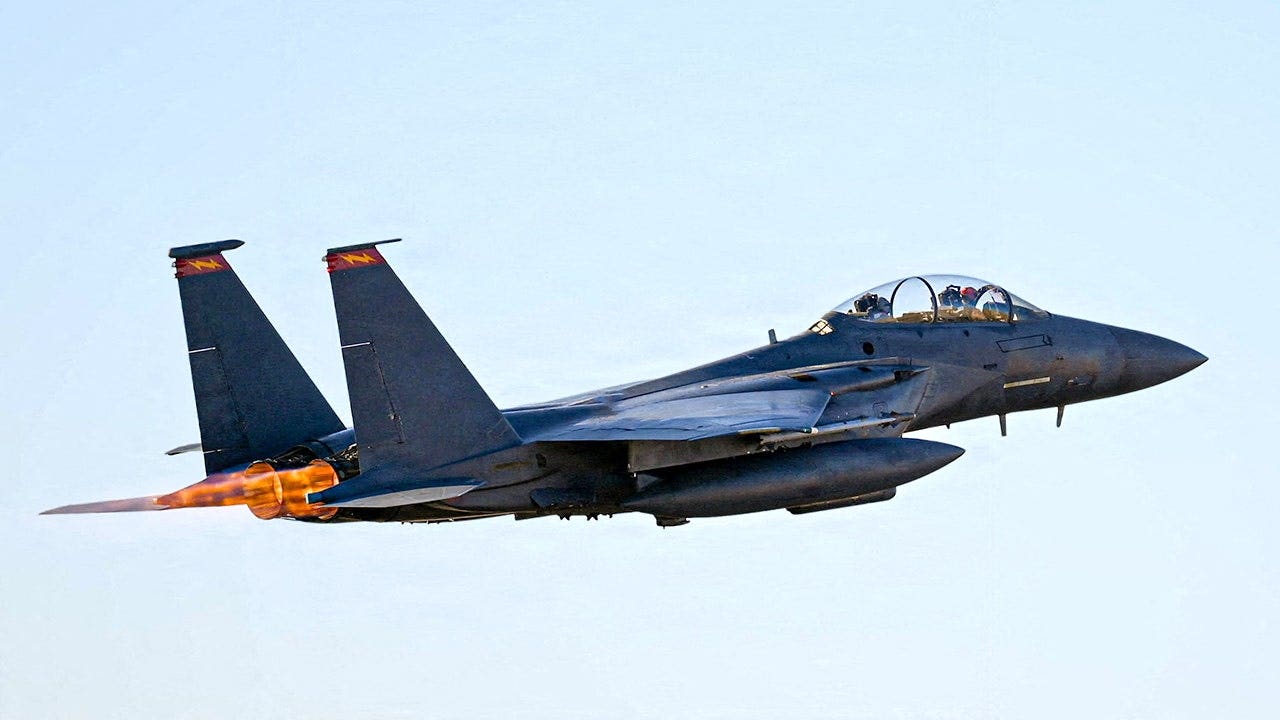
An F-15E Strike Eagle takes off for a combat flight in support of Operation Epic Fury during the Iran war at an undisclosed location on March 16, 2026. (U.S. Air Force/Reuters)
The moment a pilot pulls the ejection handle, the sequence begins almost instantly.
The canopy disappears in a fraction of a second. The seat rockets upward, forcing the body through intense acceleration.
When a pilot pulls the ejection handle, they are subjected to forces ranging from 14G to 20G (14 times to 20 times the force of gravity), according to military experts. For a 200-pound airman, this means their body feels as if it suddenly weighs 4,000 pounds.
“You’re no longer a decision-maker,” Gersten said, describing what happens to pilots who eject. “You’re a participant, and you’re on the ride.”
Within moments, the aircraft falls away behind them, while the crew is suspended in open air, waiting for the parachute to deploy.
That is the moment the two airmen over Iran would have faced after their aircraft was struck Friday, forcing them to eject and triggering a high-risk rescue operation over the weekend as U.S. forces worked to locate and recover them in hostile territory.
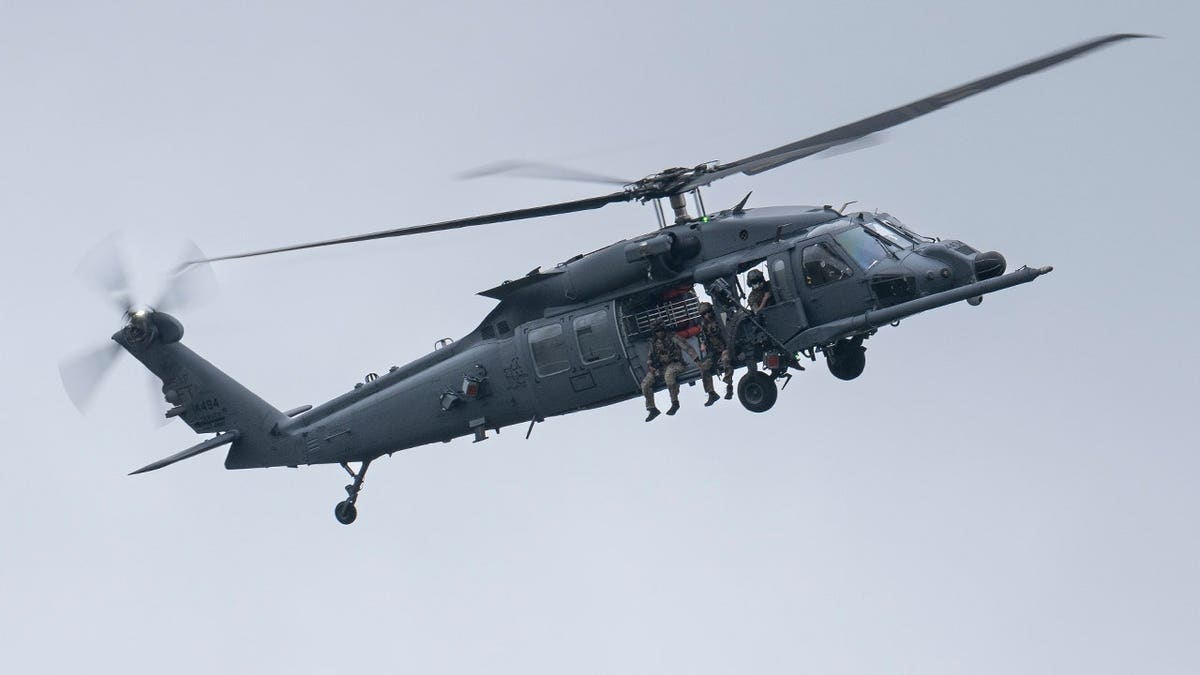
HH-60W Jolly Green II helicopters were involved in rescue efforts for a downed airman in Iran. (U.S. Air Force photo by Airman 1st Class Deanna Muir)
The successful recovery of both the pilot and the weapon systems officer in the F-15E in recent days underscored both the risks of operating in contested airspace and the importance of rapid rescue capabilities.
FORMER A-10 PILOT STRUCK BY MISSILE OVER BAGHDAD DETAILS TRAINING TO BE A ‘GOOD SURVIVOR’
Pilots never actually practice a real ejection.
Instead, they train for an emergency they hope never happens, relying on repetition, simulation and memorized procedures to prepare for a moment that unfolds in seconds.
“You’re relying on muscle memory for something you’ve never actually done,” Gersten said.
That training begins before pilots ever take their first flight.
“When they start flying, before they even get in the cockpit, they’ve been trained on how to get out of the aircraft in case something goes wrong,” Gersten said.
It starts in the classroom, where pilots learn how the ejection system works. From there, they move into simulators designed to replicate parts of the experience — without exposing them to the full force of a real escape.
HIGH-RISK EFFORT TO SAVE ‘DUDE 44’ CREW IS MOST INCREDIBLE COMBAT RESCUE IN US HISTORY
In one system, the ejection seat is mounted on a rail and launched upward, giving pilots a partial sense of the acceleration they would feel in an actual emergency.
But the training doesn’t stop once the seat “fires.”
Pilots are then strapped into harness systems that simulate a parachute descent, often using virtual reality to recreate the sensation of floating above the ground. There, they rehearse a strict sequence of actions — clearing their visor, checking their canopy, preparing their gear and steering toward a safe landing zone.
For the two airmen who ejected over Iran, that training helped make a violent, unpredictable escape survivable deep inside hostile territory.
Pilots are trained to prepare for a wide range of scenarios — from water landings to mountainous terrain — each carrying its own risks. (Jesus Olarte/Anadolu via Getty Images)
“There’s no checklist you can reference when you’re hanging in a parachute,” Gersten said. “You actually have to memorize them.”
At the end of the simulation, trainees are dropped to the ground to practice the final —and often the most dangerous — phase: landing.
“You have to be prepared, you have to be trained, otherwise you can hurt yourself,” Gersten said.
Before pulling the handle, pilots are trained to press their bodies straight back against the seat, keeping their spine rigid and aligned to reduce the risk of serious injury.
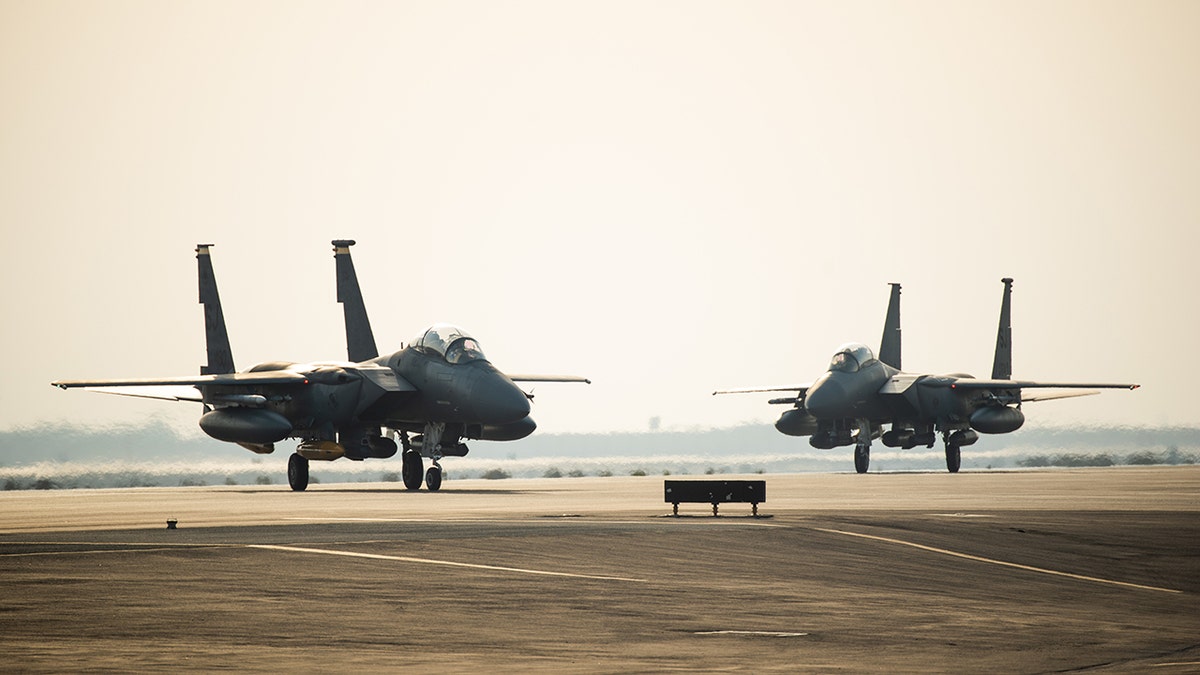
In two-seat aircraft like the F-15E, either the pilot or weapon systems officer can initiate an ejection. Once triggered, the system automatically ejects both airmen in rapid succession, separated by fractions of a second to prevent midair collision.
Even after the parachute deploys, the danger isn’t over.
“The biggest concern … is where am I going to land?” Gersten said.
CLICK HERE TO DOWNLOAD THE FOX NEWS APP
Pilots are trained to prepare for a wide range of scenarios — from water landings to mountainous terrain — each carrying its own risks. Landing injuries are common, particularly if a pilot is not properly positioned or prepared for impact.
For the two airmen who ejected over Iran, that training helped make a violent, unpredictable escape survivable deep inside hostile territory.
The pilot of the F-15E was picked up by U.S. forces later Friday. But the weapon system officer had to hide out in enemy territory until he was spotted by the U.S. and rescued Sunday.
“The second crew member — a heroic weapon system officer — was in tough shape after ejecting,” Trump said in a press conference. “He scaled cliff faces bleeding rather profusely, treated his own wounds, and contacted American forces. He was besieged by Iranian militia, but he managed to evade capture by scaling treacherous mountain terrain … he is a brave warrior.”
Modern systems have a survival rate of roughly 90% to 95%, according to military and medical studies, but injuries are common. Research shows that up to 30% of pilots suffer spinal fractures during ejection, while broader reviews have found major injuries in roughly one-third of cases.
If a pilot’s arms or legs are out of position, the extreme wind blast can cause what are known as “flail injuries,” leading to fractures or dislocations.