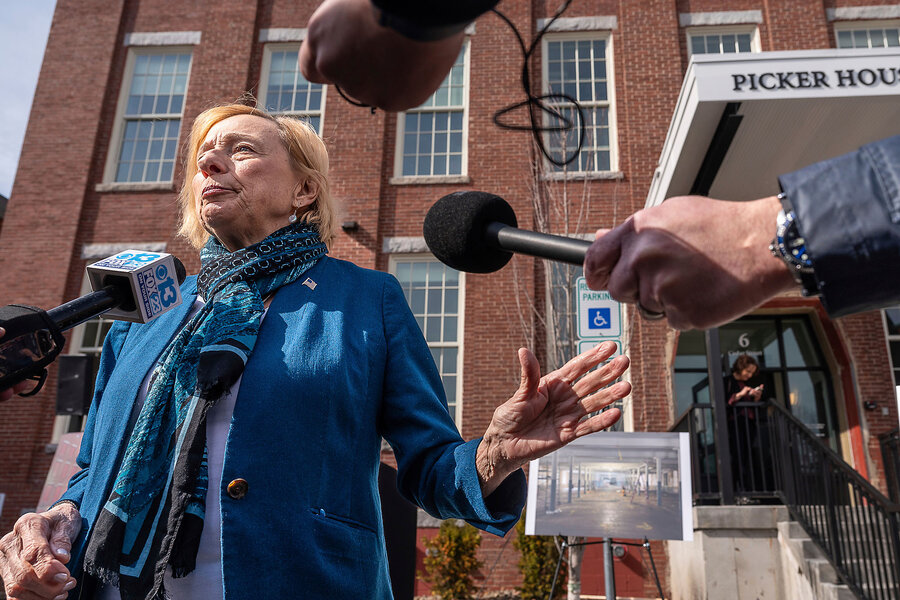
On a chilly night in early April, about two dozen people are gathered in a high school classroom to hear Democratic Gov. Janet Mills deliver her pitch for the U.S. Senate. A couple of staunch Mills supporters leave with lawn signs. Another woman remains undecided.
Evelyn Spencer, a paralegal from Sabattus, Maine, calls Ms. Mills an “incredible governor.” But as she filters out of the room, Ms. Spencer says she’s decided to cast her vote for a different kind of Democrat: oysterman and combat veteran Graham Platner.
She wants someone “focused on building power over time,” she says, and Ms. Mills has pledged to serve only one term. “I think she’ll have a really hard time in a deadlocked Senate as a freshman.”
Why We Wrote This
Democratic voters in Maine are outraged and alarmed about the Trump administration and are looking for a candidate who can meet this political moment. With relatively little daylight between Gov. Janet Mills and oysterman Graham Platner on issues, the nomination fight seems to be coming down to experience and style.
By normal predictors, Ms. Mills should be the heavy favorite to win the Democratic Senate primary here on June 9. She’s a two-term governor with a lengthy resume. And after decades in public service, voters trust that she’s vetted. Mr. Platner, on the other hand, is a political newcomer who has faced numerous scandals that raised questions about his character. Yet, he’s currently leading the polls by an average of 25 points, and garnering unmistakable grassroots enthusiasm – along with 15,000 volunteers – across the state.
Mr. Platner is also out-fundraising Ms. Mills, despite the fact that the governor has the support of Senate Minority Leader Chuck Schumer and the Democratic Party’s Senate campaign arm. Whoever wins will face off against five-term GOP Sen. Susan Collins.
Many Mainers make a point of saying that they like Ms. Mills, they really do.
But over and over, voters here also say they are craving change. Some want to see their party fight back more aggressively against President Donald Trump. Others are seeking a fresh vision for the economy. Some just think their party needs a new generation of leaders. As a 41-year-old outsider with no political record to defend, Mr. Platner seems to be successfully channeling all these sentiments, tapping into voters’ own hopes and frustrations.
“[Recent polling] suggests that the Democratic primary voters have made up their minds and are overwhelmingly going with the radical, doesn’t-have-a-resume-but-that-doesn’t-matter point of view,” says Colin Woodard, a Maine-based scholar of U.S. democracy and former journalist. “That’s a Mamdani-scale, kind of seismic shift,” he adds.
Maine Democrats are well aware of what’s riding on their choice. To capture control of the Senate this fall – and gain a real lever of power to push back against President Trump – they need a net gain of four seats. Maine, which in 2024 voted for Kamala Harris over Donald Trump by 52 to 46%, is one of the party’s top pick-up targets.
Still, Democrats have repeatedly fallen short in previous efforts to oust Senator Collins, a moderate Republican who at times has been willing to buck Mr. Trump and vote across party lines. With relatively little daylight between the two leading Democratic candidates on issues, this race seems to be coming down to questions of experience and style. Many Democratic voters are responding to the Trump administration with primal-scream levels of outrage and alarm, and are looking for a candidate who can meet this political moment – and help them win again.
“This is an opportunity to do our part here in Maine to change that balance of power” in Washington, says Keith Mestrich, chair of the Lincoln County Democratic Committee.
Charisma mixed with populist fury
In 1997, the same year Ms. Collins first joined the Senate, a 13-year-old Graham Platner received a glowing review in the Bangor Daily News for his portrayal of the Artful Dodger in a local production of “Oliver!”
“Platner is one of those rare young people who can find a sophistication and manner far beyond his years,” the theater critic wrote. “He’s graceful, alert, and confident, and you can’t help but want more of him.”

Melanie Stetson Freeman/Staff
Three decades later, that charisma is on full display on the campaign trail. Since announcing his candidacy last August, Mr. Platner has been aggressively crisscrossing the state, introducing himself in a husky baritone to voters through town halls and other events that routinely draw a crowd, even in sparsely populated corners of the state.
Speaking to more than 120 people in Millinocket – a town of about 4,000 – Mr. Platner comes across as comfortable and casual. Yet his stump speech is charged with a kind of righteous anger over what he describes as an American “oligarchy” and a rigged system that conspires against working people.
“Both the Republican Party and the Democratic Party at the national level have become subsumed by the exact same corporate interests,” he tells the audience. “We have it in our power to go after the wealth that has been stolen from the working class in this country for the last 50 years and put it into social programs all of us need, like education, universal child care.”
Mr. Platner “came out of the box as an economic populist – and he has galvanized people’s attention because of that, and because of his skills in speaking and igniting that deep angst” over a political system that many Americans believe is failing them, says Greg Marley, chair of the Knox County Democratic Committee.

Melanie Stetson Freeman/Staff
With endorsements from Sens. Elizabeth Warren and Bernie Sanders, Mr. Platner is often branded the “progressive” in the race. He, however, dismisses that label, saying his positions should rightfully be characterized as moderate.
“The idea that going after consolidated corporate power – which has bought our entire political system, which is why it doesn’t work for normal people – the idea that that is not the moderate position, is absurd,” he says in an interview with the Monitor.
A Marine and Army National Guard combat veteran, Mr. Platner served four tours in Iraq and Afghanistan. He openly talks about receiving monthly disability payments and health care from the Department of Veterans Affairs, saying those benefits allowed him to start his oyster farm. He hasn’t held political office or worked in government other than serving as harbormaster and planning board chair of Sullivan, Maine.
Some wonder if someone with his background might find the tradition-bound, famously slow-moving Senate a frustrating place.
“The big thing with Platner is his lack of political experience. Can he stand being in the U.S. Senate?” says Richard Kessler, a former Senate staffer and current chair of the Sagadahoc County Democratic Committee. “I think Janet Mills knows what’s going on, and would probably enjoy it. That’s the question for Platner: Would he?”
An experienced hand
Ms. Mills, who entered the race in October, has the advantage of already being a household name, with deep personal connections throughout the state. She has held fewer campaign events than Mr. Platner, speaking to more intimate crowds at house parties and dinners.
At the event in Auburn, she greets some voters by name, saying: “It’s good to see a lot of old friends.”

“When the United States Senate and the Congress of this country is not standing up to this president, then it’s time to change who’s in the Congress – and that means changing out Susan Collins,” she tells the group. “I don’t need the job. But I want to go save my country. Because I’m convinced if we don’t save our country, in the next two years or sooner, we may not have a country.”
A lifelong public servant, Ms. Mills spent years in the state legislature before becoming Maine’s first female attorney general and then, in 2019, Maine’s first-ever female governor. She won reelection handily in 2022 – the first candidate to win more than 50% of the vote since 1998.
She drew national attention last February for a clash with Mr. Trump over his executive order barring transgender athletes from participating on girls’ sports teams. When the president said at a White House meeting with governors that he would cut Maine’s federal funding if the state did not comply, Ms. Mills responded curtly: “See you in court.”
During her time as governor, Ms. Mills oversaw an expansion of Medicaid, a program offering free community college tuition, and universal free school lunches. And critically, she says, she’s already demonstrated that she can win the state.
“We put good people up against [Ms. Collins] in the past, but they’ve all been untested,” says Ms. Mills in an interview. “Unlike anybody else who has run against her before, I have a record of achieving things for many people. I have a record of winning statewide twice. And I have stood up to Donald Trump.”
Voters generally have confidence that Ms. Mills “knows her stuff,” says Lisa Marin, chair of the Washington County Democratic Committee, and that she’ll be ready to hit the ground running on day one.
“You need the right person in [the job] right away,” says Diane Grandmaison, who’s been a member of the Androscoggin County Democratic Committee since 1971. She plans to vote for Ms. Mills and volunteered for her in the past.

Melanie Stetson Freeman/Staff
Democrats absolutely have to take back the Senate this fall, Ms. Grandmaison says. The party simply can’t afford to take a chance on a risky candidate, she says, with possibly more skeletons in the closet.
“What difference will it make in six years,” she asks, if Democrats don’t find a way to stop Mr. Trump now?
Generational tensions
Ms. Mills has been dogged by some of the same generational tensions impacting the national Democratic Party.
The governor, who would be 79 when sworn in to the Senate, takes exception to the critique that she’s “another Biden.” She displays a different physical vigor at 78 than the former president did. But she has pledged to only serve one term, and some voters worry about the seat opening back up in six years, particularly since Maine Sen. Angus King, an independent who caucuses with the Democrats, is 82 and may not run for reelection in 2030.
Ms. Mills’ approval among progressive Mainers dipped in the second half of last year, which many attribute to frustration over her opposition to a voter-supported red flag law on guns and some labor-related bills, and her veto of a bill to expand sovereignty for the Wabanaki Nations.
“She is, in many respects, a relatively conservative Democrat – certainly not a bomb thrower,” says Mr. Woodard, whose past journalism has included work published in the Monitor.
A Morning Consult poll released in February found Ms. Mills tied with Minnesota’s Gov. Tim Walz for the highest disapproval rating of any Democratic governor in the country.
Mr. Platner, for his part, has faced questions about his character. Last fall, news outlets surfaced a number of now-deleted Reddit posts from 2013 in which he asked why Black people “don’t tip” and made what many regarded as dismissive comments about victims of rape. Other posts from 2021 disparaged rural voters. He has apologized, saying that he had PTSD after his tours: “This was a time in my life when I was struggling deeply.”
Mr. Platner also apologized for and covered up a tattoo on his chest resembling the Totenkopf, saying he hadn’t known the skull-and-crossbones symbol was associated with the Nazis. He got the tattoo while on leave in Croatia in 2007 when he was in the Marine Corps.
Two ads from the Mills campaign attacking Mr. Platner for his Reddit posts about women don’t seem to have moved the needle. Mr. Platner has continued to rise in the polls, and Ms. Mills has faced questions from voters about the wisdom of going negative against someone who could become the Democratic nominee. At the event in Auburn in early April, Ms. Mills said she would “absolutely” endorse Mr. Platner if he wins the nomination.
Many Platner supporters say they’re satisfied with his apologies and believe he’s changed. “I have strong feelings about women’s issues,” says Barbara Adams, a retired special education teacher. “He’s not the things he’s said.”
Indeed, recent polls have found Mr. Platner rated more favorably by voters than Ms. Mills or Ms. Collins. Head-to-head matchups show Ms. Mills neck-and-neck with Ms. Collins, while Mr. Platner leads both.
Regardless of which candidate wins the nomination, party leaders aren’t worried about turnout this fall. This year’s caucuses to elect Democrats to the state convention saw nearly 20% higher turnout than in 2024, says Marcia Myers, chair of the Hancock County Democratic Committee.
“People are not apathetic,” she says. “People are really ramped up.”