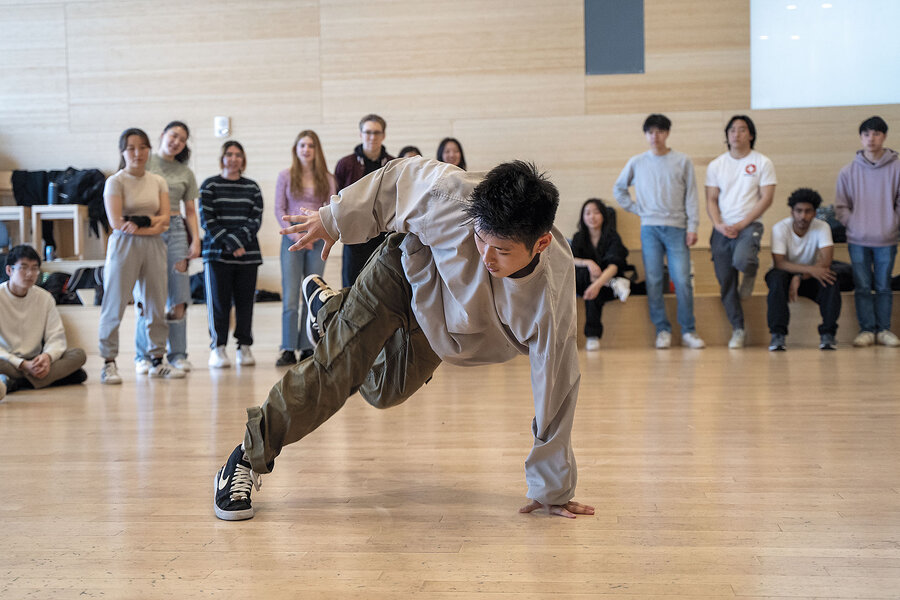
On a recent gray and dreary day, lecturer Chesney Snow circles a studio at Princeton University’s Lewis Center for the Arts, surveying students who are role-playing on yoga mats. Their aesthetic of Nikes, shell-toe Adidas, and Pumas matches the subject perfectly: hip-hop.
Mr. Snow’s students – seven women and one man – are preparing to perform spoken word and body movements as an accompanist plays a black upright piano.
“Center yourselves,” Mr. Snow instructs. “Being vulnerable in hip-hop is really, really central to the work that we have to do.”
Why We Wrote This
Colleges are adding courses and even degrees in hip-hop, signaling a growing recognition in academia of the musical genre as an art form. Educators and students believe career paths will keep opening.
The course name is Miss-Education: The Women of Hip-Hop.
Although an elective on this campus, hip-hop has advanced in academia, from the first class on the genre being taught at Howard University in 1991 to minors and certificates, and now to full degrees in hip-hop offered at schools like Johns Hopkins University’s Peabody Institute in Baltimore and Loyola University New Orleans. Some educators say hip-hop studies can boost student engagement and foster culturally relevant pedagogy. It also bridges the gap between academic theory and lived experience.
A Broadway actor and singer who founded the American Beatbox Championships, Mr. Snow envisions the class as a study of feminism in hip-hop. But he also wants it to be performance-based, similar to the popular early aughts MTV program “The Lyricist Lounge Show,” which blended sketch comedy and hip-hop. He says he uses musical theater, comedy, and hip-hop to delve into critical social issues.
His students read scholarly books, learn the importance of documenting history, and conduct research through interviews. Performance is next, with original student pieces in the pipeline.
How we got here
Hip-hop music, created in the 1970s on New York City streets, was once considered a fad, but it has grown to become arguably the most influential music genre in the United States and a dominant force globally, creating billionaire artists and producers and dominating music charts. Hip-hop has influenced global fashion and social justice movements and solidified itself as a major art form. From rapper and music producer Kendrick Lamar’s Pulitzer Prize to classes in esteemed university lecture halls, hip-hop has solidified its status.
Academics say that, like jazz in its early days , hip-hop has relatively few academic programs for now, but it will keep growing.
Hip-hop practitioners are being hired to teach, students are writing dissertations, and more graduate courses that draw research dollars are being taught. Money has been pumped into conferences at institutions such as Ohio State University, Columbia University, the University at Buffalo, and Rutgers.
Harvard University started the Marcyliena H. Morgan Hip Hop Archive & Research Center in 2002. In 2012, the University of Arizona was the first to offer a minor in hip-hop studies. A year later, Harvard offered the first Nasir Jones Hip Hop Fellowship.

Jon Sweeney/Lewis Center for the Arts, Princeton University
In 2021, Loyola University New Orleans offered the first Bachelor of Science in Hip Hop and R&B. In January of this year, the University of Illinois Urbana-Champaign board of trustees approved a Bachelor of Arts degree in Hip Hop Culture and the Arts. The Illinois Board of Higher Education is reviewing the proposal.
From study to career
Bachelor’s programs in hip-hop signal not only students’ willingness to invest four years studying it in college. It also means students believe hip-hop degrees will help them transition into marketable careers spanning from hip-hop artists and producers to teaching and researching the art form’s contributions to the world, similar to jazz more than half a century ago.
“Hip-hop has been a galvanizing grassroots arts movement that grew from our cities, including having a vibrant history and presence here in Baltimore,” says Fred Bronstein, dean of the Peabody Institute, the country’s oldest conservatory, at Johns Hopkins University. Mr. Bronstein says that the major grew from a popular class that composer and pianist Wendel Patrick started teaching in 2018. Enrollment in the course has tripled over the last five years, he says.
The major blends Peabody’s music engineering and technology programs with performance training, the foundation of its strong reputation.
Mr. Patrick leads the program and recruited Grammy Award-winning rapper Lupe Fiasco to be a visiting professor. Mr. Fiasco has held other prominent faculty appointments at schools such as Yale University and the Massachusetts Institute of Technology.
“We in academia have to break down artistic silos, expand the canon, and teach all our students to think more broadly about what it means to be a musician,” Mr. Bronstein says via email.
Using a hip-hop lens to see the world
Timothy Welbeck is an assistant professor of Africology and African American Studies and the director of the Center for Anti-
Racism at Temple University. Last year, he began teaching a class called Kendrick Lamar and the Morale of m.A.A.d City, which uses five of Mr. Lamar’s studio albums – a blend of Black music art forms, such as rap, jazz, and rhythm and blues – to discuss themes like police brutality, housing segregation, and urban policy.
In addition to his Pulitzer, Mr. Lamar is an Emmy Award-
winner who recently became the most decorated Grammy Award-winning rapper of all time.
“It’s a legitimate form of academic study, but it took a long time for the academy to figure that out, and there was a lot of stumbling along the way,” Mr. Welbeck says.
He says that it was hard for academics to wrap their heads around what hip-hop studies can be.

Jon Sweeney/Lewis Center for the Arts, Princeton University
“If we can talk about Shakespeare, we can talk about Kendrick Lamar. If we can talk about Beethoven and or Chopin and Bach, and talk about baroque music and how that illustrated the tones and the impressions of the time that it was released, we can talk about how ‘good kid, m.A.A.d city’ reflected the times that it was released,” Mr. Welbeck says, referring to Mr. Lamar’s second studio album.
How it relates
Toby Jenkins, a professor of higher education at the University of South Carolina and associate provost for faculty development, teaches a course on hip-hop culture and has documented some of the history of hip-hop and academia. She says that she treats hip-hop as a tool for student engagement.
“I think it is attractive to students to have institutions that have unique offerings that seem exciting,” Dr. Jenkins says. “[Students] expect it to feel a little bit different than high school felt, and to be more life-giving and exciting.”
The class she teaches this semester touches on hip-hop culture and elevates themes in everyday life, such as what it means to have ambition, to affirm people in their lives, or to be creative and authentic to oneself. There’s the music and the genre’s visual and audio components. Students create playlists for each class and discuss reading material through a hip-hop lens.
“As some scholars become really important, you see somebody writing a book, and they’re on The New York Times Best Seller list, then [hip-hop] becomes okay,” Dr. Jenkins says. “You see an institution like Harvard creating the Nas fellowship, and it becomes OK. Harvard has a whole archive on hip-hop. This is viable.”
“A serious class”
Back at Princeton, second-year neuroscience major Rachel Adjei participated in a class recently where students interviewed Grammy-nominated rapper Rah Digga over Zoom to learn about documenting oral history.
“What really drew me to the class was the title, the Miss-
Education portion,” says Ms. Adjei, referring to the play on the self-titled iconic debut solo album “The Miseducation of Lauryn Hill,” the first hip-hop album to win a Grammy for Album of the Year.
“Not only are we going to be working with hip-hop and creating raps, but also embodying them on stage and giving yourself a presence,” she says.
Faculty understand that parents paying more than $80,000 a year for their children to attend college might be dubious. But as hip-hop on campus grows, so might the career opportunities that have nothing to do with performance, educators say.
Jediah Worrell is a second-year African American studies major. She was all smiles as she and her two group partners performed their skit in Mr. Snow’s class. An amateur rapper herself, she raced to a microphone in front of a camera, where Rah Digga smiled back and answered her questions. She enjoys the class, but when she told her mom about it, she got questions.
“My mom’s response was, ‘So when are you going to take a serious class?’” she laughs and shakes her head. “But I was trying to explain to her, as an African American studies major, this is a part of my field. This is also a part of the culture and what we’re studying, the interior of Black life.”