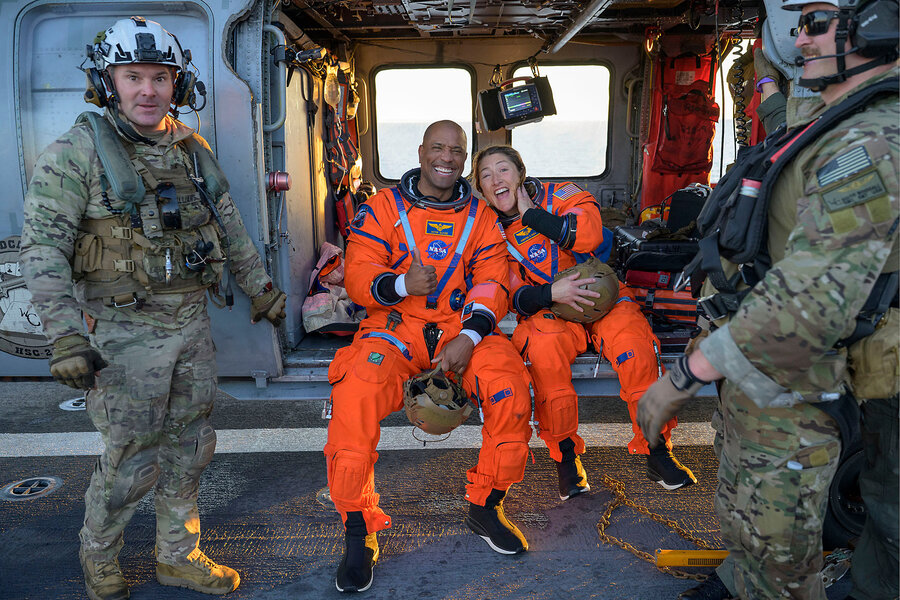
It was only a test flight, but it was a test flight for the ages.
After a nerve-wracking six-minute communications blackout, during which the Artemis II Orion spacecraft plunged through the Earth’s atmosphere at over 25,000 miles per hour – reaching temperatures of over 4,000 degrees Fahrenheit – the Artemis II crew splashed down safely in the Pacific Ocean Friday.
When the four-person crew of commander Reid Wiseman, pilot Victor Glover, and mission specialists Christina Koch and Jeremy Hansen launched into space, NASA had a five-decade data gap in its records. The agency last flew humans to the moon in 1972. Some muscle memory would have to be relearned.
Why We Wrote This
The Artemis II mission has concluded with a safe return to Earth. The mission rekindled ‘moon joy’ for the public and made scientific advancements, which NASA aims to expand during the next phases of the ambitious Artemis program.
NASA had two broad goals for Artemis II: ensure the Orion spacecraft – the home for all astronauts on future Artemis missions – can operate safely in deep space; and learn as much as they can about the moon through observations during its lunar flyby.
The 10-day mission was both record-breaking and an almost complete success.
Not only did the crew collect valuable data about Orion and about the moon – and then return safely – but they appear to have galvanized public interest in space exploration a half century after the Apollo program took humans to the moon. The crew set a record for the farthest distance traveled from Earth (252,756 miles), and they viewed areas of the moon never seen by human eyes.
NASA now turns its attention to future moon missions, with the ultimate goal of building a moon base in the 2030s and launching human crews to Mars in the 2040s.
History tells us that sustaining government funding, public support, and mission safety will be easier said than done. On Saturday, however, the Artemis II crew and NASA leaders began to process the magnitude of the mission during their first public comments since splashdown.
“You haven’t heard us talk a lot about the science, about the things we’ve learned,” said Mr. Hansen. “They’re there, and they are incredible, but it’s the human experience that is extraordinary for us.”
“What you saw was a group of people who loved contributing, having meaningful contribution, and extracting joy out of that,” he added.
Artemis II was the “opening act in America’s return to the moon,” NASA administrator Jared Isaacman said Saturday. “Artemis III will start being assembled, and the next crew will begin playing their part as we return to the lunar surface, we build the base, and we never give up the moon again.”
Here are five key takeaways from the mission:
Orion works (mostly)
The teardrop-shaped spacecraft had already flown around the moon and back in the Artemis I mission in 2022, but that mission was uncrewed. Artemis II was the vital test of the capsule’s so-called “human systems,” such as life support and temperature control.
One human system that had almost immediate problems was the toilet. Just hours into the mission, the crew reported that the specially designed microgravity commode had jammed. Despite days of troubleshooting, the crew and NASA engineers on the ground were unable to diagnose and fix the problem. They hope to find a solution once Orion returns to the Kennedy Space Center in the coming weeks.
Another, more serious, issue appears to have been resolved. The heat shield on the Artemis I Orion capsule suffered cracking and abrasion during re-entry. NASA reported that it had identified the cause and had adjusted the re-entry angle for Artemis II to reduce stress on the heat shield. More analysis will follow, but the changes seem to have worked.

Testing Orion’s maneuverability was also an important goal of the mission. The capsule reportedly passed those tests with flying colors. The crew successfully practiced docking the capsule to another ship – an important test, as this is how future Artemis crews will dock with the spacecraft they will pilot to the lunar surface.
“Overall, guys, this flies very nicely,” Mr. Glover reported during the test.
Artemis II yielded new science
The crew returned from their seven-hour journey around the far side of the moon with dozens of spectacular images of the lunar surface and of the Earth from space. NASA expects to process hundreds more in the weeks ahead.
In some cases, they saw regions of the lunar surface never before seen by humans. These early impressions will help guide NASA’s future exploration and scientific research of the lunar surface, including the selection of landing sites and the location of a moon base.
Artemis II also represented the first time a science team was integrated into Mission Control itself. The lunar science team had a physical desk in the Mission Control room, and during the flyby, a lunar scientist communicated with the crew directly through CAPCOM, the designated communication channel to Orion.
Artemis II also featured the first major test of the NASA Deep Space Network, a global array of large radio antennas that allows Mission Control to maintain communication with spacecraft on interplanetary missions. Mid-mission, flight director Rick Henfling said the network was performing “exceptionally.”
The lunar fab four captured hearts
The crew themselves can be chalked up as another success of Artemis II.
Ms. Koch and Mr. Glover became the first woman and the first Black man, respectively, to travel around the moon. Jeremy Hansen, an astronaut with the Canadian Space Agency, became the first non-American to travel into deep space.
The crew’s charisma and camaraderie shone through during the mission. Ms. Koch christened herself “the space plumber” as the Orion battled its toilet issue.
The most poignant moment came during the lunar flyby. When the crew spotted two previously unknown craters, Mr. Hansen suggested that the second be named “Carroll,” after Carroll Taylor Wiseman, Mr. Wiseman’s late wife.
“It’s a bright spot on the moon, and we would like to call it ‘Carroll,’” he added, spelling the name out for Mission Control. The entire crew were soon in tears, embracing each other in a zero-gravity hug.
“It was a powerful moment up here,” said Mr. Wiseman during a call with the press on April 8. “That was, I think, where the four of us were the most forged, the most bonded.”
On Saturday, the crew gathered for multiple group hugs and demonstrated how they would sync their watches to regroup and center themselves during the mission.
“Even bigger than my challenge of trying to describe what we went through, the gratitude of seeing what we saw, doing what we did, and being who I was with, it’s too big to just be in one body,” said Mr. Glover.
Steps for future missions are underway now
Preparations for Artemis III have already begun. That mission aims to practice, in low-Earth orbit, docking the Orion capsule with lunar landing spacecraft designed by private companies. The first flight simulations for Artemis III will be scripted this week, NASA officials said. Training for Mission Control staff will begin next week. The crew will be selected “pretty soon,” NASA astronaut Randy Bresnik told reporters on Friday.
NASA has contracted with private space companies SpaceX and Blue Origin to build the landing spacecraft. Blue Origin’s “Blue Moon” lander is being shipped to Kennedy Space Center soon, Mr. Amit Kshatriya, NASA associate administrator, said last week. More tests of the SpaceX Starship lander are scheduled for this month, but Mr. Kshatriya said they are hoping to send that ship to Florida “relatively soon.”
He added that the repair and repurposing of the Mobile Launcher 1 – a 377-foot tower used to stack the Artemis I through III rockets – at the Kennedy Space Center could be completed as soon as the end of this week.
A moon base beckons
NASA’s next goal, particularly in the context of a new space race with China, is to establish a permanent human presence on the lunar surface in the 2030s.
It’s an ambitious task, and a lot has to go right, experts say, starting with successful Artemis III and Artemis IV missions. These missions would ideally see a human walk on the moon in 2028 for the first time since Eugene Cernan stepped off the lunar surface during the Apollo 17 mission in 1972.
Such an expedited timeline carries risks, but experts say that NASA’s recent safety record is encouraging.

Other technical challenges loom, including integrating NASA’s Mission Control with the control rooms at SpaceX and Blue Origin. (The recent experience integrating the lunar science team will help in that regard, NASA officials said.)
But the biggest obstacle to achieving the moon base goal is likely to be the same challenge NASA always faces: government funding.
During Apollo, NASA accounted for 4.4% of the federal budget at the agency’s peak. That figure now stands at around 0.4%.
The past 10 days have been thrilling, but reality could quickly douse enthusiasm, according to Joan Johnson-Freese, a senior fellow at Women in International Security and author of “Space as a Strategic Asset.”
“I’ve seen more optimism [this week] than I’ve seen in 40 years, but I’m still skeptical,” she says. “Multiple times we’ve been here and not been able to sustain it.”
For example, the Apollo program canceled three missions due to budget cuts and a lack of public interest, among other factors. The Artemis program has the wind in its sails right now, but NASA will have to find a way of maintaining that momentum once the world moves on.
Artemis II “has reawakened the public to the whole joy and thrill of space exploration,” says Dr. Johnson-Freese. But “the thrill only takes you so far.”
“We can overcome technological challenges, but whether we can overcome commitment challenges is something else.”