After U.S. talks with Iran to end their six-week-old war broke down Sunday following 21 hours of negotiations, the White House is once again ratcheting up pressure on the regime.
The U.S. Navy has been directed to put in place a blockade designed to force Iran to reopen the strategically vital Strait of Hormuz, while preventing Tehran from profiting from its closure, President Donald Trump announced after the failure of weekend discussions.
The blockade will go into effect at 10 a.m. Washington time on Monday, according to a statement from U.S. Central Command, which runs U.S. military operations in the Middle East.
Why We Wrote This
US-Iran talks failed over the weekend, with Tehran’s nuclear program a key obstacle. President Trump has ordered a Navy blockade designed to pressure Iran to open the Strait of Hormuz.
It will be enforced “impartially against all vessels of all nations entering or departing Iranian ports or coastal areas,” the command said.
Officials have not ruled out returning to the peace table during the two-week ceasefire, which expires April 22.
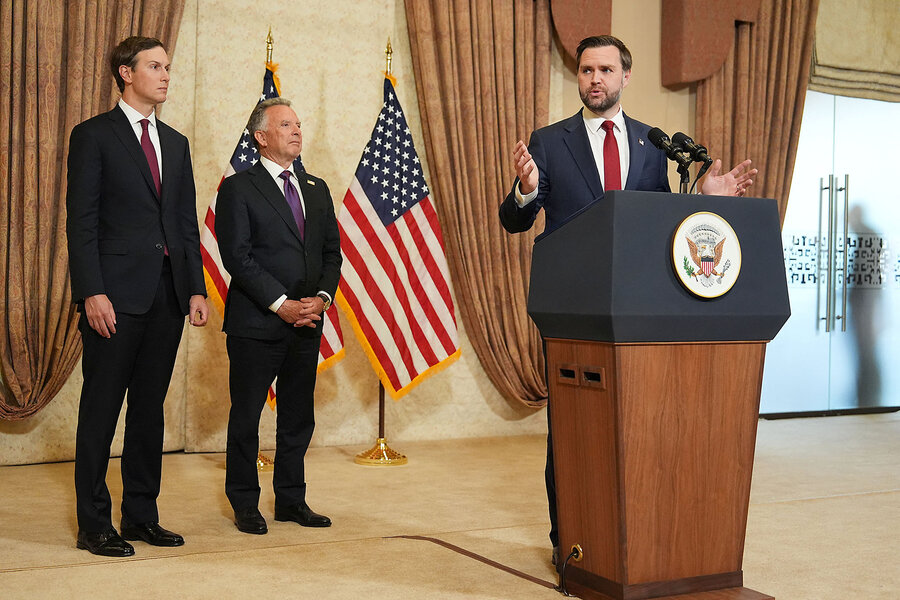
Vice President JD Vance, in Pakistan for the discussions, said a major sticking point was that the U.S. does not “see a fundamental commitment of will” on Tehran’s part to give up pursuing nuclear weapons.
“We hope that we will” in the days to come, he added.
Iran struck a defiant tone after the talks, blaming the U.S. for “excessive” demands. Tehran’s lead negotiator, Mohammed Bagher Ghalibef, said that Washington had “failed to win Iran’s trust.”
President Trump said in a social media post on Sunday that Vice President Vance, along with Special Envoy Steve Witkoff and the president’s son-in-law Jared Kushner, have become “very friendly” with Iran’s top three negotiators.
But Tehran was “unyielding” on the subject of retaining nuclear power, which Mr. Trump said he could not allow “in the hands of such volatile, difficult, unpredictable people” leading the regime.
The U.S. delegation is reportedly demanding that Iran “hand over or sell” its highly-enriched uranium stockpile.
Tehran wants, among other things, war reparations and the unfreezing of $27 billion in Iranian funds as part of the deal.
For now, the only vessels moving through the Strait of Hormuz, through which one-fifth of the world’s oil usually flows, have been Iranian and Iranian-approved vessels, according to an analysis released Sunday by the Institute for the Study of War think tank.
The U.S. Navy blockade will involve interdicting any vessel that may have paid a toll to Iran to transit the strait, Mr. Trump said.
The blockade, if effective, will cost Iran an estimated $435 million a day in lost imports and exports, said Miad Maleki, former senior Iran sanctions official at the Treasury Department and now a senior adviser at the conservative Foundation for Defense of Democracies think tank.
“The blockade makes continued [Iranian] resistance economically impossible,” he added in an FDD analysis Monday morning.
In the meantime, two U.S. Navy guided-missile destroyers, the USS Frank E. Peterson and the USS Michael Murphy, crossed the Strait over the weekend to begin minesweeping operations, according to U.S. Central Command.
“We will share this safe pathway with the maritime industry soon to encourage the free flow of commerce,” Adm. Brad Cooper, who leads the command, said in a statement Saturday.
But mine clearance is difficult and time-consuming work, and the U.S. Navy’s capabilities on that front have lagged behind its other high-tech specialties.
Some Gulf countries will also support mine-clearing efforts, Mr. Trump said. Several other nations reportedly will, too, including Britain. Officials there said last month that the U.K. was drawing up plans to send minesweeping drones to help reopen the strait.
Iran has used the threat of drone and missile barrages as well as a “limited number of mines” to declare a “hazardous area” throughout the strait –except for Iranian territorial waters, where Iran then imposes fees, the ISW report notes.
At its narrowest, the strait is about 21 miles wide. The territorial waters of Iran and Oman overlap across most of that area.

While the U.S. military has destroyed most of Iran’s larger naval vessels, the job of laying mines can be carried out by small speed boats that are easy to build and hide. By some estimates, Iran’s Islamic Revolutionary Guard Corps had hundreds of these small boats on hand before the war began.
Iran may not be able to find some of the mines it has put in the strait, which could, in turn, be complicating Tehran’s compliance in fully reopening the waterway, The New York Times reported Friday.
For now, there remains ongoing confusion about what, precisely, the two-week ceasefire agreement entails, some analysts say.
“The lack of a public, mutually-agreed upon document establishing the ceasefire requirements makes adherence to the ceasefire difficult to establish,” the ISW report concluded.
The Trump administration’s delegates left Pakistan over the weekend after making “our final and best offer,” Mr. Vance said Sunday. “We’ll see if the Iranians accept it.”