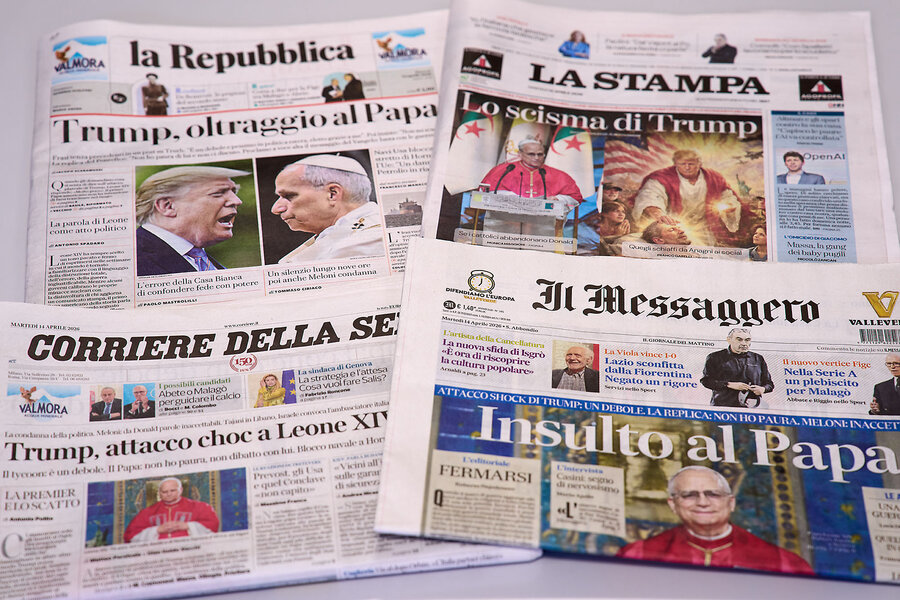
President Donald Trump has never had an easy relationship with Christian conservatives. The thrice-married real estate developer and former reality TV star is widely seen as not particularly religious – and not all that engaged on issues near to social conservatives’ hearts, starting with abortion.
Lately, however, tensions that were once smoothed over by a common political agenda have flared out into the open. When President Trump used vulgar language on Easter Sunday, posted a Jesus-like image of himself on social media, and attacked the pope online, some prominent religious supporters pushed back publicly, calling the posts blasphemous and suggesting Mr. Trump should apologize.
And while the firestorm seems to have passed for now, complaints among religious conservatives linger – from affordability concerns to frustrations over abortion policy, signaling a potential warning light about a critical part of the GOP base in the run-up to November’s midterm elections.
Why We Wrote This
President Donald Trump’s broadsides against the pope, alongside controversial memes, reveal cracks in his support from religious conservatives. That discontent is amplified by some policy disappointments, particularly around abortion.
With Mr. Trump’s Republican Party in serious danger of losing the House and possibly even the Senate, the president needs to keep these core supporters happy and energized, say experts on the politics of religion, or some might decide to stay home.
“The evangelical community is still Trump’s strongest group, but he’s beginning to wear on them, too, especially more moderate folks,” says Jim Guth, a scholar on the religious right at Furman University in South Carolina.
The AI-generated meme appearing to portray President Trump as Jesus Christ healing a sick man, posted on the president’s Truth Social account, drew an unusual amount of pushback among many Christians, who took offense. It was later taken down, with the president telling reporters he thought it depicted him as a doctor.
Once the post was deleted, some prominent allies who had made critical comments were quick to forgive.
“I love the President and I’m so grateful he’s in the Oval Office,” conservative influencer Riley Gaines wrote on the social platform X Monday night, after Mr. Trump had attacked her over her earlier response. “The truth social post missed the mark. It’s now deleted. Amazing!”
Yet the initial pushback from Trump supporters over that and his other controversial posts was a notable break. And Christian conservative leaders say other issues are hurting Mr. Trump’s standing with his religious base. Opponents of abortion rights are unhappy that the Trump administration has failed to take action against the mailing of abortion pills to states that ban the procedure. In fact, since the Supreme Court struck down the nationwide right to abortion in 2022, the number of abortions in the United States has risen.
Mr. Trump delivered on his first-term promise to add conservative justices to the Supreme Court – leading to the overturning of Roe v. Wade. But many Christian-right activists are now upset over the lack of action by the Trump Food and Drug Administration to restrict mail-order abortion medication.
At the same time, religious conservatives share many of the same concerns as nonreligious voters, experts say. They are feeling the pinch of more expensive groceries, higher gas prices, and housing affordability.
“Just like the average voter, the economic issues – the ability to provide for your family – those really are driving issues as well” for religious voters, says Tony Perkins, president of the Family Research Council.
Although Mr. Trump’s war against Iran is partially to blame for the boost in inflation, many evangelical conservatives support the war, as it takes on Iran’s Islamic theocracy and seeks to protect the state of Israel, a core priority of conservative Christians.
Mr. Perkins, who supports the war, says he thinks it could end up being a “net positive among evangelical believers, if it ends the right way” – that is, ensuring the Iranians have no capacity to enrich uranium and produce nuclear weapons, he explains.
Still, the veteran evangelical leader is unhappy about Mr. Trump’s recent social media posts, which he says were “very troubling to many evangelical Bible-believing Christians.” They include the lengthy Trump statement on April 12 that Mr. Perkins calls “picking a fight with the pope.”
Slipping support in the polls
On Wednesday, Mr. Trump reposted another AI-generated image of himself, this time being embraced by Jesus. The originator of the post said, “God might be playing his Trump card!” After the previous uproar, one might wonder why the president would return to Jesus imagery, which could potentially be seen as him mocking his own supporters.
Before Mr. Trump’s recent controversial posts, polls showed he still enjoyed relatively strong support from white evangelical voters, with 69% job approval in January, according to the Pew Research Center. But that’s down from 78% a year earlier. And while Mr. Trump still has majority support in the Pew poll among white Evangelicals for “all or most of his policies,” that percentage has also declined – from 66% in January 2025 to 58% in January 2026.
How polling of Mr. Trump’s strongest cohort might be affected by the latest controversies remains to be seen. Ryan Burge, an expert on religion and polling at Washington University in St. Louis, says he’s found that memes and social media posts have “a very short shelf life” in terms of impact on public opinion. But, he adds, “You know what does not have a short shelf life is gas prices.”
“If we do see a significant drop in approval now, it would be more about the gas prices than it would be about tweeting memes and yelling at the pope,” Professor Burge says.

Mr. Trump’s standing with Catholics presents a more complex picture, especially since the new pope is American and Vice President JD Vance is Catholic. On Tuesday, Vice President Vance criticized Pope Leo XIV for posting an anti-war comment on X, saying the pope should “be careful when he talks about matters of theology.”
Others say a pope who is engaged with world events can’t easily maintain a nonpolitical stance.
“The fact that we have an American pope means that he’s necessarily mixed into the political fabric of our country,” says the Rev. Robert Gahl Jr., an associate professor at the Catholic University of America.
“There’s a significant number of Catholics who supported Trump, and they’re like, ‘Oh, well, I’m going to ignore the pope when he talks about politics,’” Father Gahl adds. “But that isn’t a good thing at all, because Christianity is supposed to infuse our daily life, and it’s supposed to transform society. We have a challenge as Christians to act in the public square.”
Social conservatives drive GOP voter turnout
Christian anti-abortion activists like Kristi Hamrick, who runs communications for Students for Life of America, point out that the midterms will likely hinge on voter turnout. If Mr. Trump’s religious conservative base gets offended by his social media activity and doesn’t turn out to vote, Republicans will be in trouble, she says.
Ms. Hamrick, along with many other anti-abortion activists, is focused right now on the fight to restrict access to abortion medication, or “chemical abortion” – starting with making sure such medication cannot be mailed into states that have banned the procedure. And so far, she doesn’t see the Trump administration evincing much urgency on the matter.
Mr. Trump’s social media posts are one thing, Ms. Hamrick says. But “Frankly, I am way more frustrated by the fact that chemical abortion pill policy, which is entirely federal, has been stagnating in this administration.” If Mr. Trump wants to do more to motivate his base, she says, he should prioritize this issue.
After all, she notes, religious conservatives are typically a key component of GOP turnout – going door to door, reaching out to like-minded friends and neighbors to make sure they vote. A lot will hinge on whether they’re energized.
“The social conservatives have really been the ground game of the GOP for a long time,” Ms. Hamrick says.