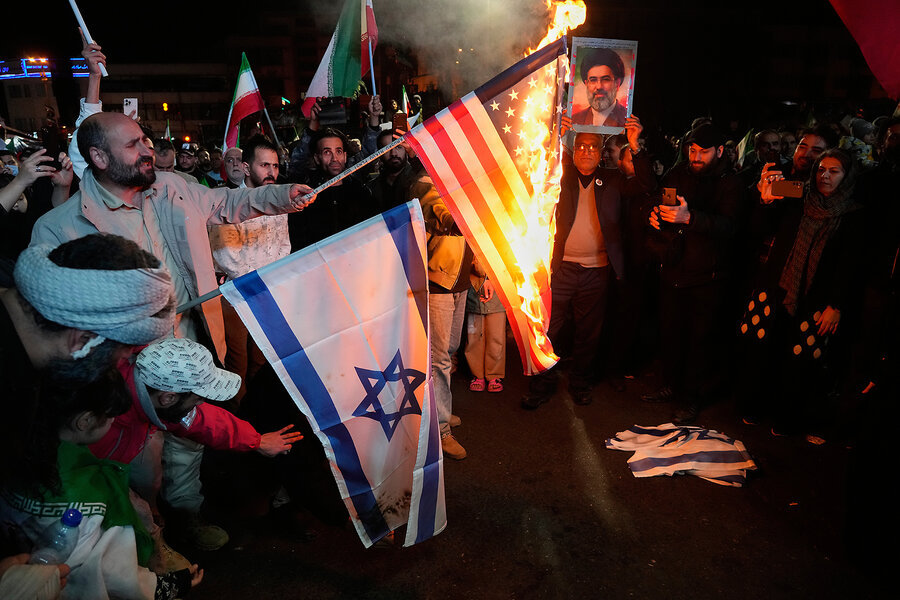
Within hours of U.S. President Donald Trump’s April 7 announcement of a two-week ceasefire with Iran, Iranians poured into Tehran’s Revolution Square, cheering, honking horns, and waving Iran’s tricolored flag.
Some burned the Stars and Stripes amid angry chants.
The display of nationalism was undoubtedly not the scene Mr. Trump envisioned when, in late February, he called on Iranians to “rise up” and join the U.S.-Israeli effort he had just launched to bring the Islamic Republic to its knees – if not end it altogether.
Why We Wrote This
For decades, perceptions of U.S. power did not rely on the use of America’s unrivaled military might. In the Iran war, a militarily inferior adversary used asymmetric warfare to resist that might, and allies whom President Donald Trump did not consult are voicing concern over the state of U.S. strategic thinking and planning.
Following hard on the president’s threats to bomb Iran back to the Stone Age and destroy its civilization, the scene was telling for America’s friends and foes alike.
It was one more exhibit in a mounting pile of evidence that, with this war, something had changed, that the global superpower was no longer the fearsome enforcer and unchallenged leader of an international order that had prevailed since World War II.
In the generations since that war, perceptions of America’s awesome military and economic power, and the diplomatic problem-solving that relied upon it, were established that did not depend on its use. It was an era of a confident and largely benevolent superpower – Ronald Reagan’s “shining city upon a hill.”
“For much of the post-World War II era, the United States largely acted as if it understood that powerful states benefit when they are perceived as mostly honest and reliable, even virtuous, and generally motivated by a desire to make the world better,” says Stephen Walt, a professor of international relations at the Harvard Kennedy School.
“The United States has not been bashful about using its military power in the past,” he says. “But this war has demonstrated how the superpower that has always tried to cloak its use of power with legitimacy and, as a last resort, has become a disruptive and crude rogue state.”
The whiplash the world is now experiencing as a result of the Iran war appears certain to continue for weeks, if not months. After the United States and Iran failed to reach any agreement during one day of talks in Pakistan on April 11, President Trump ordered U.S. naval forces to impose a blockade of the Strait of Hormuz.
Gulliver vs. asymmetric warfare
No one is questioning America’s unrivaled military might or its ability to deploy unequaled capabilities to deliver awe-inspiring tactical results. Acknowledgement is universal that few other powers could have mounted missions like the January snatching of then-Venezuelan President Nicolás Maduro from his Caracas compound, or the rescue this month of a downed airman from a mountainside deep inside Iranian territory.
But perhaps just as stunning for the world is how Gulliver has been tied down by a Lilliputian – a militarily inferior but clever opponent whose ropes to restrain the behemoth were asymmetric warfare and the seizure of a key global economic choke point – the Strait of Hormuz. Even as Iran announced on April 17 that the passage was open to traffic for the remainder of the ceasefire, a U.S. blockade of Iranian ports continued.
Equally unsettling for U.S. allies and partners – not to mention instructive to adversaries – is what the war says about the state of U.S. strategic thinking and planning.
The Iran war was a “stupid idea” and a “foolish mistake,” French President Emmanuel Macron said during a visit to Seoul, South Korea, in early April. Comparing the latest U.S. war with past military interventions in Iraq, Afghanistan, and Libya, he asked whether anyone now considers any of those wars “a good idea.”
The superpower that built its global reach and superiority with a constellation of alliances unequaled in history had launched a war without consulting those allies or providing an initial explanation of the war’s objectives.
Secretary of State Marco Rubio did offer key allies a report on the war’s aims at a March 27 meeting in Paris of foreign ministers from the Group of Seven countries, but it came a month after the start of hostilities. Listing objectives he claimed had been “clear from the very first night the president announced” the war, Mr. Rubio said, “We’re going to destroy Iran’s navy, destroy their air force … basically destroy their ability to make missiles and drones in their factories.”
The war would also “dramatically reduce the number of missile launchers,” he added, “so that they cannot hide behind these things to build a nuclear weapon and threaten the world.”

Brendan Smialowski/Reuters
“No longer” an “anchor of stability”
Yet the reliable guarantor of the norms and sea lanes of a stable and universally beneficial global economy had seemingly failed to take into account the far-reaching impact the war could have on that economy. Indeed, it is being felt from the kitchens of Bangladesh and schools and workplaces of Pakistan to the plastics molding plants of Texas and the wheat fields of North Dakota.
“I really think this war has demonstrated what we will look back on as an inflection point,” says Rosemary Kelanic, director of the Middle East program at Defense Priorities, a Washington think tank that promotes restraint in U.S. foreign policy. “Going forward, the world will have to figure out how to deal with a diminished and unpredictable great power that is no longer the reliable anchor of stability it has generally been.”
President Trump has insisted that the U.S. is, in fact, acting on the world’s behalf by finally addressing a menace – Iran’s Islamic Republic – that he says has employed terrorism, threatened regional stability by its own actions and through proxies, and raised the notion of nuclear Armageddon with its uranium enrichment program.
Recognition is indeed practically universal that Iran has long been a bad actor that the world would ignore and leave unrestrained at its own peril. And U.S. presidents since Barack Obama have taken steps to set back Iran’s advancing nuclear program.
Before Mr. Obama secured a 2015 deal with Iran to constrain its program, formally called the Joint Comprehensive Plan of Action (JCPOA), his administration acted in tandem with Israel to deploy “cyberworms” to disable Iran’s uranium-enriching centrifuges. The cyberattacks, carried out in 2009 and 2010, were hailed for slowing Iran’s nuclear progress and extending the time for diplomacy to succeed – without recourse to war.
The war in Iran, notes Dr. Walt, is not the first act of Mr. Trump’s second term that suggests the unilateral use of force will take primacy over diplomacy. But it will be the most consequential for global perceptions of the American superpower.
“There’s no doubting anywhere that the United States has … an unrivaled capacity to blow things up,” he says. “But what the war has also revealed is a superpower being led by a combination of impulsiveness and strategic incompetence that portends an unstable and untethered global order going forward.”
Suez: The fall and rise of powers
To find a similar turning point in history when a global power revealed its own retrenchment through an ill-conceived conflict of its own making, some historians and analysts of great-power politics are looking back to the Suez Canal crisis of October 1956.
The crisis pitted World War II victors Britain and France against the brash nationalist president of Egypt, Gamal Abdel Nasser. Global colonial power Britain thought it could quickly reverse – through a show of military might – Mr. Nasser’s nationalization and then closing of the Suez Canal.
Instead, Britain was humiliated by its inability to compel Egypt to open the vital waterway. Mr. Nasser came out of the crisis as an anticolonial hero, while Britain retreated to second-tier power status behind the United States, which helped devise a diplomatic solution to the crisis.
“Britain and France concocted a scheme to control the canal, and it completely backfired,” says Dr. Kelanic. “It was a shoot-yourself-in-the-foot moment that revealed Britain to be weaker than people thought it was and no longer the global power it had once been.”

Fast-forwarding to the Iran war, she says, “I think it’s legitimate to consider if this is a similar moment that demonstrates to the world the weaknesses and questionable judgment of a great power.”
Others say that, at least to some degree, both allies and adversaries have already decided that the U.S. is no longer going to be the predictable and consultative superpower they knew before.
“The rest of the world has already considered the unsteadiness of American statecraft and the prolonged period of political dysfunction and fierce political polarization in the United States,” says Charles Kupchan, director of European studies at the Council on Foreign Relations in Washington. “The Iran war simply confirms to our allies, especially, that Uncle Sam is not going to be there for you.”
Even before the war, world leaders were recognizing the implications of this shift in America’s approach to the use of its power.
Perhaps the starkest example came from Canadian Prime Minister Mark Carney in a speech at the World Economic Forum in Davos, Switzerland, in January. The rules-based world order enabled by “American hegemony,” he declared, was experiencing a “rupture, not a transition” in which “great powers” were henceforth using economic integration, tariffs, the international financial infrastructure, and global supply chains as “weapons.”
Mr. Carney called on “middle powers” to band together to enhance their global heft, “because if we’re not at the table, we’re on the menu.” He received a standing ovation – a rare show of solidarity at a Davos conference.

Conventional vs. cheaper military power
When Defense Secretary Pete Hegseth deemed Operation Epic Fury an “overwhelming victory” at an April 8 Pentagon news conference and said of Iran, “We own their skies,” some military analysts winced.
By focusing almost exclusively on the military achievements wrought by conventional airpower, some now wonder, is the U.S. at risk of missing one of the key lessons coming out of this war? Is the U.S. slow to grasp the emergence of a new kind of warfare that challenges the supremacy of the heavy – and expensive – hardware the U.S. relies on?
“The Iran war underscores how some of the elements of modern military power have changed very dramatically, revealing a landscape where new technologies – just think of drones here – are favoring the defensive and weaker power in a major way,” says Michael Desch, director of the O’Brien Notre Dame International Security Center.
“We have belatedly come to that realization,” he adds, “and that’s going to have huge implications in the Persian Gulf – and if ever there’s a shooting war around Taiwan.”
Certainly, elements of conventional modern warfare, such as airpower, remain effective “in the tactical sense,” Dr. Desch says, adding that failing to learn the lessons of those elements’ limits won’t serve the U.S. well.
“The last time we were going to bomb an enemy ‘back to the Stone Ages’ it was North Vietnam,” he says. “What I would have hoped we learned since then is that, while airpower does a lot of damage, at some point you’re just making rubble bounce without necessarily achieving your objectives.”
With its use of drones and ballistic missiles, Iran was able to keep itself in the game against a much more formidable opponent, wreaking havoc in the region even as it was being pummeled hard at home.
Not just U.S. adversaries are taking lessons from what the Iran war says about shifts in hard power.
“We know that in military terms there is no equal to the United States,” says Anna Maria Dyner, head of the International Security Program at the Polish Institute of International Affairs in Warsaw. “But we also hope that in our partnership with the U.S., we can learn the lessons of these new technologies that we have seen Ukraine deploying effectively against Russia, and now Iran in this war.”

Such a common purpose would be good for the U.S. and Europe, Ms. Dyner says, noting that while the transatlantic “marriage” is passing through “difficult times, we know we are stronger together.”
That strength of common purpose was on display when the European powers joined the Obama administration in pressuring Iran to reach the international accord limiting its nuclear program. The JCPOA was hammered out over two years of intense negotiations largely between the U.S. and Iran, but with the diplomatic backing of Europe, Russia, and China. That buy-in gave the agreement international legitimacy – and sent Iran a critical message of global support for the deal.
In 2018, during his first term, President Trump withdrew from the JCPOA, calling it a “horrible, one-sided deal.” But many nuclear experts counter that, though the deal was not perfect, it did subject Iran’s nuclear program to international oversight – whereas scuttling it freed Iran to pursue its nuclear ambitions.
Those experts also note that the Trump administration floated proposals in recent discussions with the Iranians – before the war and since the ceasefire – that would result in a deal resembling the JCPOA. One key difference, however, is that the two parties reportedly discussed a “suspension” of Iran’s nuclear activities for some determined period of time – a halt in the program the JCPOA never achieved.
The talks, whether ultimately successful or not, have spawned a debate pitting those who say the negotiations underscore diplomacy’s superiority over war as an instrument of statecraft against those who say the war was the necessary first step to compel Iran to return to the negotiating table.
Beyond the nuclear issue, the Polish Institute’s Ms. Dyner notes that the “difficult times” roiling the transatlantic partnership have been exacerbated for some European partners by the violent rhetoric employed by the Trump administration. That includes Mr. Trump’s threat to destroy Iran’s civilization, and Secretary Hegseth’s pledge last year to deploy “maximum lethality, not tepid legality” to “violent effect, not politically correct.”
But Ms. Dyner says she has a different take on the rhetoric from that of her offended European colleagues. “Sometimes, this kind of rhetoric is needed because it’s the only language some adversaries understand,” she says. “Certainly, we in Poland know that Russia only understands the language of power.”
Trump’s new posture vs. Xi
When President Trump visits Xi Jinping in mid-May, he’ll sit down with a Chinese leader who kept a close eye on the U.S. war in Iran, analysts say – and who apparently liked much of what he saw.
“Trump is going to arrive in Beijing weakened – weakened by a war that did not go as he planned, weakened by the unpopularity of the war with the American public – and that means Xi will have the upper hand,” says Dr. Kupchan of the Council on Foreign Relations.
China, like America’s other adversaries, “can’t help but be satisfied with where the war leaves the U.S.,” says the Kennedy School’s Dr. Walt.

“We’ve spent a lot of money, we’ve drawn down our armaments stockpiles, and we’ve weakened our military partners, including our Asian allies,” he says.
The war has had downsides for China as well, which might explain why President Xi nudged Iran to accept Pakistan’s invitation to peace talks. President Trump publicly acknowledged Mr. Xi’s role in getting Tehran to the table.
But more than anything, Beijing has happily sat back and watched the U.S. get bogged down by what it sees as another misguided use of its hard power, Dr. Walt says. Citing a line often attributed to Napoleon, he adds that Mr. Xi must have the same observation: “Never interrupt your enemy when he’s making a mistake.”
Napoleon’s quote has its limits. One good reason the world might have wanted to “interrupt” the U.S. war in Iran would have been to at least limit the damage of a global economic crisis spawned by the war.
But for some political leaders and analysts, the world’s even more troubling takeaway from the war might be the realization that, for the foreseeable future, it must learn to grapple with a diminished but unpredictable and even aggressive superpower.
Citing the U.S. president’s threat to “end” a civilization, British Liberal Democrats leader Ed Davey said in a House of Commons speech on April 14 that “These words are a stark reminder of how reckless, immoral, and completely outside the bounds of international law this president is.” He went on to declare Mr. Trump “no friend” of the U.K. and “no leader of the free world.”
Notre Dame’s Dr. Desch says the world’s discomfort with increasingly partisan and unpredictable American global leadership precedes President Trump, but has reached a new level under him.
“The U.S. has been something of a rogue elephant for some time, but there’s no question we’ve become more rogue recently,” says Dr. Desch. “If you’re a smaller animal in the forest, it can’t be reassuring to know you’ll be living with this elephant.”