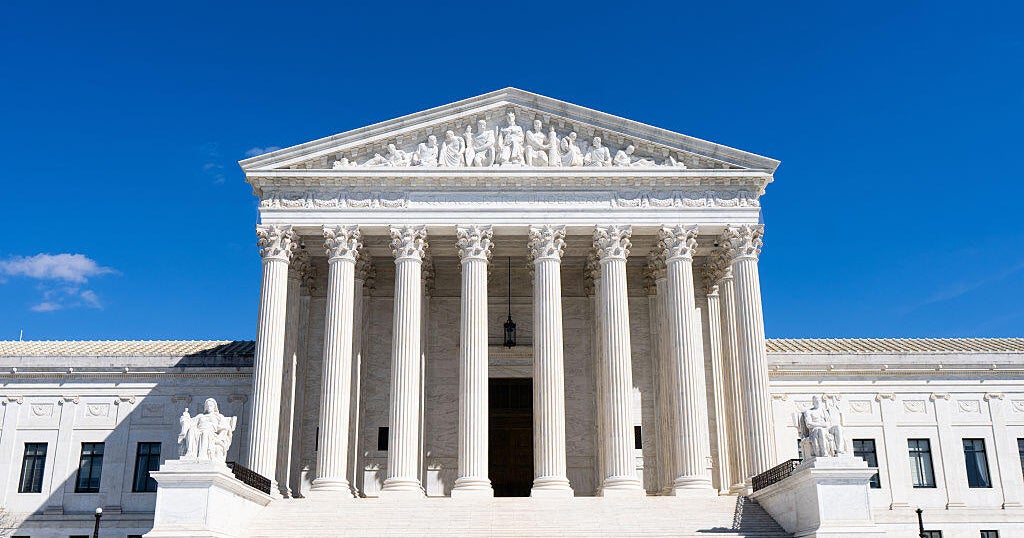
Washington — The Supreme Court on Monday said it will consider an appeal from Catholic preschools in Colorado that said they were excluded from the state-funded universal preschool program because they sought to admit only children whose families adhere to the church’s teachings on gender and sexual orientation.
The legal fight, known as St. Mary Catholic Parish v. Roy, is the latest to land before the Supreme Court in recent years that involve religious entities’ participation in state-funded programs. In a string of decisions, the high court, which has a 6-3 conservative majority, has ruled in favor of religious plaintiffs who argued they were forced to choose between participating in initiatives backed by taxpayer dollars and adhering to their sincerely held religious beliefs on marriage and sexuality.
At the center of the dispute is a 35-year-old decision in the case Employment Division v. Smith, in which the Supreme Court held that laws burdening the free exercise of religion typically do not violate the First Amendment so long as they’re neutral and generally applicable.
Several of the conservative justices, including Justices Clarence Thomas, Samuel Alito and Neil Gorsuch, have suggested that decades-old decision should be overruled. But the Supreme Court said in its brief order taking up St. Mary Catholic Parish v. Roy that it will not consider whether to overturn Employment Division v. Smith.
Colorado’s universal preschool program
The legal battle involves Colorado’s universal preschool program, which provides state funding for families to send their 4-year-olds to the preschool of their choosing. Under the program, all children in Colorado are eligible for up to 15 hours of free preschool each week in the year before they enter kindergarten. It covers public and private preschools, as well as faith-based and in-home providers.
The law establishing the universal preschool program includes a nondiscrimination provision, which requires all providers to ensure children have the equal opportunity to attend regardless of their or their parents’ religious affiliation, race, ethnicity, sexual orientation, gender identity, lack of housing, income level or disability.
The state says that under those so-called equal-opportunity requirements, faith-based providers can teach what they want but cannot decline to enroll children based on their or their families’ protected-class status.
In February 2023, the Archdiocese of Denver, which oversees 34 Catholic preschools, requested an exemption from the program’s rule, which would allow its preschools to admit only families who adhere to the Catholic Church’s teachings, including on gender identity and sexual orientation. The Archdiocese warned that if the provision is enforced against faith-based preschool providers, it would restrict their ability to participate in the universal preschool program “without compromising their sincerely held religious beliefs.”
But the state’s Department of Early Childhood declined to provide the accommodation and reiterated that “no provider may discriminate against children or families in violation of state statute.”
In August 2023, the Archdiocese of Denver, two parishes and a family with children who attend parish schools filed a lawsuit challenging the state’s refusal to grant the requested accommodation.
The plaintiffs argued that they were entitled to an accommodation under the First Amendment’s Free Exercise Clause because the universal preschool program created exemptions to the nondiscrimination requirement that made it not neutral and generally applicable. The Archdiocese and preschools said they were forced to choose between receiving government benefits and their religious beliefs, and they sought a court order preventing the state from enforcing the nondiscrimination rule against them with regards to religious affiliation, sexual orientation and gender identity.
The district court ruled for the state in June 2024, finding that the universal preschool program is neutral toward religious practice and generally applicable, since it does not allow any exceptions from its nondiscrimination policy.
The U.S. Court of Appeals for the 10th Circuit unanimously upheld that decision, finding that the provision “exists in harmony with the First Amendment” and does not violate the parish preschools’ free exercise rights. No preschool that participates in the universal preschool program is allowed to consider sexual orientation or gender identity when making enrollment decisions, the 10th Circuit said.
The appeals court heralded Colorado’s program as a “model example of maintaining neutral and generally applicable nondiscrimination laws while nonetheless trying to accommodate the exercise of religious beliefs.”
The lower courts evaluated the law under rational-basis review, the least stringent test used by courts when considering the constitutionality of a law, and said it satisfies it.
In its appeal to the Supreme Court, the Archdiocese of Denver and its parishes argued that Colorado unfairly excludes Catholic preschools from its universal preschool program while providing secular exemptions to its nondiscrimination rule.
“Far from facilitating ‘universal’ preschool, Colorado’s exclusion of Catholic preschools reduces access, pushing parents and children toward preschools that share the government’s views on these issues and penalizing the religious schools and families who disagree,” they wrote in their petition with the Supreme Court.
The plaintiffs noted that in its landmark 2015 decision legalizing same-sex marriage, the Supreme Court said religious organizations would be protected by the First Amendment when teachings about marriage and sexuality split from secular beliefs.
“The Free Exercise Clause simply cannot do that important work — which this Court has described as ‘at the heart of our pluralistic society’ — if it can be so easily evaded,” lawyers for the Catholic challengers said.
But state officials argued that the Catholic schools are seeking an exemption that would allow them to turn away preschoolers because of their or their parents’ sexual orientation or gender identity.
The universal preschool program “does not require providers to surrender their religious character: it affirmatively includes religious preschools regardless of their curriculum or who teaches it,” they wrote in a filing. “UPK’s equal-opportunity requirements instead ensure that all Colorado parents — Catholic parents as well as same-sex parents— know that their children will not be turned away, because of their protected-class status, from the publicly-funded preschool that best meets their families’ needs.”
The Trump administration is supporting the Catholic plaintiffs. In a friend-of-the-court brief, the administration urged the Supreme Court to take up the case. Solicitor General D. John Sauer wrote that under the 10th Circuit’s ruling, Catholic preschools “must forgo state subsidies if they want to prefer families who follow Catholic teachings on” gender identity and sexual orientation.