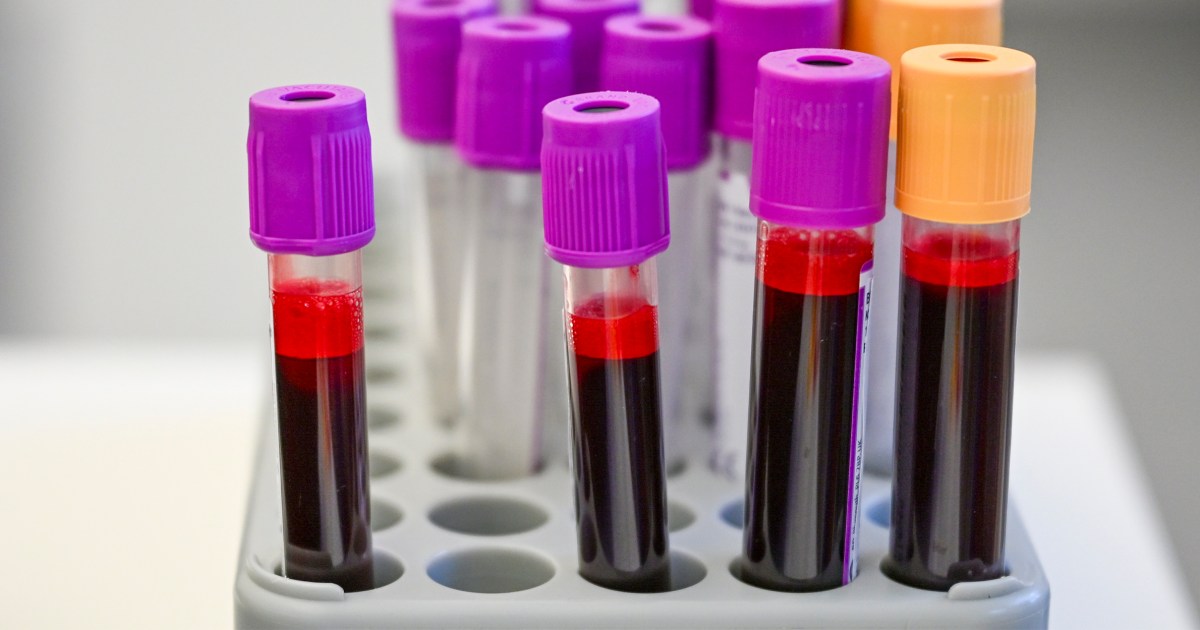
The vision of a single blood test that could screen for dozens of different cancers has tantalized oncologists for more than a decade.
Subscribe to read this story ad-free
Get unlimited access to ad-free articles and exclusive content.

The science has advanced at a rapid clip: What began by analyzing levels of proteins in the blood has progressed to scrutinizing tiny amounts of DNA and feeding the data into algorithms that can highlight changes suggestive of cancer.
It’s led to a number of eye-catching developments. In one study, a blood test called Mercury was able to correctly identify 13 cancers with an average of 87% accuracy, including 77% of stage 1 cancers.
“It’s amazing we can even do this,” says Dr. Aadel Chaudhuri, a radiation oncologist at the Mayo Clinic in Rochester, Minnesota, who himself is researching multi-cancer blood tests. “If you had asked me 10 years ago, my answer would have been ‘It’s not feasible.’ If we’re thinking of DNA shed from a small tumor, it’s like being on the beltway in D.C. and you’re looking for one Volkswagen.”
The ultimate hope is a test that would be able to accurately detect a range of cancers at an early enough stage where they are still curable. That would translate into lives saved.
But in February came disappointing news: The largest trial to date on cancer blood tests failed to achieve its primary objective. The trial was run by Grail, a biotechnology company that manufactures a test called Galleri that, it says, can detect more than 50 different types of cancer through measuring DNA fragments in the blood.
But the trial results, released by the company, saw no significant reduction in advanced cancer diagnoses in people who received the Galleri test compared with those who had not.
More on advances in cancer treatment
“It’s hard to argue that it wasn’t a setback,” Chaudhuri said, who wasn’t involved with the trial. Still, it’s premature to dismiss the trial as a total failure, he said. The full results have not yet been published and it did appear that, in some cancer types, the test had helped detect more cancers at the earliest stages, while the numbers of stage 4 diagnoses — cancers which have spread to distant organs and are considered incurable — decreased. “Clinically, what I truly care about is a decrease in stage 4 cancers,” Chaudhuri said.
Survival data
Dr. Deb Schrag, a medical oncologist at Memorial Sloan Kettering Cancer Center in New York City, said that for multi-cancer blood tests like Galleri to be seen as a paradigm shift by the medical profession, they will need to demonstrate that they can help save lives. Grail will continue to follow patients from its trial for up to eight years after they got their first test to monitor if there has been any reduction in deaths.
Schrag said this data will be crucial because one possibility for why certain cancers might be releasing detectable amounts of DNA into the bloodstream is that they’re highly aggressive. This might mean that even if a test was able to detect these tumors sooner, it’s not necessarily guaranteed that they will be any more treatable.
“If it can’t be cured or there’s nothing to do, then it’s not clear that you’ve helped,” Schrag said.
The challenge for Grail and other developers is that with people with advanced cancer living longer than ever before because of improved treatments, it could take many years to truly know whether their tests can actually make a difference to patient survival.
“So we’re the victims of our own success in some sense,” Schrag said. “As patients are living longer, these trials are getting harder to do.”
There’s another reason why survival data is important. It may prove crucial for multi-cancer blood tests to get wider reimbursement from insurers.
So far, none of these tests have been approved by the Food and Drug Administration, although Grail has been able to use a regulatory loophole to market and sell the Galleri test without review. But with very few insurers willing to cover it, it’s predominantly sold through high-end clinics and medical concierge services to people willing to pay for it out of pocket.
Cancers with no screening methods
Even without survival data, there may be other ways in which the tests can demonstrate their value in the short term. Nickolas Papadopoulos, a professor of oncology at Johns Hopkins School of Medicine, said he’s interested to see if trials show that they’re capable of detecting cancers where there’s currently no approved method of screening.
While screenings for breast, lung, colon, prostate and cervical cancers effectively catch early cases and reduce cancer deaths, these five cancers represent less than a third of all annual cancer diagnoses in the U.S.
“Existing screening leaves a lot of important cancer types behind,” Schrag said. “That includes one of the deadliest of all cancers, pancreatic cancer, but many other important cancers.”
Papadopoulos said he’s awaiting the full breakdown of the Galleri trial data before judging whether it’s been a success.
“I would like to know what they found,” said Papadopoulos, who led a session on cancer blood tests Tuesday at the American Association of Cancer Research annual conference in San Diego. “Did they find cancers that are not part of standard of care screening?”
Oncologists are also keen to assess how the accuracy of the Galleri test varied between cancer types in the trial. So far, one major limitation of multi-cancer blood tests is that their performance tends to vary greatly between different forms of cancers. One study of a test called CancerSEEK, for example, found that it detected 98% of ovarian cancers but just 33% of breast cancers.
According to Chaudhuri, this is because tumor types vary in the amount of DNA they release into the blood, with kidney, thyroid and early-stage prostate and breast cancers being “low shedders,” while head and neck and pancreatic tumors tend to be more detectable.
But in time, there may be other ways of detecting even the lower shedders. Chaudhuri said there’s considerable optimism that newer tests could be developed which are even better at picking up signs of early-stage cancers through integrating multiple sources of data collected from a person’s blood, from protein levels to the sizes of DNA fragments and using AI to look for abnormalities.
While it may take a number of years to gather the evidence that blood tests can make a difference to the lives of patients, Schrag said that she’s still incredibly excited about the potential of the technology and believes that we’re on the “cusp of breakthrough.”
However, she said, it may ultimately be too optimistic to have a single test which can screen for many dozens of cancers. Instead, she said, the likely future is that there could ultimately be a basket of blood tests which screen for different families of cancers.
“The dream is that you would go to the doctor and get one blood test that would identify 75 different types of cancer, from the common ones to the rarest of the rare,” she said. “We may not get there. It may be that there’s one blood test that looks for cancers of that pulmonary tract, another that looks for blood cancers, another for digestive cancers and so on.”