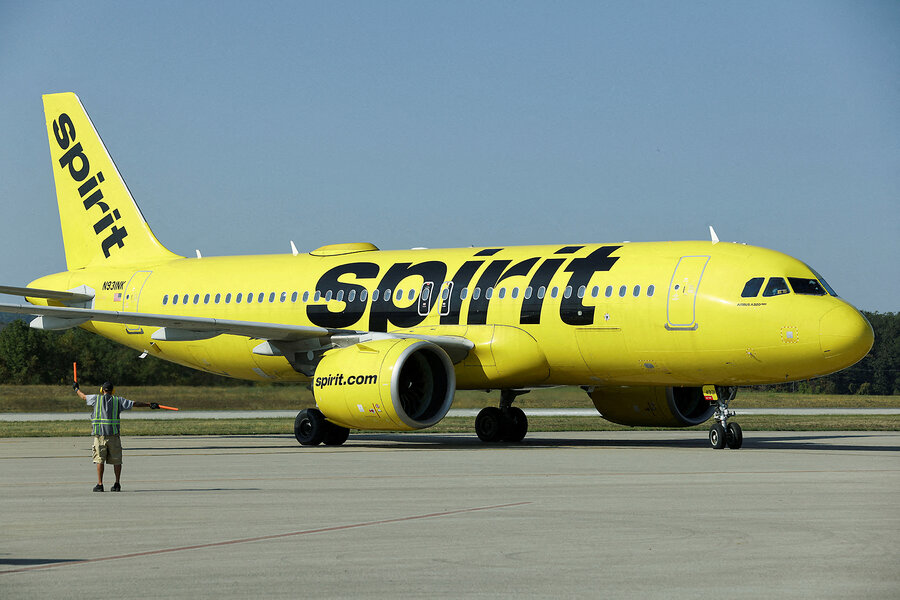
In a highly unusual move to shield a company from high fuel prices caused by its war on Iran, the Trump administration is negotiating a bailout for troubled Spirit Airlines.
President Donald Trump’s effort to buoy an airline in its second bankruptcy has drawn both criticism from the right and skepticism from within his own administration.
“What we don’t want to do is put good money after bad, and there’s been a lot of money thrown at Spirit, and they haven’t found their way into profitability,” Transportation Secretary Sean Duffy told Reuters on Tuesday. “Or does Spirit have some pathway to make it?”
Why We Wrote This
A $500 million bailout for Spirit Airlines could save thousands of jobs. But the deal, which could give the government a 90% stake in the company, is sparking criticism over federal interference in private industry.
Mr. Trump has been relatively quiet on the matter. He has said only that he would prefer to find a buyer for Spirit, but backs a bailout as a way to save jobs and prevent the collapse of an ultra-low-cost carrier – a needed and affordable choice for many Americans.
“Spirit’s in trouble, and I’d love somebody to buy Spirit,” President Trump said in a CNBC interview Tuesday. “It’s 14,000 jobs, and maybe the federal government should help that one out.”
The deal reportedly would give Spirit up to $500 million to resolve problems in exchange for warrants that would give the federal government up to a 90% stake in the airline. Free-market advocates worry the president is setting a dangerous precedent for federal interference in America’s economy.
A deal “would set the stage for a shocking federal takeover of a private American airline company in all but name,” Tad DeHaven, a policy analyst at the libertarian Cato Institute, wrote in an analysis Tuesday. The loan, he argued, amounts to “quasi-nationalization.’’
“Once Washington normalizes bailouts and government ownership claims, further – and potentially more dubious – interventions become likely,’’ he added.
The federal government has intervened in the economy before, and in big ways, during crises. In the 1970s, it bailed out railroads by creating Amtrak, which took over their money-losing passenger operations. It has saved Chrysler twice, most recently during the financial crisis in 2008 and 2009, when it also bailed out General Motors and banks that had been deemed too big to fail.
Airlines have also gotten federal help repeatedly during crises, such as the aftermath of 9/11 and the COVID-19 pandemic, when passenger traffic plummeted.
What stands out about a possible Spirit deal is that it would help a single company with 14,000 employees and less than 5% of the airline market share. While it’s true that high fuel prices have pushed the company’s finances to the brink, other airlines face the same cost pressures. Spirit’s troubles predate the runup of fuel prices nearly two months ago, when the United States, with Israel, began bombing Iran.
Several Republicans have already spoken out against the deal.
“This is an absolutely TERRIBLE idea,” Sen. Ted Cruz, a Texas Republican, posted on X on Wednesday.
“American families shouldn’t be forced to bail out Spirit and the shareholders or pay the bill to see if the federal government can run an airline,” Advancing American Freedom, an advocacy group founded by former Vice President Mike Pence, wrote in a memo. “Conservatives must oppose this bailout.”
Some analysts point the finger at the Biden administration, which blocked a merger of Spirit with JetBlue, a competing budget airline, in 2023 on antitrust grounds. Had the merger gone through, these analysts say, Spirit’s operations wouldn’t be in their current dire situation.
The negotiations may be unusual from a historical perspective. Still, they represent another step in what has become a string of single-company interventions by the Trump administration in his second term.
Last August, Mr. Trump struck a deal in which the federal government received a nearly 10% stake in Intel in exchange for $8.9 billion in federal funds to keep computer chip research, development, and manufacturing in the U.S.
In the same month, he convinced Nvidia and other U.S. chipmakers to give the federal government 15% (later 25%) of their sales of certain semiconductors to China in return for approval of those sales.
Then in January, the White House said it would take a 10% stake in USA Rare Earth to help the company develop a U.S.-based rare-earth mine in a bid to counter Chinese dominance in the strategic minerals field. Rare earth minerals play a key role in powering high-performance magnets, electronics, green energy systems, and defense applications.
In the Spirit deal, “an equity stake would make the federal government an owner, not merely a regulator or temporary source of relief,” wrote Mr. DeHaven of Cato. “And once the government becomes a shareholder, the temptation to meddle does not disappear when the immediate crisis passes.”