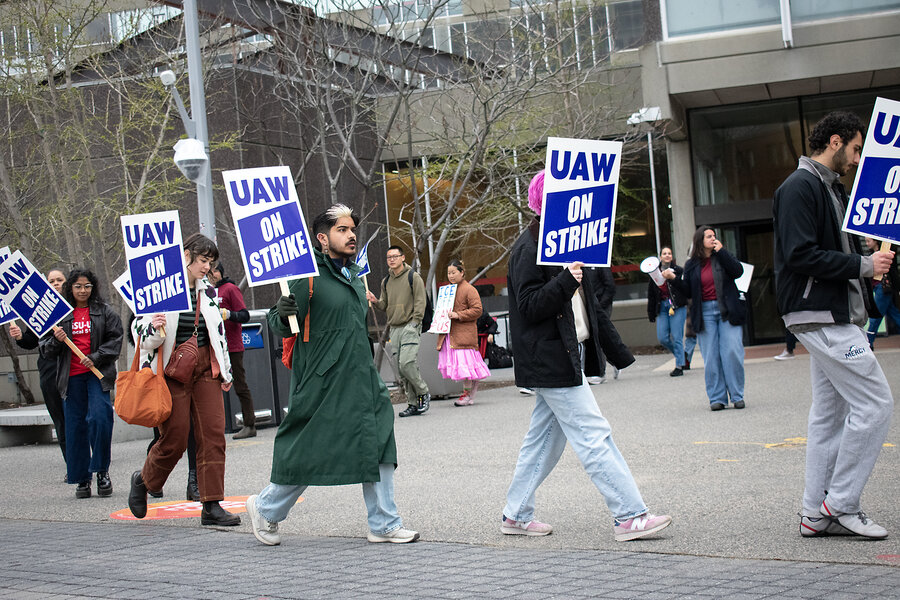
Beneath rolling storm clouds and a spattering of spring rain, about two dozen people holding blue and white signs march in front of Harvard University’s Science Center. Circling around a young woman holding a megaphone, their chants ricochet off stately brick buildings dotting the campus.
The woman in the middle shouts: “What’s outrageous?”
“Harvard’s wages!” the crowd replies.
Why We Wrote This
Harvard University’s graduate student union went on strike this week to demand higher wages for all graduate student workers and more protections for immigrant student workers. The university has countered with an offer to raise salaries more modestly.
These protesters are among more than 4,000 graduate student workers at Harvard who began a strike this week, walking off campus jobs where they teach classes, grade papers, and conduct research that has long placed the school among the world’s top universities.
The strike comes at a tenuous time for Harvard, which has endured the glare of the national spotlight as President Donald Trump assails the university with the full force of the U.S. government. Harvard has faced government lawsuits, billions of dollars in frozen federal funding, and threats to revoke its tax-exempt status. It ran a deficit last year for the first time since the pandemic, and administrators have repeatedly sought to negotiate with the Trump administration.
On campus, the Harvard Graduate Students Union (HGSU) says that after 14 months of talks, it has seen little to no progress on its demands. Chief among those are more than doubling the lowest annual salary of about $26,000, an emergency legal fund for student workers who get caught up in immigration proceedings, and a reformed process for workplace harassment and discrimination claims.
In a statement before the strike, the university said it had offered a 10% increase in wages over four years, and that the union’s request for an independent grievance process could violate federal law. The statement did not address protections for noncitizen workers.
Through a spokesperson, Harvard Provost John Manning declined to provide comment beyond the university’s public statement.
“Although we are students here, we are supplying a lot of labor to the university,” says Juan Orozco, a doctoral candidate in microbiology, on the union’s second day of picketing. “This is not just me doing personal benefit. I am benefiting the university.”
Power in numbers
Across the United States, union participation among graduate students has ballooned by 133% since 2012, according to a report by Hunter College, and 60% of that growth has been driven by students at private institutions. Since 2023, graduate students have voted to unionize at Stanford, Duke, Yale, and others. Closer to Harvard, students in 2022 voted to unionize at Boston University and the Massachusetts Institute of Technology.
Such graduate student unions have also proven their power in recent years. In 2022, some 48,000 graduate students in the University of California system staged the largest strike in U.S. academia’s history, demanding better working conditions and higher pay. About 3,000 graduate students at Boston University struck for seven months in 2024. This March, a graduate student union at Northeastern University, across the river from Harvard in Boston, indicated it would soon hold a vote to authorize a strike.
HGSU was certified as a union in 2018, two years after the National Labor Relations Board granted students at private institutions the legal right to unionize. It has struck twice before – once for nearly a month in 2019, and again for three days in 2021. Both incidents involved disputes over compensation and procedures for reporting workplace grievances.
This time, with just weeks before students take final exams, it’s not clear when the strike might end. Harvard administrators and the bargaining committee are scheduled to meet April 28.
The strike has attracted widespread local attention.
“I also really sympathize and empathize with the plight of the graduate student workers in this moment where we have an ongoing affordability emergency,” state lawmaker Mike Connolly, a Democrat representing Cambridge and neighboring Somerville, says in a phone interview. He visited the picket line on Tuesday. “One of the things these universities can do is use more of their resources to … address things like housing affordability.”
Many of the union’s demands are perennial labor concerns. Others – like a request for paid leave to attend immigration proceedings for noncitizen workers – reflect nationwide tensions, as the Trump administration moves to clamp down on both lawful and unlawful immigration.

Cameron Pugh/The Christian Science Monitor
“We’ve been under so much political pressure in the last year, specifically around the rights of noncitizen workers,” says Rochelle Sun, who’s pursuing a doctorate in government, as strikers chant in the background. “How do you expect a noncitizen student to be able to continue their work safely here and to feel like they’re secure as a student here without having those commonsense protections?”
Strikes often reflect basic concerns about justice, and fairness, says Kate Bronfenbrenner, a senior lecturer emeritus at Cornell University who studies collective bargaining.
“Union organizing campaigns and strikes are never won if they’re just about wages, because the employer can always throw a little more money at it and defuse it,” Dr. Bronfenbrenner says. “Success is much greater when they focus on justice and fairness.”
Question of affordability
On the second day of picketing, strikers march, ignoring the biting April cold, and hand out informational fliers to passersby.
Participants seem just as animated by low pay as by a desire to shield immigrant students from detention and deportation. Denish Jaswal, a doctoral candidate in philosophy and a member of the union’s bargaining committee, says she makes about $26,000 a year working as a teaching fellow. In Massachusetts, that qualifies her for the Supplemental Nutrition Assistance Program, she says.
Most Harvard teaching fellows teach four sections and earn about $26,300 per year under the most recent contract, which expired this past June. Research assistants make a contractual minimum of $42,480 a year – though most make more, according to the union. By contrast, doctoral research and teaching assistants at MIT, just three miles away, make north of $50,000 annually. Strikers point out that Harvard’s endowment in 2025 was $56.9 billion – more than double MIT’s.
Doctoral candidates receive grants to cover tuition and health insurance. But they live on earnings from their teaching and research. And those salaries do not go far in Cambridge, which is among the most expensive cities in the country. The average rent here is $3,700 a month, according to Zillow, 85% higher than the national average. Student workers also argue that wage increases should be commensurate with inflation. Past contracts have included only flat, predetermined increases.

Cameron Pugh/The Christian Science Monitor
Harvard has defended its salaries, highlighting that doctoral students receive at least $425,000 in support over at least five years of study and arguing that its offer of a 10% raise over four years is “in line with compensation offers in other recent labor negotiations.”
In a counterproposal to the union’s demands, Harvard offered to increase research assistant and teaching fellow salaries to $50,340 and $27,024 a year, respectively, with flat raises until 2029.
Also at issue are the university’s procedures for reporting harassment and discrimination in the workplace. Under its current rules, Harvard internally fields formal grievances by graduate student workers. The union argues that such complaints should be subject to third-party arbitration, which it says is standard at other universities.
Harvard has countered that it must use identical processes for all employees, and contended the union’s requests would violate “federal regulations for Title IX complaints.”
Sending a message
Ms. Jaswal says the union hopes to end the strike soon. They don’t want to see the prolonged disruption that resulted from the 2019 strike.
“Our goal is really not to harm our university community, but to send a message to the university that Harvard works because we do,” she says.
Mr. Orozco, the microbiology student, says that fundamentally the strike is about recalibrating what Harvard sees as valuable. Although university officials repeatedly emphasize the importance of graduate students to its mission, Mr. Orozco says he doesn’t feel it. It’s not reflected in the pay, he says, or in the amount of pushback they’ve gotten on their demands.
“Harvard really rides on the fact that it has this big prestige,” he says. “We are the people who make the institution prestigious.”