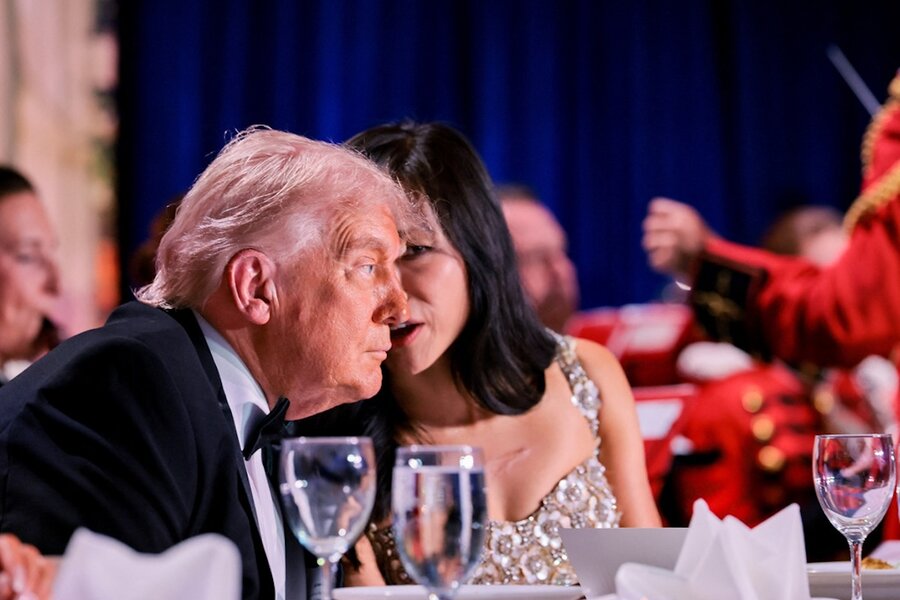
This was not a drill. At 8:34 p.m. Saturday night, in the cavernous ballroom at the Washington Hilton, I heard a loud crashing noise, like a big tray of dinner plates hitting the floor. Then shouts of “get down” and “shots fired,” as the annual White House Correspondents’ Association dinner descended into mayhem.
Secret Service and other security personnel stormed the room, at times jumping across table tops to make their way through the densely packed hall. Soon they were whisking senior government officials to safety.
We now know that the gunman had charged through security a floor above us, exchanging gunfire with Secret Service agents before being tackled to the floor. One agent was shot in the chest, but protected from serious harm by a bullet-proof vest. The alleged shooter, identified as Cole Tomas Allen of Torrance, California, is in custody.
Why We Wrote This
As a veteran of more than 20 White House correspondents’ dinners, I was struck by how lax security seemed on Saturday – particularly given the attendance of President Donald Trump, and the U.S.-Israeli war against Iran. The assassination attempt is already prompting calls for better security protocols.
But in real time, we knew none of that. At 8:43 p.m., crouched next to my chair, I texted my husband: “Are you watching TV? Ballroom being evacuated.” He wrote back immediately: “Shots fired?” Then a minute later: “CNN says shooter is dead.”
That proved untrue, and was quickly corrected. But in the depths of the Washington Hilton, packed with some 2,500 people, we were largely in the dark – a giant room full of reporters, clad in gowns and tuxes, eager to get the facts while trying to stay safe and obey instructions. Some attendees held their phones up from the floor, taking video and photos. Others stood or half-crouched, despite orders to stay low.
Soon, my Monitor colleague Caitlin Babcock and I evacuated upstairs to the lobby, where we traded information with other reporters and tracked events via our phones. President Donald Trump’s statement on social media that he wanted the show to go on wasn’t a surprise. After the 2024 assassination attempt in Butler, Pennsylvania, “Fight, fight, fight” became his mantra. Then he announced that law enforcement insisted he return to the White House, where the tuxedo-clad president held a late-night press conference.
It was not lost on most of us that the incident took place at the “Hinckley Hilton” – the hotel where President Ronald Reagan was shot and nearly killed 45 years ago. The side entrance where John Hinckley shot the president was renovated soon after that assassination attempt, to be more enclosed.
Now there are widespread calls again for stepped-up security protocols around events featuring the president and other top officials. And I must say, as a veteran of more than 20 White House correspondents’ dinners, I was struck by how lax security seemed at the hotel – particularly given the attendance of Mr. Trump, who had already faced two assassination attempts, and the U.S.-Israeli war against Iran.
Early in the evening, entering the hotel was a breeze – just flash your dinner ticket or show an invitation on your phone to one of the receptions and you’re in. No need to show ID, and no metal detectors until you got down a few flights, almost to the ballroom.
On Sunday, The Washington Post reported that the correspondents’ dinner was not granted by the administration the highest level of security, despite the presence of the president, vice president, and many top Cabinet members.
The hotel had plenty of guests who were there for reasons other than the dinner. Mr. Allen had reportedly booked his room in early April and traveled to Washington by train from California, carrying multiple firearms and knives.
That said, I was also struck by the professionalism of security personnel when shots rang out. They seemed to come out of the woodwork from all directions, issuing orders, and rushing toward their protectees and seeking to secure the room.
The incident seems likely to step up pressure for Congress to end the Department of Homeland Security shutdown, which has dragged on for more than two months. On Sunday, GOP Sen. Lindsey Graham of South Carolina, a Trump ally, called for DHS to be fully funded, including the Secret Service. Mr. Trump, too, praised the Secret Service’s performance in his press conference.
It has also led to new calls to get the White House ballroom completed, with several lawmakers saying they planned to introduce legislation granting congressional approval or even appropriating money for the space, which will have high-level security features. (Although the White House correspondents’ dinner is an event organized and hosted by the press, not the administration.)
Perhaps most noteworthy in the president’s late-night remarks were his kind words for the news media – a press corps he has derided as “enemies of the people.”
“This was an event dedicated to freedom of speech that was supposed to bring together members of both parties with members of the press, and in a certain way it did,” Mr. Trump said. “I saw a room that was just totally unified. It was, in one way, very beautiful, a very beautiful thing to see.”
Before the dinner, Mr. Trump and his press team had made clear he intended to rip into the media Saturday night. But under the circumstances, for a shining moment he was complimentary, thanking the media and saying, “You’ve been very responsible in your coverage, I will say.”
Other moments of grace played out during an otherwise surreal evening. Right after the gunshots, when it wasn’t clear what was happening, we could see Democratic Rep. Jamie Raskin of Maryland protecting Kerry Kennedy, sister of Health and Human Services Secretary Robert F. Kennedy Jr. Later, she recounted gratefully, the congressman kept whispering, “You’re OK, you’re OK.”
Most moving to me was the support our own guests showed one another as events unfolded. JoJo Drake Kalin, development officer at Moment magazine, slumped in her chair, weeping, and said, “I can’t believe it’s happening again.” She explained that she had been the organizer of the event at the Capital Jewish Museum in Washington last May, at which two young Israeli Embassy staffers were shot and killed.
Another Monitor guest, Nadine Epstein – editor and publisher of the Jewish-focused Moment – hugged Ms. Kalin in consolation. Photos of the embrace circulated widely in the media.
Later that night, when several of us finally felt safe enough to leave the Hilton and walk to a nearby Mexican restaurant for dinner, Ms. Kalin told me that Ms. Babcock, my Monitor colleague, had also comforted her.
“She was very sweet,” Ms. Kalin said. “She held my hand.”