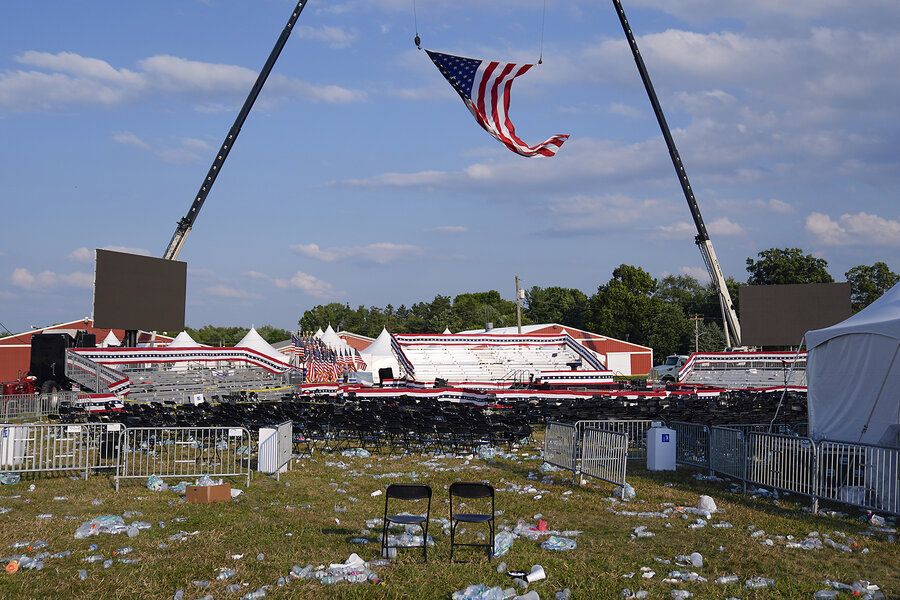
The assassination attempt unfolded in the vicinity of hundreds of reporters. Surveillance footage of the alleged gunman racing through a checkpoint was publicly released. Administration officials gave press conferences and provided information about the events.
And yet, minutes after authorities say a lone gunman tried to attack the White House correspondents’ dinner on Saturday, cries of conspiracy began lighting up social media.
Some X accounts zoomed in on President Donald Trump’s face when shots rang out, finding his lack of apparent fear suspicious. Others questioned how security at such a major event could be so poor. Some even jumped on press secretary Karoline Leavitt’s remark prior to the dinnertime speeches that some “shots” would be fired. Many pointed out that Mr. Trump and his allies used the hours after the shooting to demand that his White House ballroom, which faces legal hurdles, be built for security reasons.
Why We Wrote This
Some corners of the MAGA movement are questioning official accounts of two suspected assassination attempts on President Donald Trump – despite a range of video and forensic evidence. Experts see several factors enhancing the appeal of conspiracy theories, from political discontent to distrust of mainstream media.
“Until last night President Trump had never attended the White House [correspondents’] dinner as President. Oddly himself and nearly his entire cabinet attended this one, the one where there was an assassination attempt,” Trisha Hope, a Trump delegate at the 2024 Republican convention and advocate for convicted Jan. 6 defendants, posted on X. “Made for TV movie, that’s what this is,” she wrote above a photo of Mr. Trump and other administration officials smiling at a press briefing following the shooting.
The flood of skepticism might have been boosted by the fact that social media was already abuzz in recent weeks with conspiracies around a different presidential assassination attempt: the one in Butler, Pennsylvania. Earlier this month, Ms. Hope wrote a viral almost 750-word X post suggesting that the 2024 Butler shooting had been staged – a theory that’s gained new traction of late among a number of far-right accounts, as well as some prominent conservative media figures and podcast hosts.
Mr. Trump was asked on CBS’s 60 Minutes Sunday about the conspiracies building around these two shootings. He said he “hadn’t heard” the conspiracies around Saturday. “Usually it takes a little bit longer,” for a conspiracy to gain traction, the president said. “Usually they wait about two or three months to start saying that.”
Notably, many of the voices raising suspicions about Butler and now the White House correspondents’ dinner have also been critical of Mr. Trump’s handling of the Epstein files – another topic that generated a host of conspiracy theories, some of which wound up being validated. And many are strong opponents of the war against Iran, which has caused sharp divisions in Mr. Trump’s “America First” coalition. As public disapproval of the war has pushed Mr. Trump’s overall approval rating below 40%, the lowest of his term, the president has found himself at odds with some of his longtime supporters.
Experts on conspiracy theories note that they often appeal to people who feel powerless or isolated, creating a sense of community and a way to impose meaning on a chaotic-seeming world in which faith in institutions has plummeted. As advancements in artificial intelligence make it increasingly difficult to tell the difference between real videos and fake ones, and amid historically low public trust in the media, the “official” version of major news events is being challenged like never before.
“So many people both on the right and the left are doubting whether this was a true event or staged incident. We are seeing people writing and questioning and analyzing photographs,” says Jeffrey Dvorkin, a former ombudsperson at NPR and author of “Trusting the News in a Digital Era.” “It’s like ‘The Matrix.’ We don’t know what to believe,” he adds. Social media today is “a petri dish of anxiety and misinformation.”
Many of Mr. Trump’s supporters weren’t traditional Republicans when they were drawn to the MAGA movement, but they were united in part by an inclination for conspiracy theorizing, says Joseph Uscinski, a professor at the University of Miami. Mr. Trump himself leaned in to such conspiratorial thinking, pushing during his presidential campaign in 2016 the “birther” theory that former President Barack Obama was born outside the United States. Mr. Trump still claims that he won the 2020 election over former President Joe Biden, and just this week he posted on Truth Social that the Virginia referendum to redraw the state’s congressional districts was “RIGGED.”
A receptive audience
“You build a coalition of conspiracy-minded, antiestablishment-minded followers, and you ride that to become the establishment; at some point, they are going to start pointing their ire at you,” says Dr. Uscinski. “It was only a matter of time for Trump to become a lighting rod for them.”
Of course, much of MAGA is still behind the president. A recent poll suggests that 65% of Republicans approve of Mr. Trump’s handling of the war, and the Republican-controlled Congress has so far blocked measures to curtail presidential war powers. In the wake of this weekend’s shooting, several Republicans in Congress have vowed to pass legislation to fast-track Mr. Trump’s ballroom, arguing that the structure is imperative for the president’s protection. And as with the shooting in Butler, administration officials and other Republicans have blamed the violence on left-wing rhetoric.
At a Department of Justice press conference Monday afternoon, acting Attorney General Todd Blanche said that they are investigating this week’s incident “fully,” adding that law enforcement “did not fail” and protected the president as intended.
Mr. Blanche said that the alleged shooter, Cole Allen, fired his shotgun and that it “appears” five shots were fired by law enforcement, but that it was too early in the investigation to provide ballistic details. Mr. Allen’s manifesto, along with devices recovered in his hotel room and in California, confirms that his intent was to kill as many high-ranking administration officials as possible, investigators say. Mr. Allen currently faces three charges, including attempted assassination of the president, and U.S. Attorney Jeanine Pirro said there could be more.
“This was an attempted assassination of the president of the United States, with the defendant making clear what his intent was,” said Ms. Pirro during the press conference. “Any suggestion that he wasn’t there to do harm is absurd.”
Doubt over an interrupted dinner
But users on X, some with thousands of followers, have still questioned this weekend’s events, with a central suspicion surrounding Mr. Trump’s decision to attend this year’s dinner after declining so many previous invitations. And like Ms. Hope, former Georgia Rep. Marjorie Taylor Greene, a onetime Trump ally who became sharply critical of the president after leaving office, has compared and contrasted the most recent shooting with the one in Butler. On X, Ms. Greene questioned why Mr. Allen’s manifesto was released, while no manifesto from Butler shooter Thomas Matthew Crooks has surfaced. “I’ve asked questions about the lack of security around President Trump before,” she wrote on Sunday. She says she’s still waiting to know what happened in Butler.
Conspiracy theories about Butler have floated around ever since the shooting took place in July 2024. Theories have circulated online about why Mr. Trump doesn’t talk about the shooting more, how the Secret Service was able to fail so publicly, and why the agents allowed the president to rise up after the shooting for the now-iconic raised fist photo. “The more you read about it, the more you’re like, ‘What is going on?’” said Joe Rogan on his podcast the week after the shooting.
Speculation on the right began growing last year when commentator Tucker Carlson posted a 34-minute video on the shooter, criticizing the FBI’s handling of the case. It took off last month, after former National Counterterrorism Center Director Joe Kent, who had resigned from the Trump administration over disagreements about the Iran war, made an appearance on Mr. Carlson’s podcast and said that the investigation into the assassination attempt had been prematurely closed.
“I’m not calling the Butler assassination a hoax,” Ms. Greene wrote earlier this month. “But there are a lot of questions that deserve public answers.”
Other MAGA influencers are outright calling it a hoax. “Just admit you staged it in Butler,” comedian and conservative podcaster Tim Dillon said in a recent podcast. “Explain to us how you did it.”
The Butler investigation
Investigations that spanned both the Biden and Trump administrations found that the Butler shooter, who was killed at the scene, acted alone.
A bipartisan congressional task force led a five-month investigation into the Butler assassination attempt that included 46 interviews with state, local, and federal officials and reviewed almost 20,000 pages of documents. In a December 2024 report, task force members highlighted “significant failures” by the Secret Service and law enforcement partners in the planning of the event. The report concluded that the shooting was preventable and “should not have happened” – but found no evidence to suggest it was an inside job.
The FBI conducted its own investigation of the incident, and Director Kash Patel had promised to release more information about the shooter, Mr. Crooks. In a February interview, Fox News host Bret Baier asked Mr. Patel why the public still did not have “a more robust picture” of the shooter, to which Mr. Patel replied that the FBI had “put out all the information that we possibly and legally can,” while protecting “ongoing matters that are unrelated” to Mr. Crooks. More files, with redactions, were then released later that same month by the FBI following a Freedom of Information Act request, further fueling suspicions.
“It’s never going to be enough for everyone,” Mr. Patel told Mr. Baier. “It’s never going to be enough.”