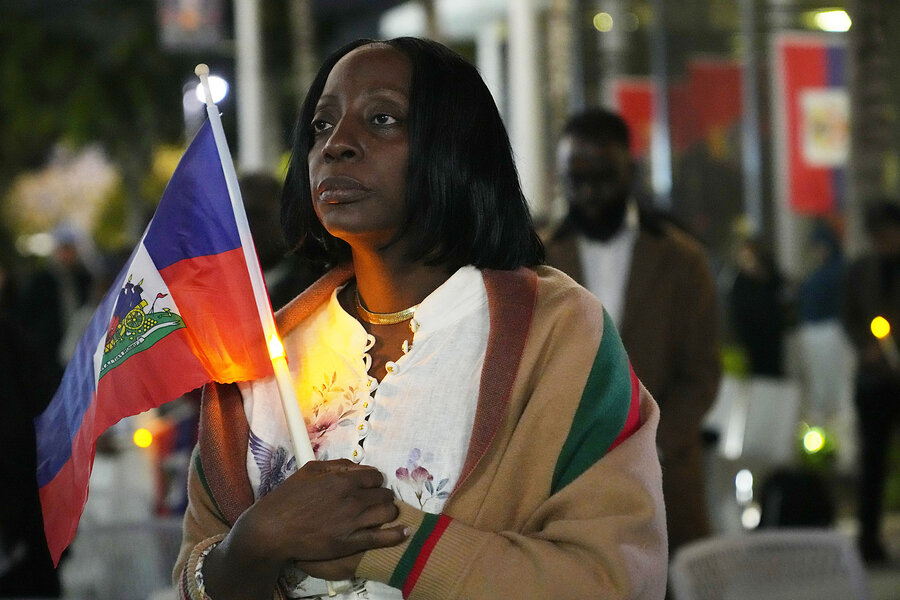
Citing security risks, the Trump administration had already suspended the entry of Haitians and Syrians into the United States and paused their applications for asylum. Now, the Supreme Court will decide whether the government can end temporary protections for hundreds of thousands of immigrants already here.
A ruling in the administration’s favor following oral arguments in Mullin v. Doe, scheduled for Wednesday, could expose those immigrants to deportation to countries the U.S. government regards as extremely dangerous. The decision could carry implications for other protected groups as well.
The safeguard under scrutiny is called Temporary Protected Status, which can be granted by the Secretary of Homeland Security to citizens of designated countries when it is considered unsafe to return. TPS offers access to work permits and protection against deportation – available only to immigrants already in the U.S. The status doesn’t offer a path to a green card or U.S. citizenship, but many recipients have lived here for years if not decades because of multiple extensions of their country’s protected status.
Why We Wrote This
The Supreme Court will hear arguments Wednesday in a case about the government’s decision to end protections from deportation for hundreds of thousands of Haitians and Syrians living in the United States. The Trump administration says that its decisions on the subject cannot be reviewed by courts, but immigrant advocates argue that the administration’s move could send the immigrants back to two of the world’s most dangerous countries.
U.S. law says there’s “no judicial review of any determination” on TPS decisions. But Trump administration officials have also deemed Haiti and Syria two of the most dangerous places in the world.
After record-high illegal border crossings during the Biden administration, President Donald Trump has targeted unauthorized immigrants in the country’s interior. He has also sought to strip the status of many lawfully here, including those with TPS, widening the pool of people to deport.
In the case before the Supreme Court, the Trump administration contends that immigration law plainly says that courts can’t second-guess its decisions on TPS. The Department of Homeland Security moved to revoke TPS for Haiti and Syria last year. Immigrant advocates have sued the government over its termination attempts – and the process behind them. On TPS for Haiti specifically, those advocates allege that the administration was motivated, at least partly, by race, which the White House denies.
“The Trump administration is restoring integrity to our immigration system to keep our homeland and its people safe, and we expect a higher court to vindicate us in this,” a spokesperson for the Department of Homeland Security said in an email. “The United States has had a generous asylum program – those who can prove a need for it should apply instead of expecting extensions of their temporary status” (bolding in original).
Since last year, however, the government has paused asylum decisions for applicants from Haiti, Syria, and 37 other countries the president has deemed high-risk. Citizens from those countries are also banned from entering the U.S.
Against “national interest”
Following an influx of Central Americans, many fleeing conflicts stoked by U.S. involvement, an immigration bill passed by Congress and signed into law by President George H.W. Bush created TPS in 1990.
The DHS secretary can designate countries whose citizens can’t safely return home because of armed conflict, natural disaster, or other “extraordinary and temporary conditions.” The benefit can last up to 18 months and can be extended. (Protected status for Haiti has been in place since a major earthquake there in 2010. Syria was first designated for TPS in 2012, a year into that country’s civil war.)
Many of Mr. Trump’s immigration crackdown strategies have triggered lawsuits, with several cases litigated up to the Supreme Court. The justices have handed Trump officials mixed results in the past, but the court in two emergency orders last year allowed the administration to move ahead with ending TPS for Venezuelans while litigation worked its way through the lower courts.
This Supreme Court decision could impact hundreds of thousands of TPS holders from Syria and Haiti. A ruling against them might not mean immediate deportation, but it could expose them to eventual removal if they lack another lawful path to remain.
Oral arguments on Wednesday will consolidate two cases. According to estimates, more than 330,000 Haitians and nearly 4,000 Syrians were covered by TPS last year, out of some 1.3 million with that status overall.
DHS has argued that country conditions in Haiti and Syria have changed since their original protected-status designations. Plus, officials say, letting those countries’ nationals live temporarily in the United States is “contrary to the national interest.”
Syria, which the U.S. government has dubbed a state sponsor of terrorism, is transitioning out of civil war. But the Trump administration, in a notice about the end of TPS for Syria, says that issues with civil and criminal recordkeeping in the country make vetting Syrians “virtually impossible.”
Former Homeland Security Secretary Kristi Noem had reasoned last year that while certain conditions “remain concerning” in Haiti, “parts of the country are suitable to return to.”
Another official has spoken in starker terms. A week after a federal judge paused the TPS termination in February, the top U.S. diplomat to Haiti notified Congress of “full-scale urban warfare” there. Most of the capital, Port-au-Prince, has fallen under the control of gangs. Amid rampant food insecurity, those criminal groups recruit minors.
Revoking TPS could “not only mean huge risk for these people that will be sent to the most insecure place in the Western Hemisphere, but also could fuel the violence here,” says Diego Da Rin, a Haiti analyst at the International Crisis Group, commenting from Port-au-Prince. Deportees risk “collaborating in some way with the gangs – to have enough money to at least have some food.”
Critics of TPS – and of policies that expand immigration paths more broadly – say the U.S. can’t accommodate all the world’s humanitarian needs. And while the TPS statute doesn’t impose a limit on the number of extensions, conservatives underscore how the “T” stands for temporary. They see decades-long TPS extensions as contrary to the purpose of the law.
“Many on the left just want this to be a form of amnesty, [for these people] to stay here permanently,” says Lora Ries, director of the Border Security and Immigration Center at the Heritage Foundation. “The statute authorizes the secretary to terminate [TPS], and yet every time this president tries to terminate, he’s sued.”
“Racial animus”
Meanwhile, Haitian parents in the U.S. are afraid of potential separation from their children, some of whom are American citizens.
Jeffrey Thielman’s International Institute of New England helps clients create family preparation plans in case a parent is detained. More of his group’s immigrant clients, including Haitians, are skipping English classes and medical appointments because they fear being arrested, he says.
“We’ve used federal money and private money to help people get jobs and enter the economy,” says Mr. Thielman, the Boston-based nonprofit’s president and chief executive. Ending TPS amounts to “throwing away all the investments” by taxpayers into these workers, he adds.
Earlier this month, Haitian TPS holders garnered rare bipartisan support in Congress. In the House, 10 Republicans joined Democrats to pass a bill that called for Haiti’s protected status to be extended for three more years. Even if the Senate passes the bill, it would face a likely veto from Mr. Trump.
Immigrant advocates argue that past statements by Mr. Trump, and by Ms. Noem when she was DHS secretary, show “racial animus” that factored into Haiti’s TPS termination. The government denies such motivations.
At an Oval Office meeting in 2018, Mr. Trump reportedly used vulgar and derogatory language to describe Haiti, El Salvador, and African nations. While campaigning in 2024, he elevated a false claim about Haitians in Ohio, saying immigrants were “eating the pets” of people who lived there. Ms. Noem, now a special envoy, had mirrored the president’s rhetoric, calling immigrants “leeches” and “foreign invaders.”
Overall, affirming that the executive branch can stop and start TPS with limited court oversight “would bring much-needed clarity to this corner of immigration law,” writes Charles Lane, a nonresident senior fellow at the American Enterprise Institute and a columnist for The Free Press.
Congress could also be forced to reform TPS, he says. It was created as “the Cold War was ending, liberal democratic values appeared ascendant, and lawmakers failed to foresee that humanitarian catastrophes and failed states would be chronic, not ‘extraordinary,’ circumstances,” Mr. Lane writes.
A ruling in Mullin v. Doe is expected by the summer.