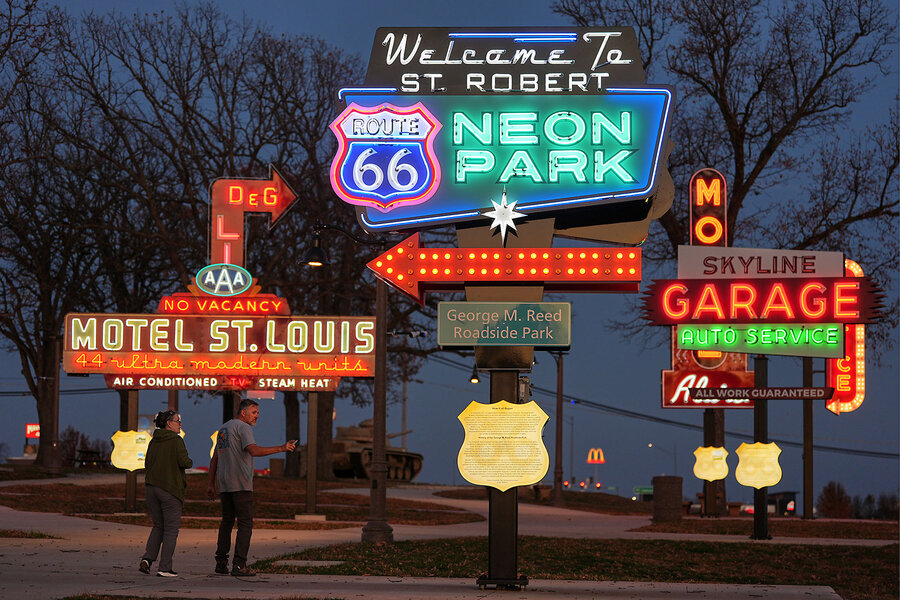
After 100 years, U.S. Route 66 is still one of the most famous roads on the planet.
Which is in some ways peculiar. Among the first of America’s cross-country highways, it was officially decommissioned on June 27, 1985. Bureaucratically, U.S. Route 66 no longer exists.
Yet millions of people are still drawn to what remains of it. In Illinois alone, Route 66-related sites are still a major draw, woven into a tourism economy that attracts more than 100 million visitors to the state each year. According to an AAA survey, 41% of U.S. adults nationwide said they plan to travel some part of Route 66 to celebrate its centennial year.
Why We Wrote This
Route 66 traces the tale of a century of American life: pioneers, immigrants, economic booms and busts, lore and legends. The Monitor will explore the historic road and the people and places that are still telling our shared story today.
So something about Route 66 looms large in the American imagination.
It has been celebrated in both high-brow literature and breezy pop culture. It has been called the Main Street of America, its Mother Road, and the Hillbilly Highway. Some might remember the old hit: “If you ever plan to motor west, travel my way, take the highway that’s the best: Get your kicks on Route 66.”
For many people, traveling the road even today symbolizes “the quintessential American experience,” says Jim Hinckley, a writer and historian who recently edited the essay collection “Route 66: 100 Years.” It is “the American story made manifest.”
The centennial of Route 66 coincides with the 250th anniversary of the Declaration of Independence – marking 2026 as a kind of jubilee year for the United States of America. It’s a moment in which many across the nation are both celebrating and reflecting on this grand experiment in self-government, individual freedom, and, indeed, a different way of life.
These are some of the reasons the Monitor will embark on a journalistic project this summer, following the remaining parts of old U.S. Route 66, traveling through eight states and across roughly 2,400 miles of road, from Chicago through the Great Plains and Southwest, and on to Santa Monica, California.
We will report on the wider regions that Route 66 passes through, covering the news and writing stories about the lives of the people who live, or are simply traveling, along its way.
Like Anneliese Place. She traveled Route 66 for the first time in the summer of 1986, just after graduating from high school, when she bought a used 1967 Ford Mustang convertible and headed west.
“We put the top down, and my sister and I drove from Boston to California,” says Ms. Place, founder of the Rock ’n’ Roll Highway, which works to preserve historic music-related sites. “Two teenage girls, no seat belts, no real plan, just music turned up and the idea of California pulling us west.”
German-born, Ms. Place is also part of a growing movement of Route 66 enthusiasts in Europe – one of the places around the world where the American story, imagined through the mythology of Route 66, has an almost surprising hold.
There are dozens of associations across Europe, Japan, and Australia. In 2024, the European Route 66 Festival drew tens of thousands in Prague. And most of the annual tourists visiting this iconic American highway each year are from countries outside the United States.
“For us, it was a symbol of freedom,” says Zdeněk Jurásek, president of the Czech Route 66 Association and an organizer of the 2024 event. “I grew up in the communist era. We were not allowed to travel to Western countries, and we dreamed about America, about a different way of life.”

The coincidence of two such richly defined American anniversaries (the road, the nation) invites a kind of national self-reflection, too. This project will be a part of that conversation. The kinds of stories that surround Route 66 – stories the nation tells itself about the values it represents and the virtues it exhibits – often highlight the triumphs Americans have celebrated for two-and-a-half centuries. But such stories also sometimes hide the nation’s flaws.
In fact, the highway traverses land the U.S. acquired by war.
“Most of Route 66 is in a historical footprint of what was once Mexico,” says Sehila Mota Casper, executive director of Latinos in Heritage Conservation, who traveled the road from Amarillo through California with her organization in 2021, recording oral histories and documenting Latino sites along the way.
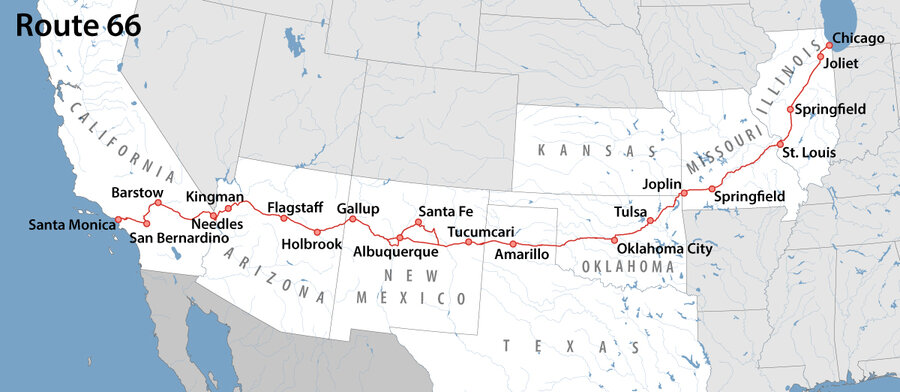
“So these cities, these people, have always been there,” she says. “And where are they?”
The “Main Street of America”
Route 66 was assigned its number on April 30, 1926, in Springfield, Missouri – which still calls itself, proudly, “the birthplace of Route 66.” But not long after it was officially established as part of the new federal highway system, a group of business leaders gathered in Tulsa, Oklahoma, and formed the U.S. Highway 66 Association, giving the road its first and most deliberate label: the Main Street of America.
It was chosen, as one early account put it, “for promotional purposes.” Cyrus Avery, an Oklahoma oilman, entrepreneur, and chamber of commerce visionary, helped conceive the idea of a corridor that would run not around towns, but through them.
Automobiles and paved roads were only then beginning to change the rhythms of American life. Avery wanted to bring these new travelers past the storefronts, filling stations, and diners of American small towns. He saw the highway as a way to “connect rural America and create new pockets of commerce.”
The moniker “Main Street of America” had, in fact, been applied to other highways before, so the marketing idea wasn’t entirely original. But to stretch it across 2,400 miles, from Chicago to Los Angeles, was to attempt something more ambitious: a nationalization of America’s most idealized civic space.
Miles Orvell, a historian of American culture at Temple University, spent years tracing the power of this image. In his book “The Death and Life of Main Street: Small Towns in American Memory, Space, and Community,” he describes Route 66 as both a place and an idea – a symbol of democratic participation, small-town identity, and what he calls the “bedrock of America’s embattled democracy.” The small town, Mr. Orvell argues, has always been offered to Americans as a kind of imaginary home, a place where conflicts are resolved and differences set aside.
For that reason, there were already vigorous voices of dissent to the image. In 1920, the novelist Sinclair Lewis published his most successful book, “Main Street,” an enormously popular bestseller that dissected exactly that idealized American civic space, vilifying it instead as small-town narrow-mindedness.

Both ideas existed together in the American imagination – which is itself a very American response to contradiction. It’s also a reminder that Route 66, from its very first days, was a road built on a story that was always more complicated than its name let on.
From “The Mother Road” to “Get your kicks…”
By 1939, Route 66 acquired another enduring designation, a second, darker name that would ultimately outlast the first.
Of course, the irony of Route 66 as America’s “Mother Road” is the fact that in John Steinbeck’s “The Grapes of Wrath,” the author did not mean it in any maternal sense. “Highway 66 is the mother road, the road of flight,” he famously wrote, as the Joad family loaded everything they owned onto a battered truck and joined the hundreds of thousands of Okies heading west.
Steinbeck’s Route 66 was neither Avery’s nor Lewis’s Main Street. It was the road you took when the land gave out, when the banks came, when there was nothing left to do but point the truck toward California and hope. The Mother Road named the relationship between Americans and their great westward highway not as commerce or adventure, but as desperation – the road as last resort.
And then there is the other tradition – the one that is louder, faster, and considerably more fun.
Bobby Troup wrote “Get Your Kicks on Route 66” in 1946, driving the road with his wife on a cross-country trip. And if the song has a thesis, it is essentially this: The road is a pleasure, the Southwest is waiting, and you should get in the car and go.
Nat King Cole recorded it first, and the song became a standard that has since been covered by the Rolling Stones, Chuck Berry, Depeche Mode, Van Morrison, Natalie Cole, and dozens of others – making it one of the most recorded songs in the history of American popular music.
The song opened a door that American popular culture has been walking through ever since. A CBS television series called “Route 66” ran from 1960 to 1964. Pixar formalized the mythology for a new generation with the movie “Cars” in 2006, setting its story in Radiator Springs, a fictional Route 66 town bypassed by the interstate and left to fade.

There is, too, that legendary corner in Winslow, Arizona – a perfectly ordinary intersection that has become a pilgrimage site because of a single line from a hit song in 1972. “Well, I’m standin’ on a corner in Winslow, Arizona,” the Eagles sang in “Take It Easy.”
“At its heart, it’s just another road,” says Rhys Martin, president of the Oklahoma Route 66 Association. “When Route 66 was created, it was one among many. But Route 66, for me and for many of the people that I work with, is a microcosm of the greater American experience, especially in the 20th century.
“It was built as a connector of towns, and it became a connector of people, and it still is that today.”