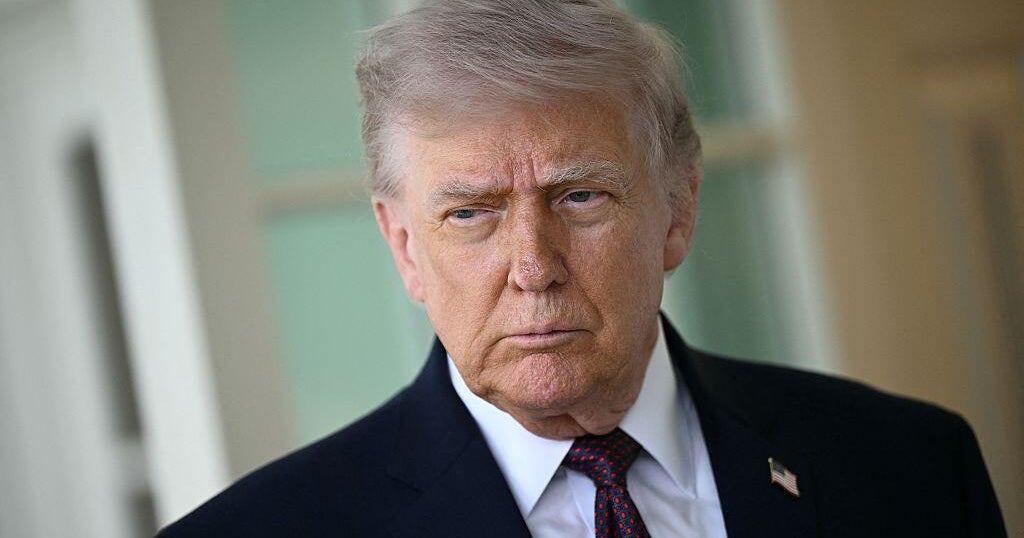
Washington — President Trump faces a key deadline in the war with Iran on Friday under a decades-old law that limits the use of force without authorization from Congress.
The War Powers Resolution of 1973 lays out a timeline for when lawmakers must be notified of hostilities and when a president is required to withdraw American forces from a conflict in the absence of congressional authorization.
Under the law, the president is required to give formal notification to Congress within 48 hours of introducing American forces into hostilities, which officially begins a 60-day clock for the president to terminate the use of force unless Congress has declared war or authorized the use of military force.
The 60-day window
The Iran war began Feb. 28. Mr. Trump formally informed congressional leaders of the hostilities in a March 2 letter, starting the 60-day clock that expires Friday.
The law allows the president to extend the period for an additional 30 days to safely withdraw forces from hostilities, but it does not grant him authority to continue an offensive campaign.
“It’s not a 30-day blank check for the president to continue whatever hostilities he sees fit,” said David Janovsky, who leads the Constitution Project at the Project on Government Oversight.
Friday’s deadline could set up an eventual clash with Republicans in Congress, who have largely been reluctant to break with Mr. Trump on the war, which has extended beyond the four to five weeks he initially predicted without a firm resolution. The fighting has been mostly paused since the U.S. and Iran agreed to a ceasefire on April 8 to allow for talks on a broader settlement.
Since the start of the war, Republicans in the House and Senate have blocked more than half a dozen Democratic war powers resolutions that would explicitly limit Mr. Trump’s ability to further strike Iran. Some GOP members have indicated that their stance could change after the statutory 60-day deadline.
Republican Sen. John Curtis of Utah said that he would “not support ongoing military action beyond a 60-day window without congressional approval.”
“A period of 60 days is a fully sufficient window for presidents to take emergency measures in response to a national threat and then remit a decision to the duly elected representatives of the people as to whether a state of war should in fact be declared and continued,” he wrote in an opinion piece earlier this month.
Republican Sen. Josh Hawley of Missouri told reporters “the statute does need to be followed,” adding that he hoped the war would conclude by the 60-day deadline.
“I think we need an exit strategy,” he said on April 15.
Asked earlier this month at what point lawmakers need to check the president’s war authority, Senate Majority Leader John Thune, a South Dakota Republican, said the administration needs “a plan for how to wind this down.”
Republican Sen. Lisa Murkowski of Alaska is drafting a formal authorization for the use of military force in Iran, but has not yet introduced the legislation. Whether there’s enough support to pass such a measure is uncertain.
Democrats in both chambers have introduced a slew of war powers resolutions in recent weeks. They plan to keep forcing votes on the issue to put their Republican colleagues on the record regarding the war that polls show is unpopular.
Continuing hostilities
It’s unclear how the war will end. Last week, Mr. Trump extended the ceasefire with Iran indefinitely. Days later, he abruptly called off plans for two of his top negotiators to travel to Islamabad, Pakistan, for a second round of peace talks. The fate of Iran’s nuclear program remains a central issue and the standoff over the Strait of Hormuz, a vital oil chokepoint, has created an energy crisis.
If the president wishes to continue the war without congressional approval, Katherine Yon Ebright, an attorney at the Brennan Center’s Liberty and National Security Program, said it’s possible that the Office of Legal Counsel tries to argue that the ceasefire stopped the 60-day clock and any further hostilities reset the clock altogether. But she said “that is not something that by its text or by its design the War Powers Resolution accommodates.”
“But there is a long history of executive branch lawyers willfully misinterpreting the War Powers Resolution to allow presidents to conduct hostilities even past that 60-day clock,” Ebright said.
In 2011, the Obama administration argued that it did not need congressional approval for air strikes against Libya past the 60-day mark because the operations did not rise to the level of “hostilities” within the meaning of the law and because they did not involve American ground troops.
In 1999, the Clinton administration continued its bombing campaign in Kosovo past the statutory deadline, arguing that lawmakers had authorized the operations by approving funding for it.
Congress has never successfully used the War Powers Resolution to end a military campaign. Mr. Trump vetoed a resolution that sought to end U.S. military involvement in Yemen after it passed both chambers with bipartisan support in 2019. Congress did not have the votes to override the veto.
Janovsky said the War Powers Resolution has been “fairly ineffective” since its enactment.
“It’s very hard to look back on the 50-year history of the War Powers Resolution and say that it has successfully constrained presidential action,” he said.
The courts have been largely silent on the issue of war powers and getting a court to make a ruling on the merits of the constitutionality of the Iran war would be a “tough sell,” Ebright said.
But she said the War Powers Resolution has also served as a political constraint. For example, a handful of Republicans helped advance a measure in January to rein in Mr. Trump on Venezuela. Some flipped their support after receiving assurances from the Trump administration that it wouldn’t use ground troops. Secretary of State Marco Rubio also agreed to testify to Congress as the administration worked to stave off defections.
“What we’ve seen in the past year is the War Powers Resolution acting in the political sphere much more so than in the legal sphere,” Ebright said.