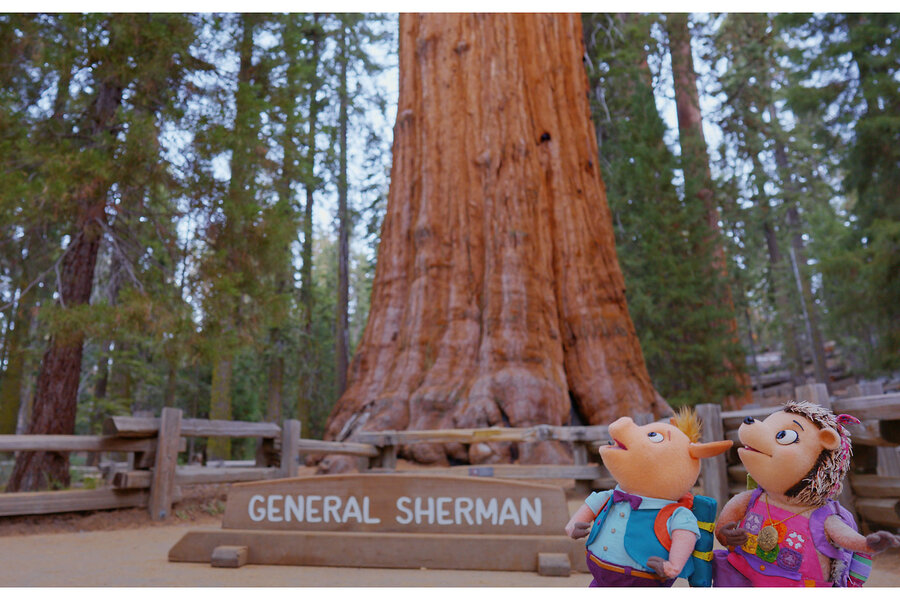
Tourists in Sequoia National Park typically keep their eyes peeled for bears, bighorn sheep, and elusive mountain lions. Recent visitors to the California park might have spotted something even more remarkable: A piglet singing and hiking through the giant trees.
Ronald the piglet is a puppet character in “Wowsabout,” the latest offering from The Jim Henson Company. The show, which was filmed on location at Sequoia National Park rather than inside a studio, tells the story of Ronald befriending a hedgehog named Roxy. She drives a camper van. Premiering on PBS Kids on May 1, and also available for streaming on PBS Kids on Prime Video, “Wowsabout” celebrates American history and environmental preservation.
Anything with Jim Henson’s name on it has long represented a top-tier standard for children’s entertainment and imagination – including “Sesame Street,” “Fraggle Rock,” and the Muppets. Now, that major name in art is matched with a major name in nature: the real-life wonder of Sequoia National Park.
Why We Wrote This
Ronald and Roxy are a piglet and a hedgehog who meet in Sequoia National Park, in a new kids TV show about the wonder and history of nature in America.
Both Halle Stanford, a co-creator, writer, and executive producer for the show, and John Tartaglia, the director, co-executive producer, and puppeteer of Ronald, take pride in honoring Mr. Henson’s legacy. “When I watched ‘Fraggle Rock’ around 7 years old, that was literally the reason I decided to become a puppeteer. … Magic like that has been a part of my DNA since I was younger,” Mr. Tartaglia says.
The Monitor spoke to Ms. Stanford and Mr. Tartaglia over the phone ahead of the show’s premiere date. The interview has been lightly edited for length and clarity.
On the two main characters and their interaction
John Tartaglia: Ronald represents the kid who has read all the books, read all the facts [about] the National Parks, and collects everything. He finally gets to go and he has this very kind of rigid expectation of what it’s going to be like to have these experiences and then ultimately become a junior ranger. What I love is that he has those moments, those fun facts and his ranger book, but he also kind of gets woken up by Roxy to the idea that there are other ways to experience the parks. Be in the moment and take it in.
Ronald was a great reminder for us, even as we were shooting it. When you walk into a production, you have your timeline and schedule, but then you just kinda have to be ready sometimes to roll with it and take it in as it happens.
On young people’s role in protecting the environment
Halle Stanford: We wanted to make the [junior] rangers our “Captain Planet” superheroes. We want young people to believe they’re caretakers and stewards of the planet. The superintendent of Sequoia National Park, Clay Jordan, told us that like Ronald, he wanted to be a ranger from the time he was a little boy. It felt great knowing that in this park, we had our very own “grown-up Ronald.”
On the themes “Wowsabout” explores
HS: In research [for the show], we came across eight “buckets of awe.” Nature is one of them, but there’s music, big ideas, moral beauty, transcendence, lifecycle, visual design, collective effervescence. Every single one of those buckets of awe is in Sequoia National Park. It’s extraordinary. The parks themselves, these national treasures, they’re here for us.
We wanted trees to be our first curriculum subject for kids, because an itty-bitty seed grows up to be a big tree, just like a little itty-bitty preschooler grows [to adulthood]. With that said, we just didn’t understand how big these trees were. Sequoia is the second national park ever created, and it was created to protect the trees. There’s so much beautiful lore around this park that it was really fun to indulge, and we hope that we can convey that to everybody watching [“Wowsabout”].
On the joy and professionalism associated with the Henson name
HS: Being raised in the Henson tradition, perfectionism, beauty, innovation – it’s in our souls. When we put together a production, we want to get the A-plus. With “Wowsabout,” it was very important that we brought together an A-team. These are colleagues and creative artists that both of us have been working with for over 20 years, so to bring on board that sort of excellence is the kind of team you need to meet the challenge.
On what’s innovative about this show
HS: I believe it’s the first show for preschool [audiences] that you’ll see like this, where we take the puppets out into the real world to tell a story, to help us see the beauty of this planet. The people that love Jim Henson also loved the mission of this show.
On the magic of puppets in storytelling
JT: I always say that first when we look at a script, we ask, “OK, why puppets?” I think what puppets do better than anything is besides all of the silly physical comedy that humans can’t do, they also really break down emotions into this really organic, tangible, abstract way. You can project your feelings, emotions, and thoughts onto those puppets.

The Jim Henson Company for Wowsabout
They’re an incredible tool and they connect with every generation, and they just have the ability to bring the best out in people.
On the challenges of working in a national park
JT: What’s amazing about it is you turn [one way] and there’s a beautiful shot, and you turn [the other] way and there’s another gorgeous shot. Nature gives you this unbelievable canvas to film upon.
Still, it’s a challenge when you take puppets outside because first of all, you’re at the mercy of the elements. If it rains, it rains, and that’s not good with puppets, also you really don’t have control of the set. Inside of a sound stage, you can control everything, the lighting, the sound, who’s there, how’s it built, everything. Out in nature, we’re standing on top of roots and [cameramen] are stepping outta the way of bushes and things like that to get the shot.
As puppeteers, we tend to work best when we’re standing so that we can get the most mobility. You wouldn’t think so, but the human being able to move underneath the puppet as much as possible, makes the puppets look so much more real on screen. We had to kind of be tricky and figure things out. We’re in the middle of the forest. With people, they can just walk, stand on the grass, and you can roll. With puppets, you always have to kind of treat every shot like a special effect shot.
On the “Yoda effect” when a scene succeeds
JT: It takes a real team to shoot puppets out in the wild. I call it the Yoda effect. When you watched the original “Star Wars” films, you knew that Yoda was right there with Mark Hamill, and there was this amazing feeling of reality because of that. I think it’s the same thing with seeing these puppets in nature. They’re really interacting with that tree or stepping over that branch. It’s a challenge, but it’s always worth it.