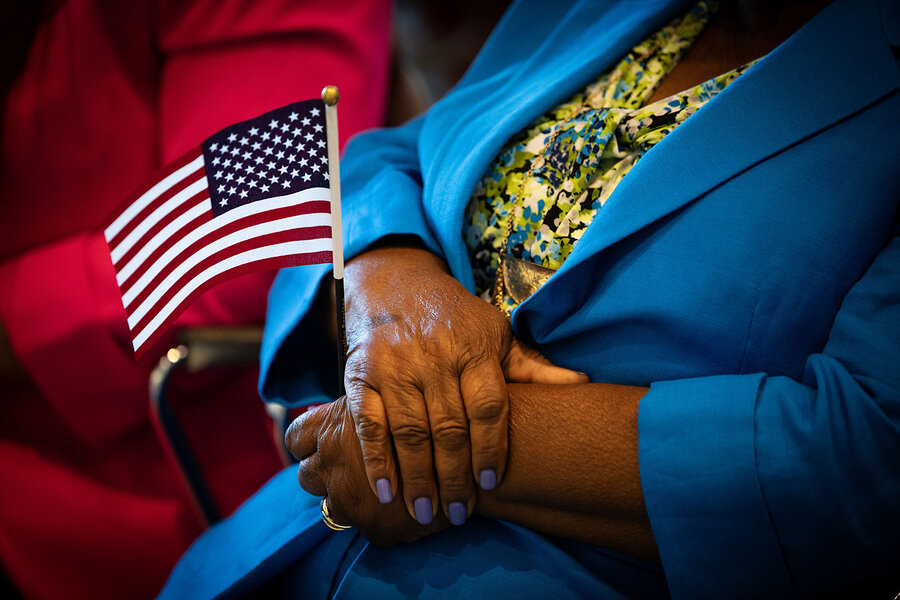
In Boston’s Faneuil Hall, a site tied to the American Revolution, immigrants were pulled out of line during a naturalization ceremony last December, moments before taking the oath that would have christened them as U.S. citizens. In the months since, they’ve waited to hear about rescheduling.
Those immigrants are done waiting.
A group of 14 green card holders sued the Trump administration in federal court this week, alleging that immigration officials have unlawfully delayed their naturalizations. The plaintiffs hail from Haiti, Venezuela, and Ivory Coast, and are clients of Project Citizenship, a Boston-based nonprofit that provides immigrants with legal advice. Other green card holders around the country have also had their naturalization ceremonies canceled in recent months.
Why We Wrote This
A lawsuit filed in federal court in Boston marks a latest push by immigrant advocates to challenge the Trump administration’s moves to tighten legal migration pathways, amid a decline in naturalizations overall.
The lawsuit marks the latest push by immigrants and their advocates to challenge President Donald Trump’s moves to narrow pathways to legal migration. After an Afghan national shot two National Guard members, one fatally, in Washington, D.C., last year, administration officials tightened vetting procedures and paused asylum decisions. U.S. Citizenship and Immigration Services, which oversees legal immigration to the United States, suspended immigration decisions for citizens of 19 “high-risk” countries subject to a full or partial travel ban. Mr. Trump subsequently added 20 countries to the travel ban list. The full list of 39 countries includes the plaintiffs’ homelands.
The case sets up a clash between those who support the rights of immigrants who have followed legal steps to gain citizenship, and the White House’s position that laxness in previous administrations and national security concerns require a slower legal immigration process and tighter restrictions.
“There’s thousands and thousands of individuals whose immigration proceedings or naturalization proceedings are on hold while this administration attempts to discourage people from staying in the country,” says Gail Breslow, executive director of Project Citizenship. The group has partnered with Harvard Law School’s Immigration and Refugee Clinic, which is representing the plaintiffs in court. “These people are now living in shadows when they have every right to be here.”
The plaintiffs argue that the delay violates federal immigration law, which requires that USCIS make a final decision on naturalization applications within 120 days. The administration has also violated the Fifth Amendment, the lawsuit says, by basing naturalization decisions on national origin, as well as federal statutes that require government decisions “within a reasonable amount of time.” The plaintiffs are asking the court to either make a decision on their applications or compel the government to do so.
The Trump administration has previously cast its crackdown as necessary to boost vetting and protect national security. In a statement to the Monitor, a USCIS spokesperson reiterated those assertions and described the lawsuit as meritless.
“This is another baseless lawsuit that attempts to usurp the President’s lawful authority to determine which foreign nationals may enter, remain, and enjoy certain privileges in this country,” the statement reads. “USCIS has paused all adjudications for aliens from high-risk countries while USCIS works to ensure that all aliens from these countries are vetted and screened to the maximum degree possible.”
Are delays justified?
In a March 30 news release, USCIS said that it would tighten its screening practices, including by scrutinizing immigrants’ social media accounts prior to entry. In presidential memos, Mr. Trump has said that immigrants from some countries on the travel ban list tend to overstay their visas.
Immigrants applying for naturalization are among the most vetted in the country. To qualify, an applicant must generally have held permanent residency for at least five years – or three, if they’re married to a U.S. citizen – pass tests in civics and English, clear a background check from the FBI, and sit for an in-person interview with USCIS. They must also provide biometric information, answer questions about their travel history, and disclose affiliations with the Communist Party or other totalitarian parties. The process can take years, and it follows additional vetting during the green card process.
“They’re here legally. They’ve made their homes here,” Ms. Breslow says of her clients seeking naturalization. “Many of them have lived here longer than they’ve lived anywhere else.”

Avery Farmer/Courtesy of Project Citizenship
Under the Immigration and Nationality Act, applicants who meet those requirements are scheduled for an oath ceremony, which is largely seen as a formality, within 120 days of the interview.
Project Citizenship says that the government has violated that statute. More than 140 days have passed since the Faneuil Hall ceremony on Dec. 4, 2025, when many of Project Citizenship’s clients were notified that they were ineligible for naturalization.
“What we’re seeing is an arbitrary intervention in that process, and it’s particularly damaging for folks who have already jumped through several hoops to get to this point,” says Lauren O’Connell, a law student at Harvard who’s working on the case.
The Trump administration has repeatedly indicated that it lacks faith in the immigration system’s screening procedures.
“Many applicants for naturalization and lawful permanent residence were not sufficiently vetted,” the March USCIS news release reads. “As a result, applications were approved, and individuals were naturalized who should not have been. These gaps expose the United States to significant national security and public safety risks and compromise the integrity of the immigration system.”
A denaturalization push
The Justice Department has recently said it would push to denaturalize 384 citizens, according to The New York Times, as part of an effort to root out fraud in the citizenship process. The Department of Homeland Security also plans to scrutinize green card applicants for “anti-American” and “antisemitic” views, the Times reported.
The number of naturalization approvals has steadily fallen over the past year. In April 2025, USCIS approved 88,488 naturalization applications, compared with just 32,862 in January this year. That’s the lowest number of approvals since USCIS began tracking monthly naturalization data in 2022, according to NPR.
In its lawsuit, Project Citizenship argues that the government has exceeded its authority by seemingly indefinitely pausing naturalization decisions. Eligibility for naturalization is clearly established in the law, the lawsuit argues, and is not up to USCIS.
“Certain immigration benefits are not discretionary,” reads the USCIS policy manual, citing naturalization as one example. “In these cases, if the requestor properly filed and meets the eligibility requirements, then USCIS must approve the benefit request.”
Project Citizenship’s lawsuit is not the only one challenging the Trump administration’s efforts to restrict legal immigration. In January, nearly 200 immigrants sued the government over delays in their immigration applications. On Thursday, a U.S. District Court judge in Massachusetts granted the plaintiffs’ motion for an injunction to lift the administration’s policies for 22 plaintiffs who submitted to the court declarations of harm while the lawsuit continues. The court also ordered the parties to confer on whether its order should apply to the remaining plaintiffs.
On Monday, a federal judge in a separate case in Maryland ruled that USCIS must allow green card applications for 83 immigrants to continue. In both those cases, the plaintiffs immigrated from a country on the travel ban list, and litigation is ongoing.
Other arguments in the Boston lawsuit include that USCIS has violated the Fifth Amendment by making naturalization determinations based on national origin. Though the amendment does not contain an explicit equal protection clause, as the 14th Amendment does, the Supreme Court has routinely found that it provides the same protections.
The plaintiffs also argue that USCIS has violated the Administrative Procedures Act, which requires that government agencies act “within a reasonable time” and allows courts to overturn decisions they find to be “arbitrary, capricious, an abuse of discretion, or otherwise not in accordance with the law.”
The government has 60 days to respond to the lawsuit. In the meantime, those suing wait in limbo, says Ms. O’Connell, the law student.
“They’re not being told anything about what’s going on regarding their applications,” she says. “And the uncertainty of the environment that they’re living in and what will happen next is impeding their plans to move forward, to make plans in their professional lives, their personal lives, their family lives.”