Kathleen Naranjo was almost eight years into paying off her portion of $50,000 in student loans when a federal appeals court last month ended one of the most affordable loan repayment plans in history. That Biden administration-era plan had reduced her monthly payments to $92 and she was working toward the day when the remaining balance would be forgiven after 10 years of payments doing public service as a nurse.
Now amid soaring gas and food prices, Ms. Naranjo is enrolling in her next best option. Her monthly payment will triple, scrambling her personal finances at a moment when she is hunting for her first house.
“That’s the only way that I can really do it, otherwise I’m going to be paying this loan until I die,” she says.
Why We Wrote This
A federal appeals court officially ended the Biden-era student loan repayment plan that made payments more affordable. Now, some 7 million borrowers are facing the likelihood of higher payments.
More than 7 million borrowers who had been enrolled in the income-based Saving on A Valuable Education (SAVE) plan like Ms. Naranjo have been told that beginning July 1, they will have 90 days to get into a new loan repayment plan or be routed into one by the government.
The SAVE plan arrived in 2023 as millions of student borrowers were emerging from a three-year pause in payments during the pandemic. It was meant to chip away at the now more than $1.8 trillion in total student debt held by borrowers across the country by tying payments to income. The plan lowered payments to $0 for many of the lowest earners – preventing unpaid interest from accumulating and offering earlier loan forgiveness. But many critics charged that American taxpayers were being saddled with debt. Republican-governed states challenged the executive action and ultimately the courts stopped it because Congress had not approved it.
President Donald Trump’s administration is now forging ahead with a tack on student loans that significantly differs from the Biden years. Responsibility for managing the student loans is moving to the Treasury Department from the Department of Education. Pay, wages, and tax returns will start to be garnished to cover debts. This approach will affect 44 million student loan borrowers in the country, 12 million of whom are behind on payments or in default, according to researchers at the Education Data Initiative. The average federal student loan balance is $39,547, according to the group.
“For years, borrowers have been caught in a confusing cycle of uncertainty, but the Trump Administration’s policy is simple: if you take out a loan, you must pay it back,” Under Secretary of Education Nicholas Kent said in March.
Finances upended
That announcement punctuated what borrowers knew was coming after two years of not having to make payments during legal challenges to SAVE, which had been scheduled to end in 2028.
Ms. Naranjo says that she asked to continue paying her $92 a month during the legal wrangling, but her service provider told her that it wouldn’t count toward loan forgiveness, which frustrated and confused her.
“Now this is going to be worked into my debt ratio when I buy a house,” says Ms. Naranjo, who is looking for a home outside Bend, Oregon, in an area where a three-bedroom was going for $550,000. She thought she had every dime accounted for on her monthly bills, from mortgage down to snacks, but then she got a rude awakening from Aidvantage, her federal student loan service provider.
“It’s going to be financially stressful,” she says of her new bill that will be more than $270 per month.
Any kind of entertainment spending is gone, she says. Now she will make decisions based on what she needs and not what she wants.
“I’m just being very careful with what I spend every time I buy groceries or go to Costco. I’m conscientious about where I’m driving,” Ms. Naranjo says. “Any luxury items will be the first to go.”
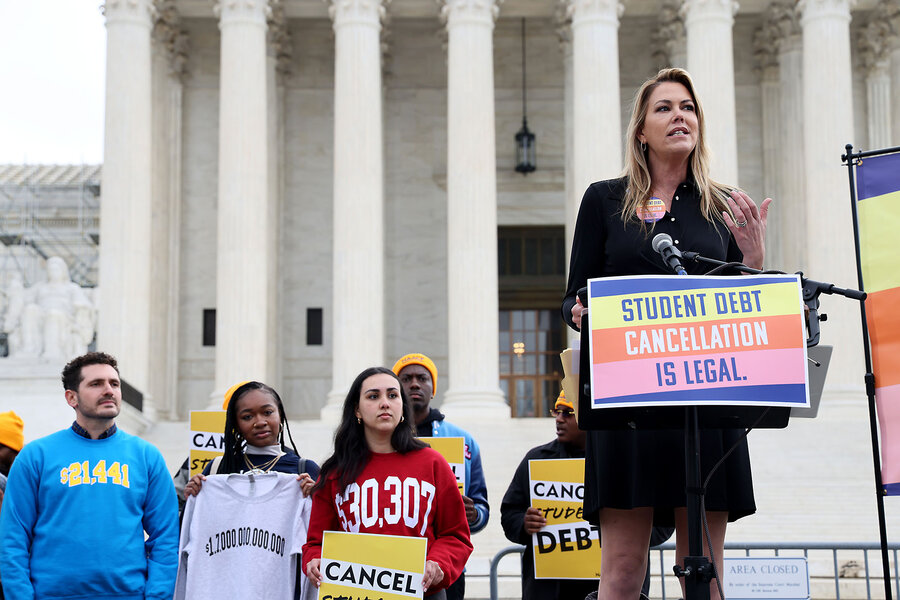
Natalia Abrams, president and founder of the Student Debt Crisis Center, a nonprofit organization that advocates for borrowers and lobbies for debt cancellation, says that messaging around the revamp is confusing for borrowers. People she advocates for say that servicers keep telling them that they have to enroll in the new income-based option, the Repayment Assistance Plan, which starts July 1 and will feature monthly payments between 1% and 10% of income for up to 30 years. But because some borrowers enrolled in student loan repayment programs before SAVE, they don’t necessarily have to enroll in the newly announced income-linked plan, she says.
“I’ve worked in this space for 15 years now, roughly, and this is the most confusing, hardest time for student loan borrowers that I’ve seen,” Ms. Abrams says.
With affordability being the issue that it is, for low income people, even paying $10 a month is a lot, she says.
“For so many borrowers, that’s more than they can afford, let alone the standard repayment plan” Ms. Abrams says. “The SAVE program was the most generous repayment program out there, so the payments for almost everyone are going to be higher.”
Pay up
Almost immediately there were legal challenges to SAVE when the Biden White House started it. Former Education Secretary Miguel Cardona said then the plan gave financial breathing room to millions, and many Democratic lawmakers supported the initiative. Republicans called it reckless and fiscally irresponsible, saying that it would cost taxpayers $559 billion. Several state attorneys general argued that loan forgiveness programs had to be enacted through Congress and not executive action, which courts agreed with.
Andrew Gillen, research fellow at the libertarian Cato Institute, was one of the many who disagreed with the legality of SAVE and viewed it as taxpayers bailing out borrowers.
“Being an adult is paying your debt,” Mr. Gillen says. “A lot of us have car payments and mortgages. When you borrow money, you gotta pay it back, and I think a lot of student loan borrowers got into the unhealthy perspective that they wouldn’t need to repay this.”
Mr. Gillen cited the respite that borrowers had during an almost three-year break in payments during the COVID-19 pandemic and then an additional two years for legal battles.
Mr. Gillen says he mostly disagreed with the SAVE program because it was an executive branch overreach, not created by Congress, and the burden of paying for it was placed on taxpayers. He also believes the part of SAVE that paid interest for borrowers was too generous, and that capping payments at 10% of borrowers’ income, like the new plans, is in line with historic practices.
Sabrina Calazans, the executive director at the Student Debt Crisis Center, has made fewer than 10 payments toward loan forgiveness, because after she graduated in 2019 she didn’t find a job immediately and was caught up in the forbearance program.
She says that she has watched the government help wealthy people via tax breaks, but at the same time, her insurance premiums skyrocketed recently because the government stopped funding subsidies for the Affordable Care Act. She does not receive health insurance from her employer and relies on the ACA marketplace.
“I’m a taxpayer too,” Ms. Calazans says. “The goal is not that anyone wants to be viewed as a charity case. I think it’s just that people want to be able to live with dignity and to be able to pay their bills in a way that is affordable and that is doable.”