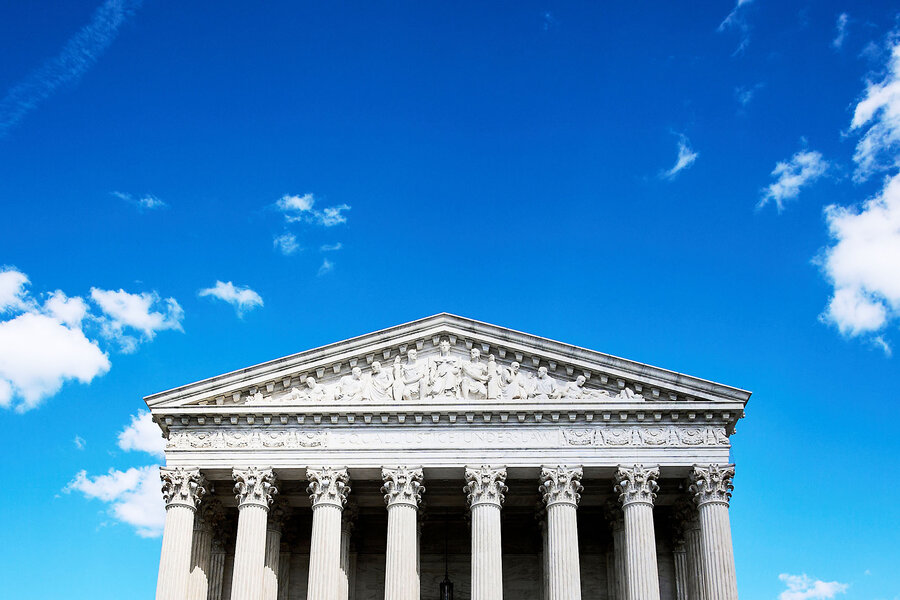
America’s struggle over abortion rights has come roaring back – right as crucial midterm elections are ramping up.
Nearly four years after the U.S. Supreme Court overturned Roe v. Wade, the 1973 ruling that guaranteed a nationwide right to the procedure, a federal appeals court has upended the abortion landscape once more by blocking access to a common approach to abortion: medication sent in the mail.
In a ruling Friday that applies nationally, a three-judge panel on the Louisiana-based 5th U.S. Circuit Court of Appeals ordered a pause on the prescribing of abortion pills via telemedicine and their delivery by mail, curtailing the most-used method for ending an unwanted pregnancy. The 5th Circuit panel, all Republican appointees, was responding to a lawsuit by the state of Louisiana against the U.S. Food and Drug Administration, which had loosened regulation of the abortion pill mifepristone during the administration of President Joe Biden.
Why We Wrote This
Since the overturning of Roe v. Wade four years ago, abortions in the United States have actually increased, with the rise of abortion medication sent through the mail. Now, a nationwide ruling puts the issue back before the Supreme Court – and on the campaign trail.
On Saturday, Danco Laboratories and GenBioPro, makers of mifepristone, each filed emergency requests asking the U.S. Supreme Court to lift the lower court’s temporary nationwide order blocking telehealth prescriptions. The case itself, Louisiana v. FDA, is expected to reach the Supreme Court. The two drugmakers are also defendants in the case.
For now, the high court has multiple options: It could uphold the 5th Circuit’s pause on the FDA regulation, overturn it, send the case back to the lower courts, or take up the case itself.
Louisiana is one of 13 states with a near-total ban on abortion, in a nation that has become a patchwork of varying state laws on access to the procedure since the Dobbs v. Jackson Women’s Health Organization decision in 2022. A majority of states allow abortion until late in the second trimester of pregnancy or have no gestational limit, though the vast majority of abortions occur in the first trimester.
Since Dobbs, in fact, the number and rate of abortions in the United States have increased, with the rise of telehealth. What are known as shield laws in states with legal abortion aim to protect providers from prosecution for prescribing and sending abortion medication to patients in states with a ban.
In its case against the FDA, Louisiana argued that the agency’s rules around mifepristone violated state sovereignty. In pausing the rules, the 5th Circuit panel agreed.
“The regulation creates an effective way for an out-of-state prescriber to place the drug in the hands of Louisianans in defiance of Louisiana law,” wrote the judges.
Now, policy experts say the future of abortion in the U.S. is once again in flux.
“We are in uncharted territory,” says Joanne Rosen, a professor at the Johns Hopkins Bloomberg School of Public Health.
Having an in-person dispensing requirement for mifepristone isn’t new, she says, noting that this was the case until 2021 – but at that time, Roe was still the law of the land.
“What’s new is the in-person dispensing requirement in combination with the lack of a constitutional right to abortion,” Professor Rosen says.
The FDA ended the in-person requirement during the COVID-19 pandemic and is studying the drug’s safety and effectiveness. The agency approved the abortion drug mifepristone, along with a companion drug, in 2000. Mifepristone has other uses, defenders say, including during miscarriages.
Given that nearly two-thirds of abortions nationwide take place via medication, and 1 in 4 are provided via telehealth, the 5th Circuit’s pause on prescription-by-telemedicine potentially represents the biggest reduction in access to abortion since Dobbs. Women in states where abortion is banned can still travel out of state to end a pregnancy, but for many, the costs and logistics are prohibitive. After Dobbs, an “underground” network emerged to assist women seeking abortions in those states.
For activists on both sides of the abortion divide, the 5th Circuit’s order has reignited the issue at a politically charged moment – six months before the November midterm elections, in which Republicans are scrambling to hold their slim majorities in the House and Senate. The party that controls the White House typically loses seats in the midterms, and President Donald Trump’s low job approval rating, now averaging under 40% amid voter concerns about affordability and the Iran war, suggests a Democratic advantage in the fall.
Notably, in the 2024 presidential campaign, Mr. Trump asserted that abortion was no longer a “big factor” in elections. During his first term, he had appointed three of the Supreme Court justices who voted to overturn Roe in 2022, fulfilling a key campaign promise to his religious conservative base. But by 2024, as he sought to regain the presidency, he made clear that his work on the matter was done and that it was now up to the states.
Democrats support abortion rights in all or most cases to a far greater degree than Republicans – 84% to 36%, in the latest Pew Research Center poll – and the reemergence of the issue gives Democrats another cause to campaign on.
For abortion opponents, the 5th Circuit pause on abortion telehealth was a welcome victory at a time of frustration with the Trump administration and its unwillingness to reverse the FDA’s shift in 2021 toward allowing abortion by telehealth. In fact, in January, the administration asked the 5th Circuit not to rule on the telehealth case while the FDA reviewed the safety of mifepristone. That study is due to be completed later this year.
“We are cautiously optimistic,” says Kristi Hamrick, spokesperson for Students for Life of America. “The FDA should be addressing this, but at this point, most of the strategic and effective efforts to address chemical abortion are in the courts.”